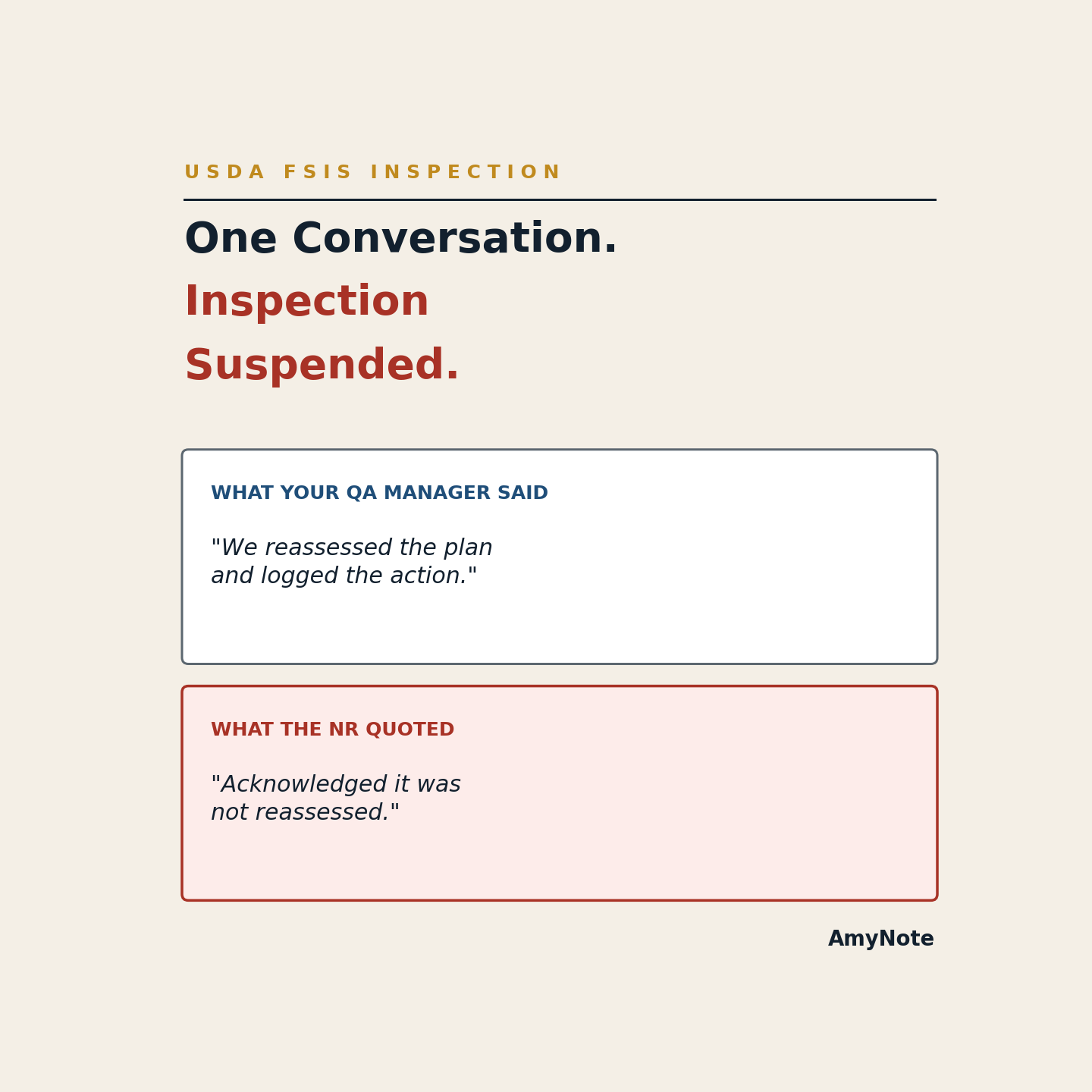
Your QA manager stood at the chiller with the inspector for twenty minutes. She walked through the deviation, the corrective action taken on the affected product, the reassessment that followed, and why the critical limit was never actually exceeded in the first place. It was a professional conversation. Nobody raised their voice, and nobody thought it was a confrontation.
The Noncompliance Record posts that afternoon. It says the establishment representative acknowledged the HACCP plan had not been reassessed.
Nobody on your team remembers it that way. But nobody can prove otherwise, because there is no recording and no transcript of a twenty-minute conversation held on a wet floor next to a chiller — only the inspector's write-up. And a line that reads like an admission is now a permanent entry in a file that follows your establishment into the next Food Safety Assessment, the next enforcement decision, and the next customer audit.
The Problem: Inspection Is a Conversation That Never Ends
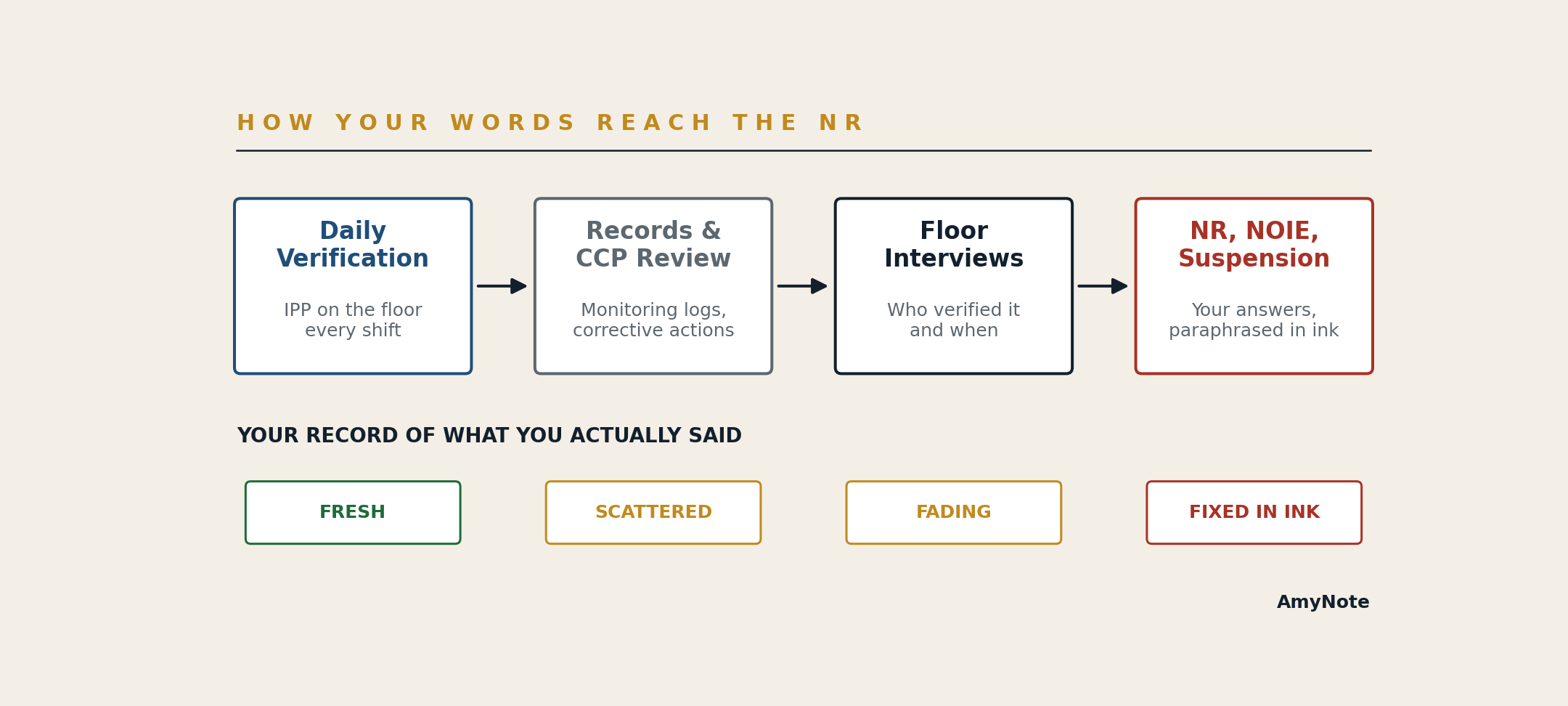
Federal meat and poultry inspection is not an annual event you prepare for and then survive. FSIS in-plant personnel are inside your establishment every production day. They watch the line, they read your monitoring records, and they ask questions — of your QA manager, your HACCP coordinator, your line supervisors, and whoever happens to be standing at the station when something looks off.
The questions are specific and they come fast. Who verified this critical control point. What did the monitor actually see. When was the plan last reassessed, and what triggered the reassessment. Why did you decide this deviation did not affect product safety. These are reasonable questions, and your people answer them in the middle of a shift, standing up, over the noise of production.
The inspector writes it up on a Noncompliance Record, the FSIS 5400-4. You are described in it, but almost never quoted word for word. Your QA manager's twenty-minute walkthrough of a corrective action becomes one paraphrased line about what the establishment "acknowledged." The reassessment date drops out. The supporting documentation drops out. The qualifier — "we reassessed it in March after the equipment change" — drops out. What remains is a sentence that reads, to anyone who picks up the file later, like your own admission.
You never receive a transcript. There is no recording of the conversation at the chiller. When you file your response, you are arguing against the agency's paraphrase from memory.
How One Paraphrased Line Becomes an Enforcement Action
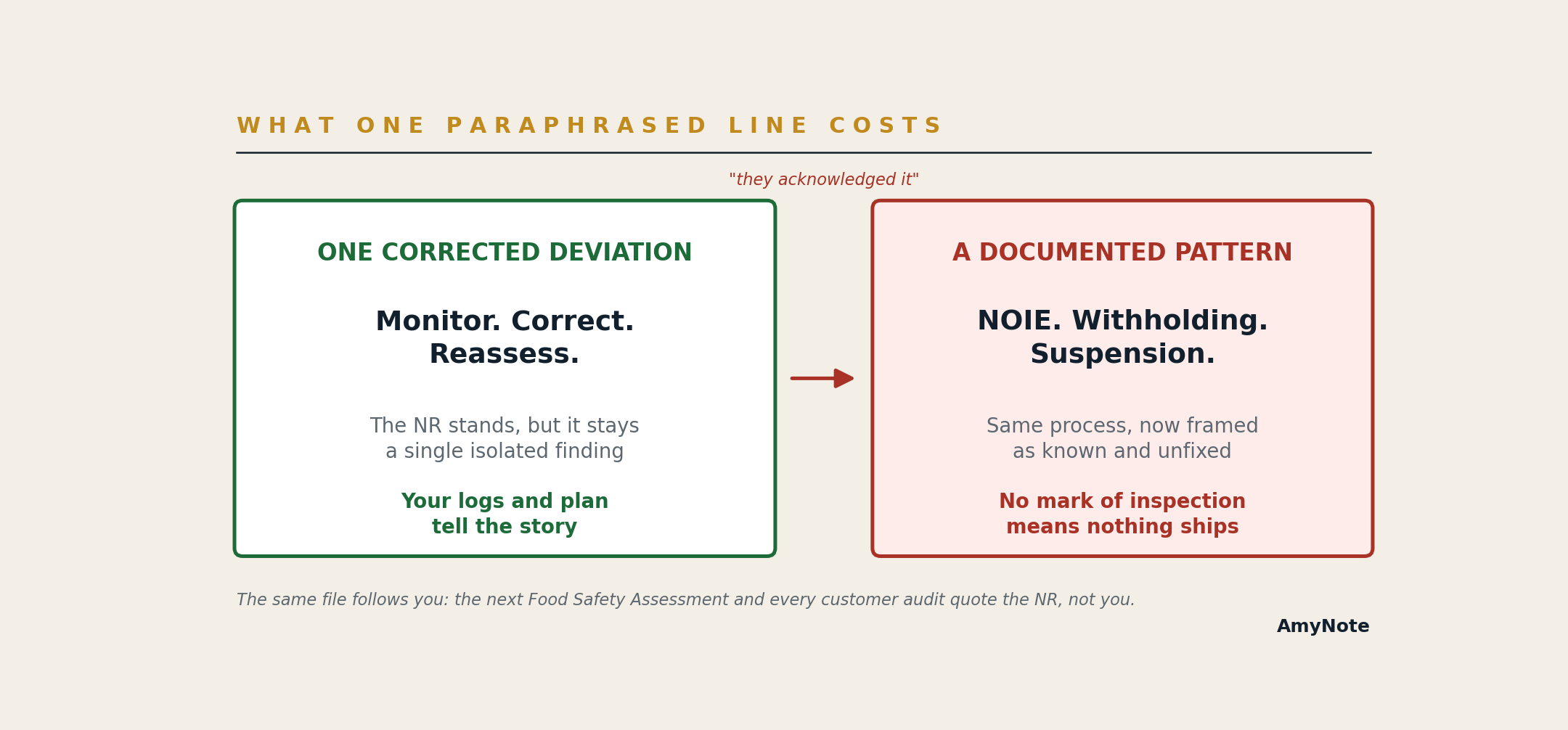
A single NR is survivable. Establishments get them, correct the underlying issue, and move on. The danger is not the individual record — it is what the individual records add up to.
NRs written against the same regulation build a documented pattern. A pattern is what supports a Notice of Intended Enforcement, and a NOIE opens the door to a withholding action or a suspension of inspection. When inspection stops, the mark of inspection stops. Product stops moving out of the building the same day, and a plant that cannot ship is a plant that is not operating.
Notice what the escalation actually turns on. It is rarely a positive sample or a recall. It is a reading of your establishment's state of mind: did you know about the problem, and did you fix it. That reading is built almost entirely out of what your people are recorded as having said. The same corrected deviation reads one way if the file shows a monitored, corrected, reassessed process, and a very different way if the file shows an establishment that "acknowledged" a plan was never reassessed.
Why Current Solutions Fail
Memory fails first. A Food Safety Assessment or a bad week of NRs covers dozens of exchanges across shifts, stations, and supervisors. Your team was running production, not documenting who said what. By the time you sit down to write an appeal, the exact wording of a Tuesday conversation about a corrective action is already gone, and what you have instead is the general sense that the inspector "got it wrong."
Handwritten notes are partial. Even when your HACCP coordinator shadows the inspector — which is good practice and worth doing — they capture themes, not exact words. An appeal to the Frontline Supervisor turns on precise phrasing: what was verified, when, and by whom. The difference between "we reassessed the plan after the equipment change and logged it" and "acknowledged it was not reassessed" is the entire appeal. Handwritten notes rarely preserve which one your QA manager actually said, in what order, in response to which question.
Cloud meeting bots do not fit. These conversations happen on a wet, loud kill floor and in a cooler, not on a scheduled video call. There is no meeting link for a bot to join, no participant list to slip into, and nobody is inviting a recording bot onto the production floor. Shipping proprietary process detail — your critical limits, your validation approach, your supplier arrangements — to a vendor that trains on it creates a second problem you do not need.
So most establishments finish the day with nothing but recollection, and the only detailed record of what was said belongs to the agency.
What Actually Works: Your Own Contemporaneous Record
The plants that answer an NR or a NOIE with confidence hold their own contemporaneous record of every inspector conversation and every internal HACCP meeting. Not a summary written from memory at the end of the week — a verbatim record made while the words were being said.
This is where AmyNote fits. It runs on your own device and captures in-person conversations directly, with no bot joining anything and no one else notified. Transcription runs through the OpenAI Speech API, and analysis runs on Anthropic's Claude models, which can surface every question the inspector asked, every answer your QA manager gave, and every process fact stated at the line — the same day, while your response window is still open.
The privacy architecture matters in exactly this scenario. Both OpenAI and Anthropic contractually guarantee zero training on user data. Audio is encrypted in transit and not retained after processing. Transcripts are stored locally on your device with end-to-end encryption, so your record of a federal inspection — and everything it reveals about how you actually run your process — stays yours.
Why this changes outcomes:
- Paraphrase versus quote. When an NR says the establishment "acknowledged" the plan was never reassessed, your verbatim transcript shows the reassessment date, the supporting documentation, and the qualifier the note dropped. You stop arguing about impressions and start pointing at sentences.
- Appeals reward proof. An NR appeal and a NOIE response live or die on evidence. A same-day record of exactly what was discussed is that evidence — not an assertion your QA team makes weeks later, but a record made on the floor while the conversation was happening.
- The file resurfaces. Today's NR is quoted back to you in the next Food Safety Assessment, in your enforcement history, and in any customer audit that pulls your public inspection record. Your transcript of the same conversation is the counterweight when a reviewer reaches for the old file.
- Your own meetings get sharper. The same capture applied to HACCP reassessment meetings and pre-shift reviews means your team describes the same process the same way — which is exactly what an inspector is testing when the questions come fast.
A suspension does not begin with a recall or a positive sample. It usually begins with a series of short conversations that got written down by one side only.
Getting Started
A practical sequence most establishments can adopt before the NRs stack up:
- Capture your internal meetings now. Record your HACCP reassessment meetings, pre-shift reviews, and corrective-action debriefs. This costs you nothing in inspector relations and immediately gives you a record of what your process actually is and how your team describes it.
- Record inspector exchanges where your policy allows. Confirm your establishment's policy and the applicable consent rules with counsel first; in many settings your own participation in the conversation is enough. Where recording is not appropriate, capture a spoken debrief within minutes of the conversation ending — while the exact phrasing is still recoverable.
- Summarize the same day. Have the AI pull out every question the inspector asked, every answer your people gave, and every process fact stated at the line, while the details are fresh and your appeal window is still open.
- File the record with the inspection documents. When the NR posts, comparing your transcript to the agency's paraphrase takes minutes, not memory — and it gives an appeal to the Frontline Supervisor its strongest possible evidence.
Start before the NRs stack up, not after the NOIE arrives. Use AmyNote to capture your HACCP reassessment meetings and pre-shift reviews, then every inspector exchange where your policy allows, and have it summarize commitments the same day. When the noncompliance record comes back with your words rearranged, you will be the rare establishment holding a better record than the agency. AmyNote at amynote.app offers a 3-day full trial with no credit card.
Originally published as an X Article by @AmyNoteApp.