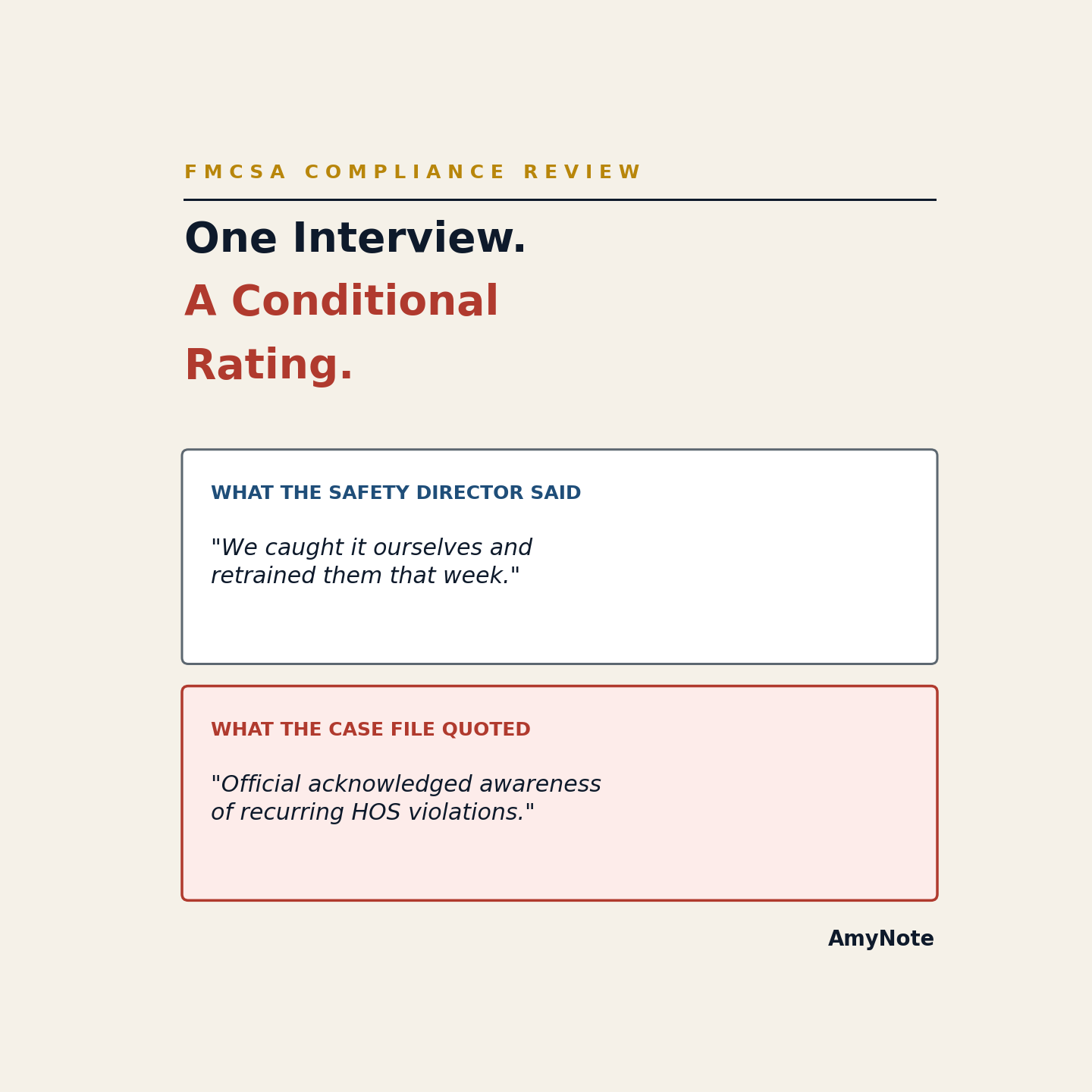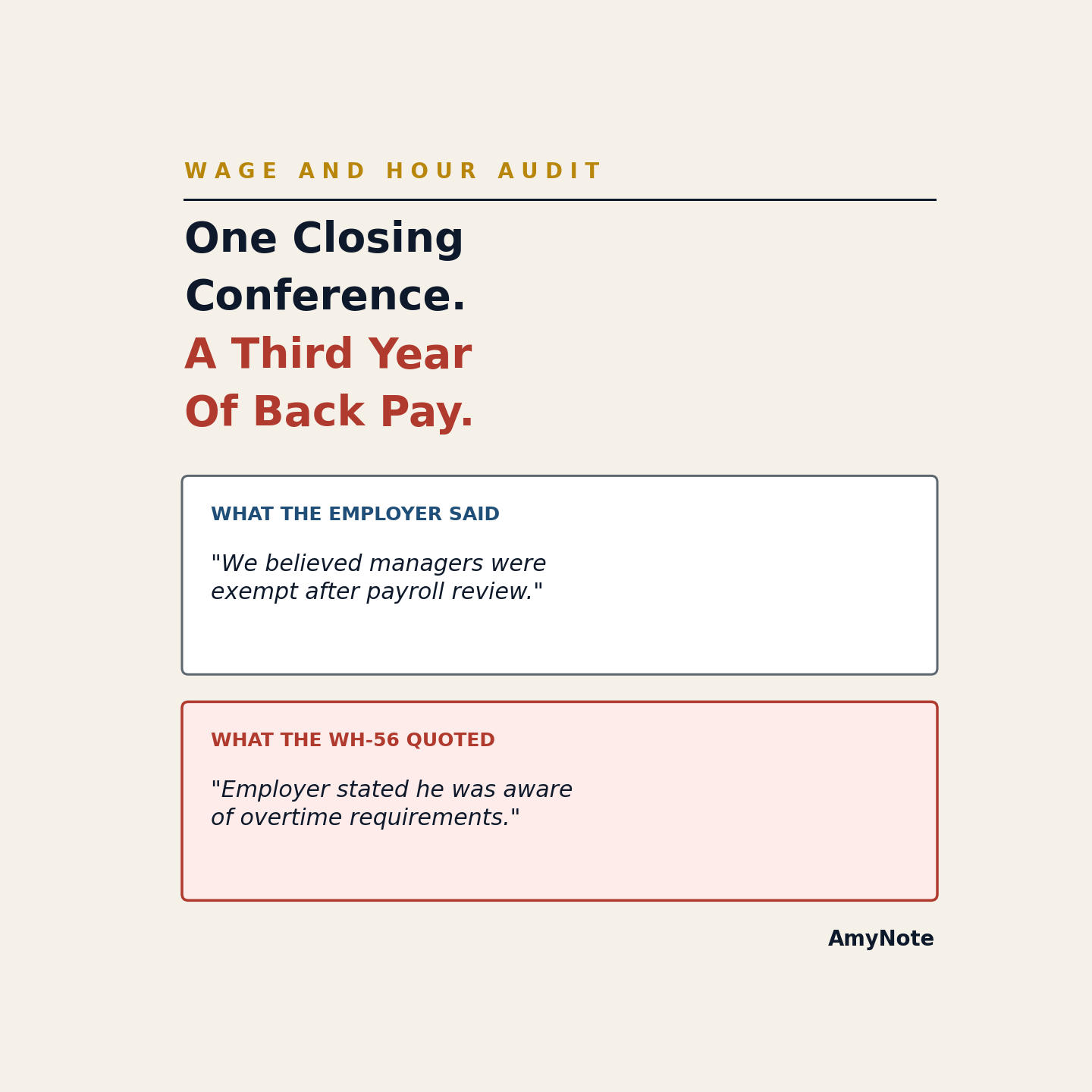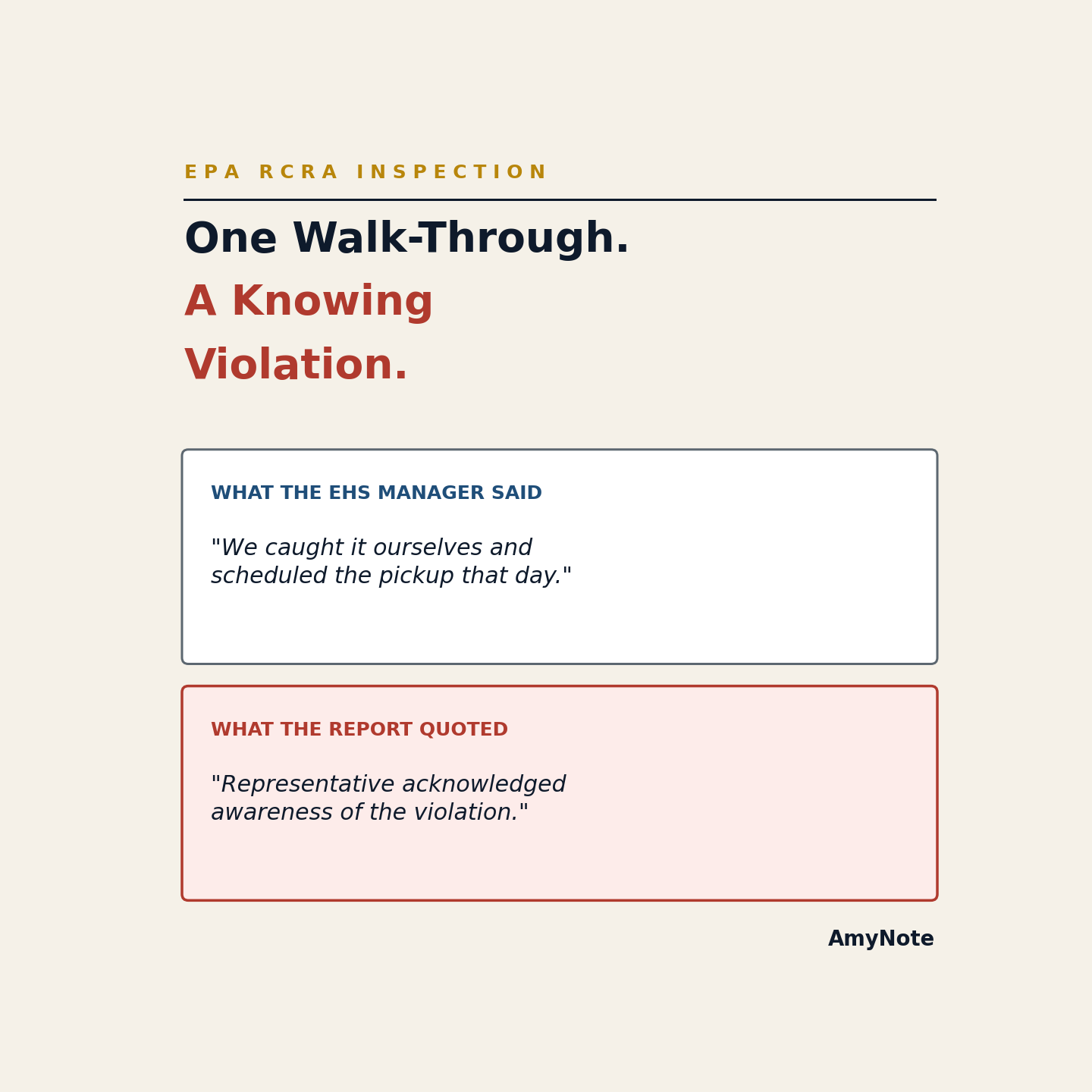
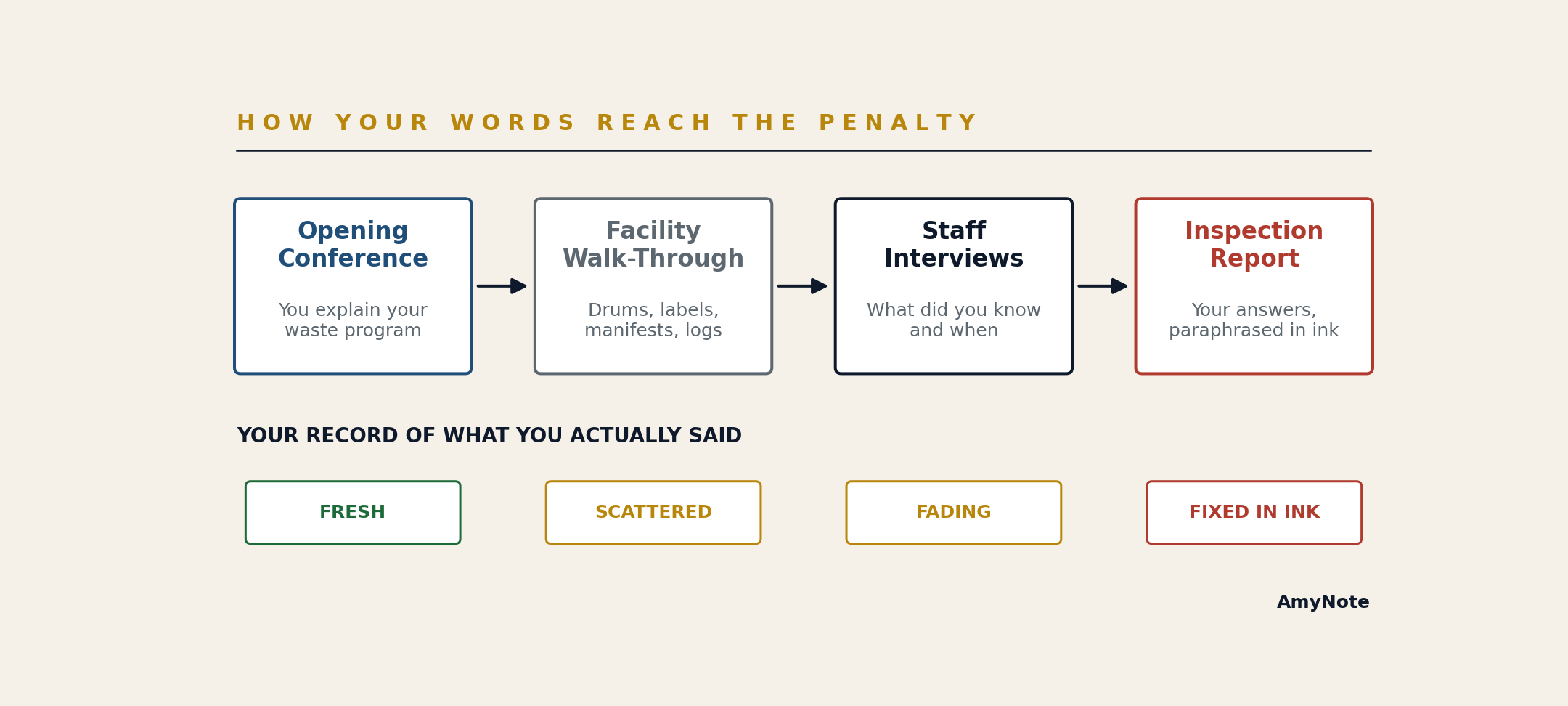
The inspection lasted one day. Your EHS manager walked the storage pads, opened the logbooks, and answered every question about drum storage, labels, and manifests. Everyone shook hands at the closing conference. Six weeks later, the inspection report arrives — and it quotes "the facility" acknowledging that containers sat past the accumulation deadline. The penalty letter that follows treats that one sentence as proof you knew.
Nobody at your facility remembers saying it that way. But nobody can prove otherwise, because the only detailed record of that day belongs to the government.
The Problem: An Inspection Built on Conversations
An EPA hazardous waste inspection is built on conversations. Under RCRA Section 3007, the inspector holds an opening conference, walks your storage areas, and interviews your EHS manager, operators, and waste handlers. The questions circle one theme: what did you know about that leaking container, when did you know it, and what did you do about it.
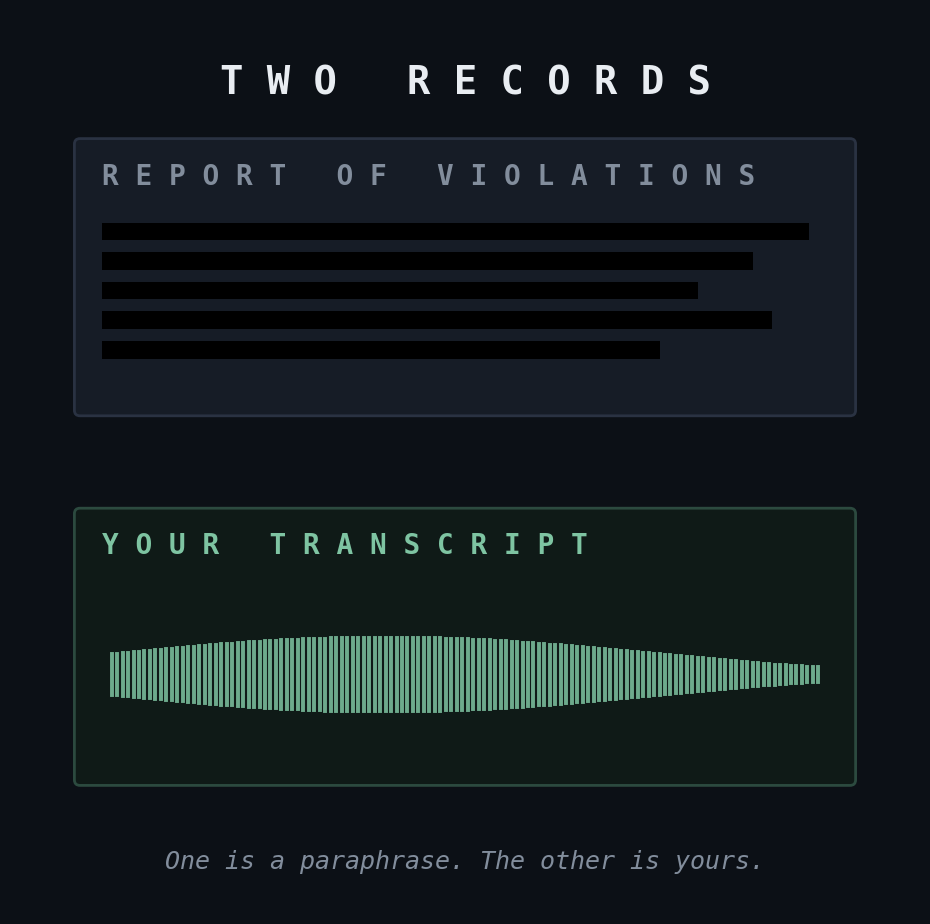
The inspector writes field notes through all of it. Those notes feed the inspection report that supports Notices of Violation and the penalty calculation. You are quoted in that report, but almost never verbatim. Your EHS manager's ten-minute explanation of the weekly container inspection program — the schedule, the checklist, the one week a contractor missed — becomes two paraphrased sentences chosen by the person building the enforcement file.
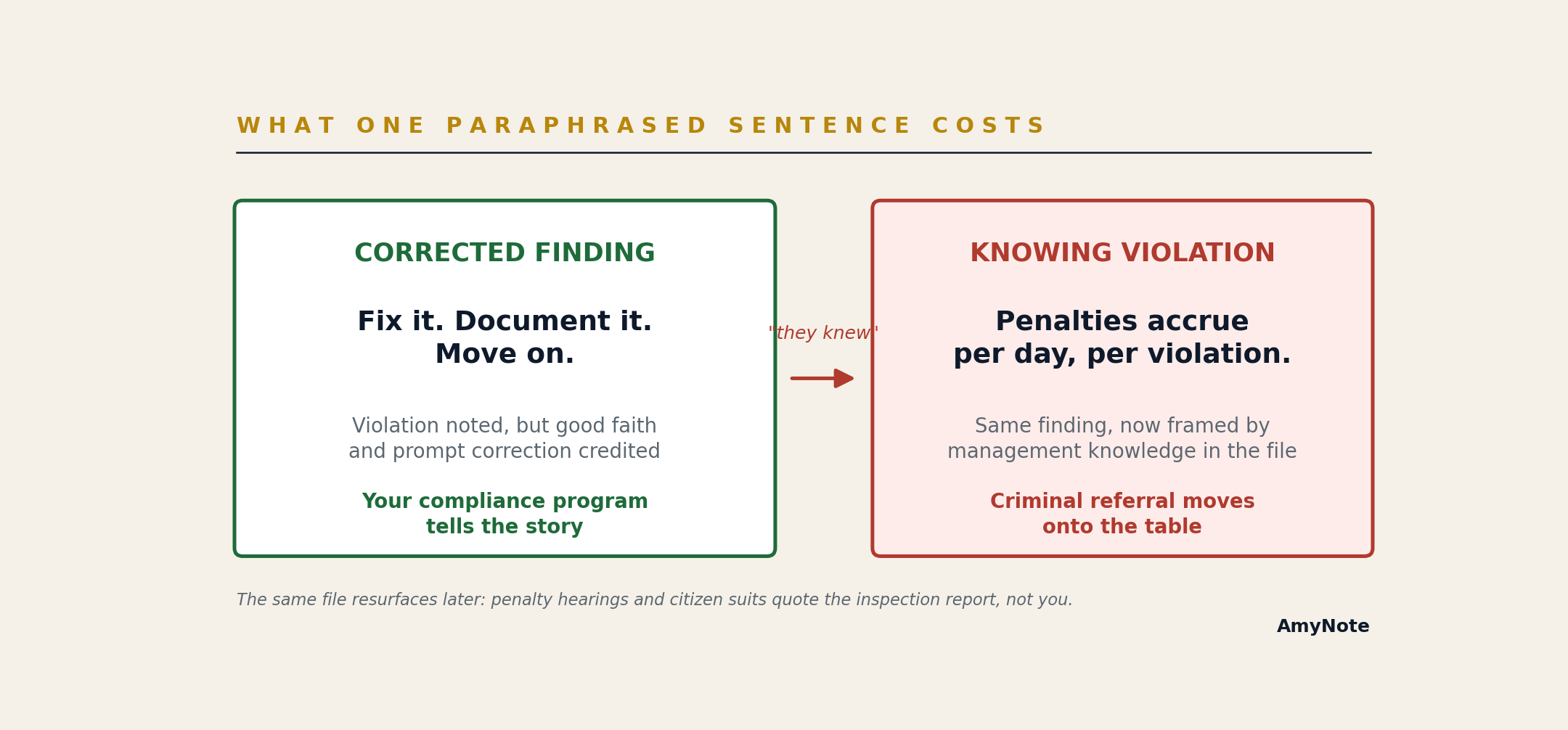
That paraphrase carries enormous weight. RCRA civil penalties accrue per day, per violation, and a note that management knew is what separates a paperwork finding from a knowing violation — the territory where criminal referral lives. The same sentence resurfaces later in penalty hearings and citizen suits, long after everyone's memory of the actual conversation has faded.
You never receive a transcript. There is no recording. When you dispute the characterization later, it is your memory against the agency file.
Why Current Solutions Fail
Memory fails first. A full-day inspection produces dozens of exchanges across offices, loading docks, and storage pads. Your EHS manager was answering questions, not documenting them — and under the stress of a federal inspection, recall gets worse, not better.
Attorney notes are partial. Even when counsel attends, they capture themes and red flags, not exact words. Penalty negotiations turn on precise phrasing: the difference between "we found the leak Tuesday and scheduled pickup Wednesday" and "we knew about the leak" is the difference between diligence and knowledge.
Cloud meeting bots do not fit. This is an in-person walk-through of your plant. Nobody invites a bot into a federal inspection, and shipping that audio to a server that trains on it creates a second problem while you are trying to solve the first.
So most facilities finish the closing conference with nothing but recollection, and the only detailed record of what they said belongs to the government.
What Actually Works: Your Own Contemporaneous Record
The facilities that survive enforcement fights have their own contemporaneous record of every inspector conversation and every internal compliance meeting. Not a summary written from memory three days later — a verbatim record made while the words were being said.
This is where AmyNote fits. It runs on your own device and captures in-person conversations directly, with no bot joining anything and no one else notified. Transcription runs through the OpenAI Speech API, and analysis runs on Anthropic's Claude models, which can pull out every question the inspector asked, every answer given, and every corrective action promised — the same day, while you can still act on them.
The privacy architecture matters in exactly this scenario. Both OpenAI and Anthropic contractually guarantee zero training on user data. Audio is encrypted in transit and not retained after processing. Transcripts are stored locally on your device with end-to-end encryption, so your record of a federal inspection stays yours.
Why this changes outcomes:
- Paraphrase versus quote. When the report says your EHS manager "admitted" knowing about the drum, your verbatim transcript shows the discovery date, the pickup order, and the context the field note dropped.
- Penalty math rewards proof. EPA's penalty policy credits good faith and prompt corrective action. A same-day record of every commitment made during the inspection is that proof — not an assertion, a record.
- Enforcement defense. The inspection file resurfaces in penalty hearings and citizen suits, sometimes years later. Your transcript of the same conversation is the counterweight.
A knowing-violation framing can turn a fixable finding into six-figure exposure and a referral memo. The evidence deciding it is often one sentence of paraphrase.
Getting Started
A practical sequence most facilities can adopt this quarter:
- Capture inspection-prep meetings. Record the internal walk-throughs where your team rehearses the compliance story, so everyone describes the container program the same way under pressure.
- Record inspection-day conversations where the law allows. Check your state's consent rules with counsel first; in many settings your own participation is enough.
- Summarize the same day. Have the AI pull out every question asked, every answer given, and every corrective action promised while the details are fresh and the corrective-action clock is still on your side.
- File the record with the inspection documents. When the report and Notice of Violation arrive weeks later, the comparison takes minutes, not memory.
Start before the inspector arrives, not after the Notice of Violation. Use AmyNote to capture your inspection-prep meetings, so the compliance story your team tells is consistent before anyone is under pressure. Capture every inspection conversation where the law allows, and have it summarize the commitments made — the same day, while the corrective-action clock is still on your side.
When the report comes back with your words rearranged, you will be the rare facility holding a better record than the government's. AmyNote at amynote.app offers a 3-day full trial with no credit card.
Originally published as an X Article by @AmyNoteApp.