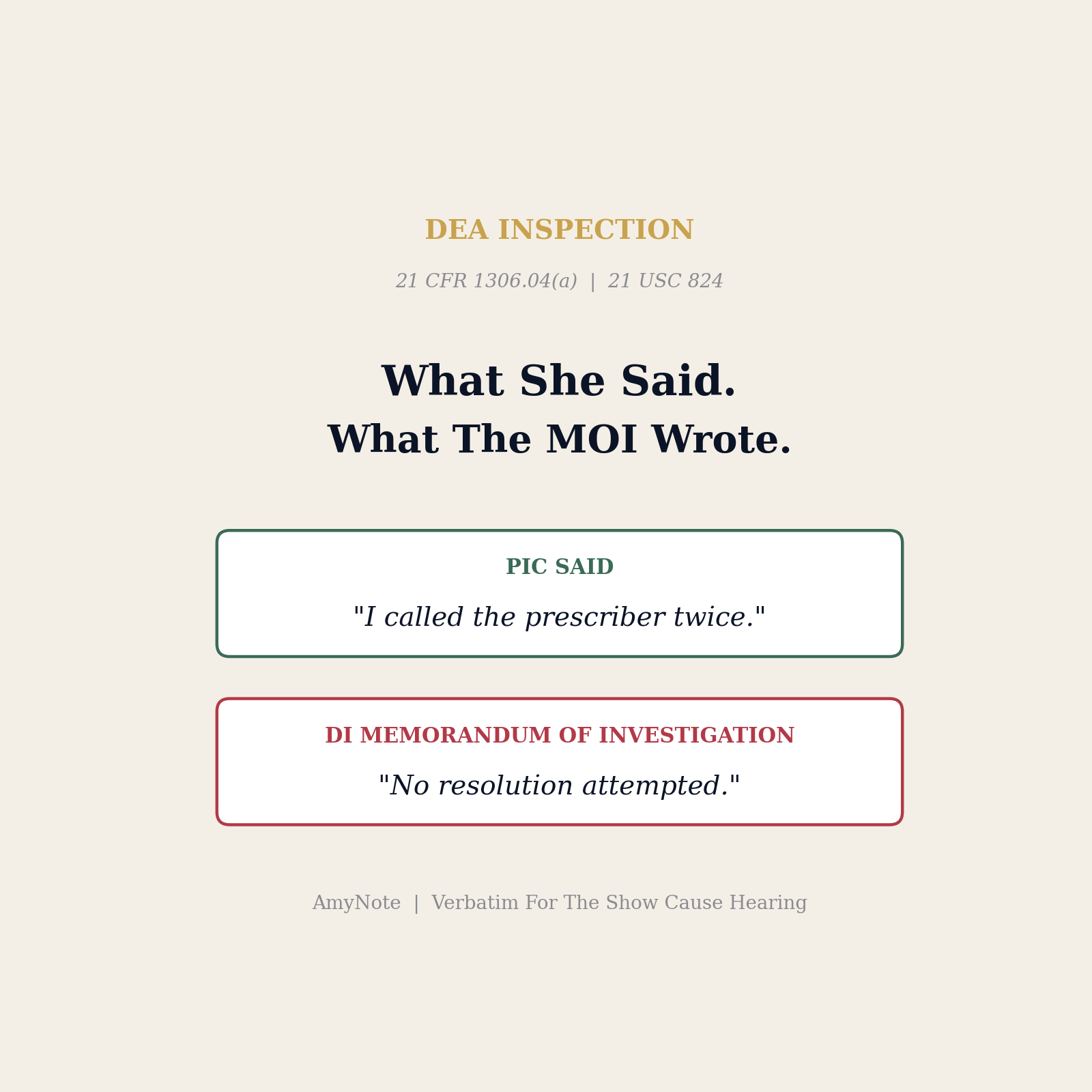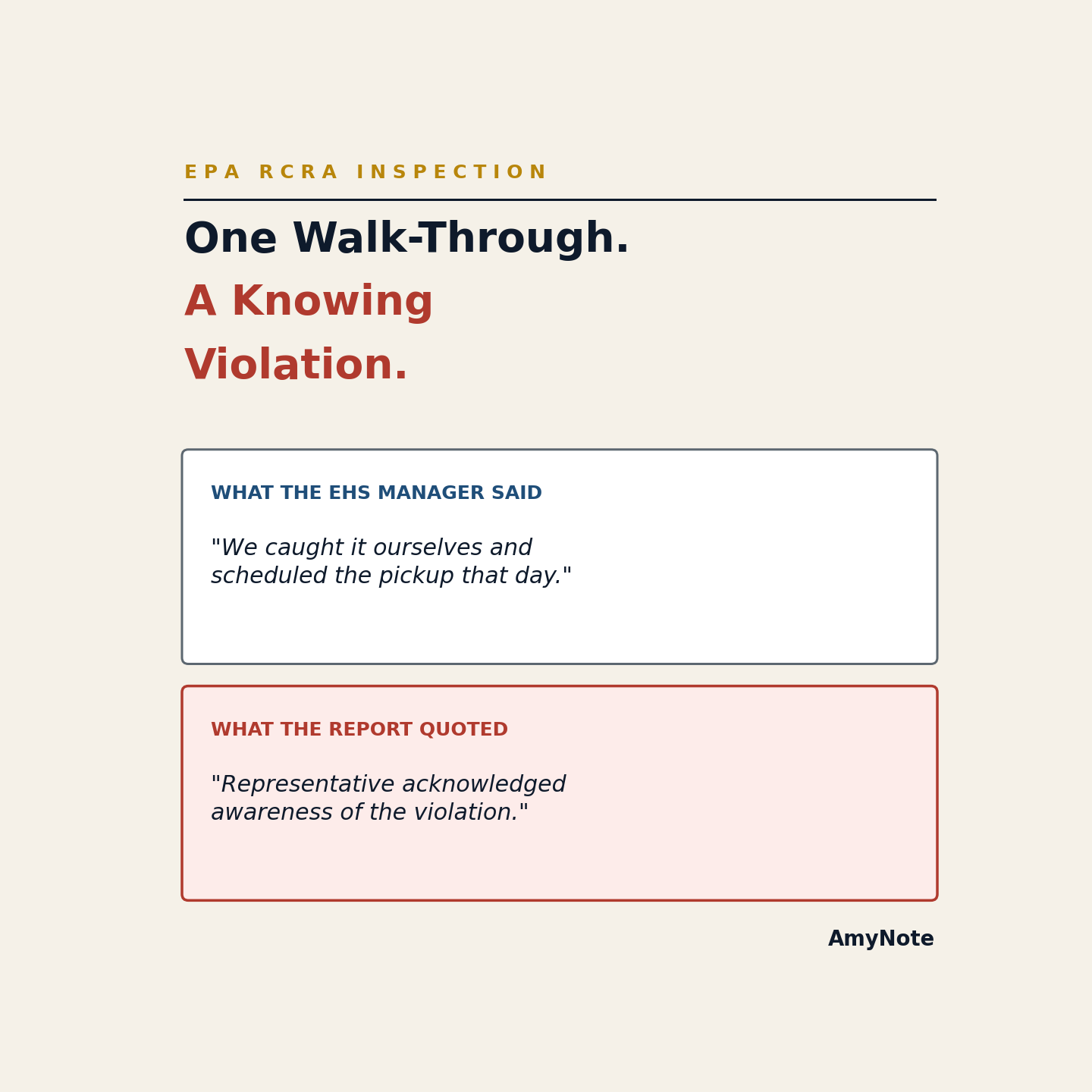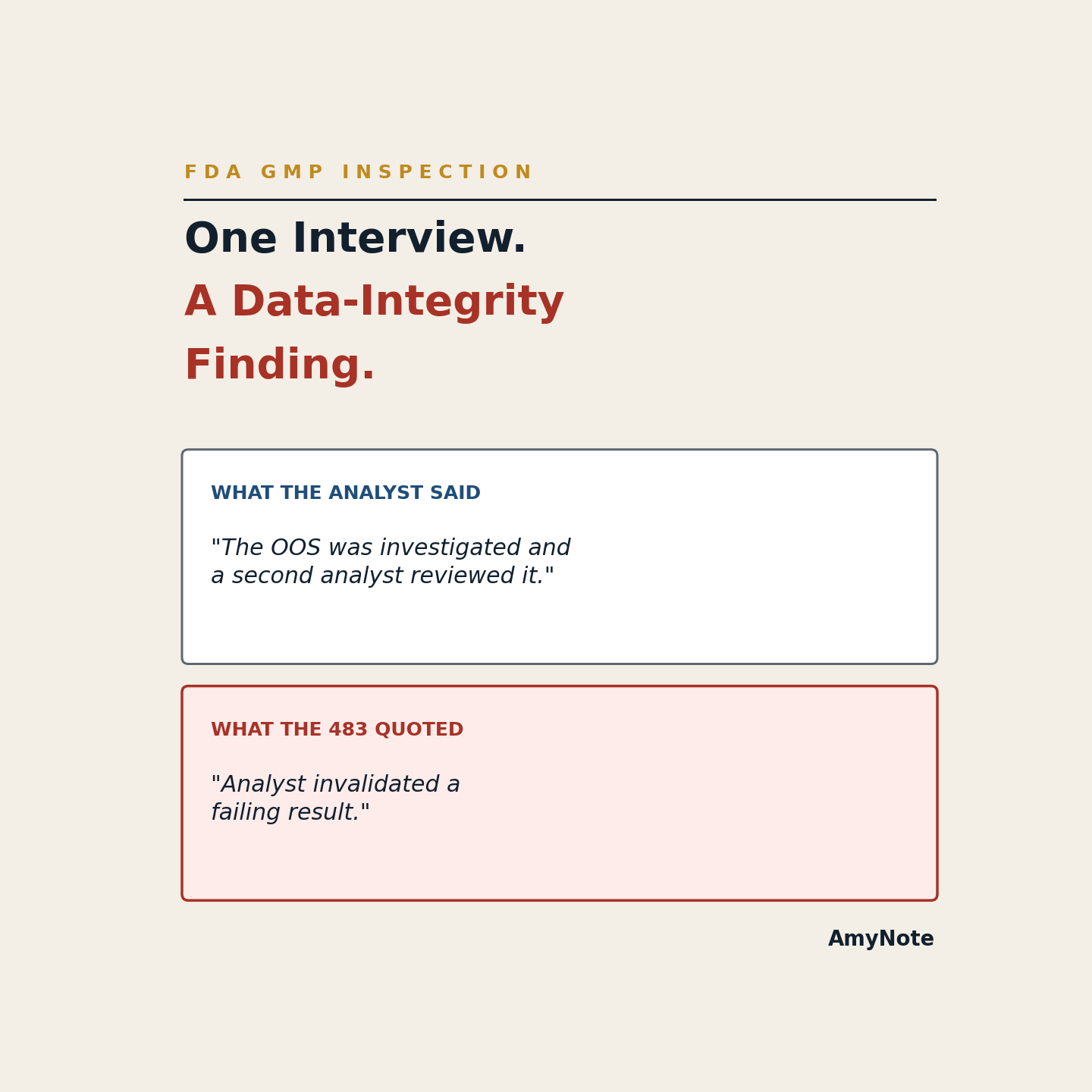
The inspection ran four days. Your QC analyst walked the investigator through the out-of-specification result, the retest, and why the batch still met the spec. Everyone was professional; the questions were fair. Then at the closeout, the investigator reads an observation aloud, and it says your analyst acknowledged invalidating a failing result without a documented investigation.
Nobody on your team remembers it that way. But nobody can prove otherwise, because there is no transcript and no recording — only the investigator's field notes. And a field note that reads like an admission is now the seed of a Form 483 observation that will follow your firm for years.
The Problem: An Inspection Is Built on Conversations
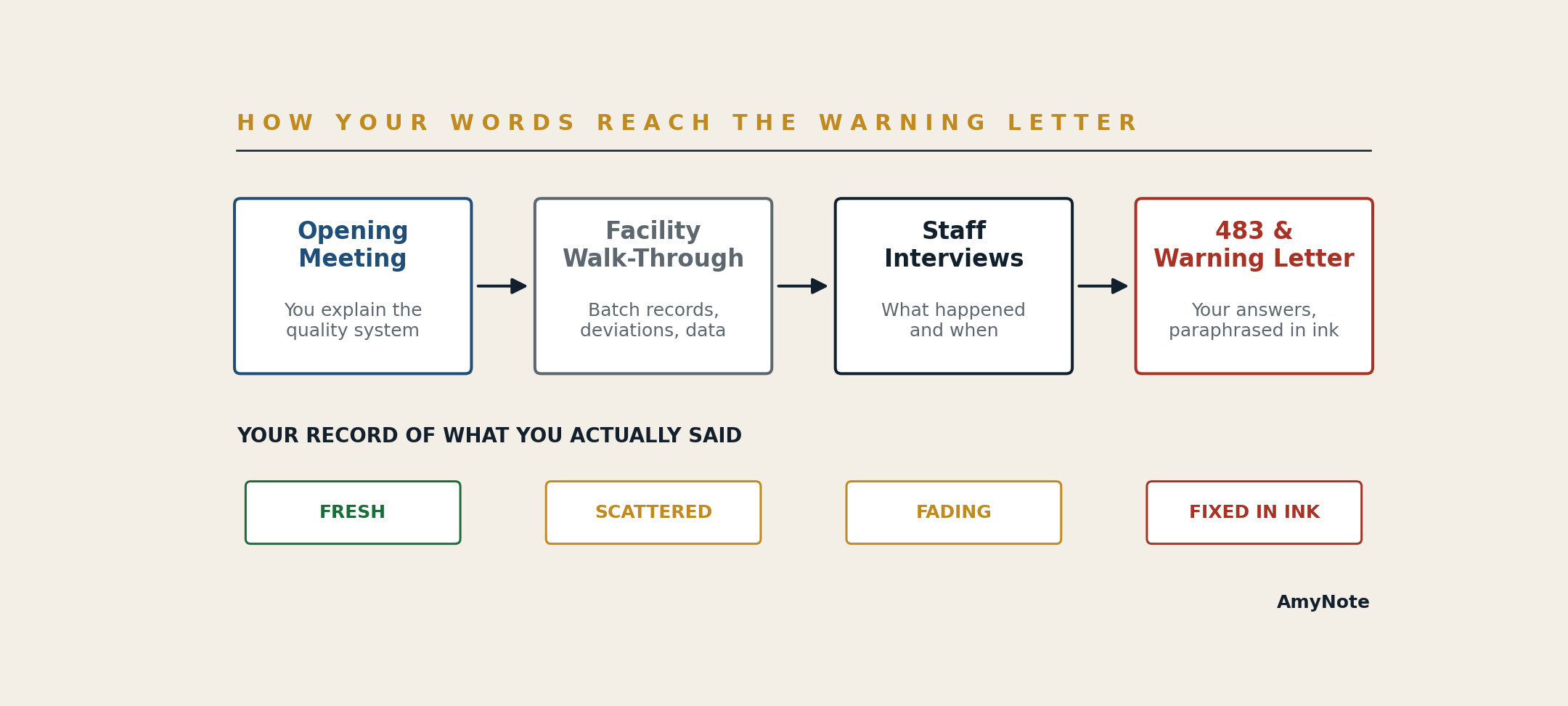
An FDA inspection is built on conversations. The investigator arrives, holds an opening meeting, walks your facility, and interviews your QC analysts, production operators, and the quality unit about how the work actually gets done. Under 21 CFR, that walk-through and those interviews are the primary way the agency learns what happens on your floor and in your lab. The questions get pointed fast: what happened with that deviation, who reviewed the batch record, and when did you know the result was out of specification.
The investigator takes field notes through all of it. Those notes feed the observations written on the FDA Form 483 and the narrative in the Establishment Inspection Report. You are quoted, but almost never word for word. Your ten-minute explanation of an OOS investigation — the initial result, the assignable-cause review, the second analyst, the confirmed retest, the release decision — becomes one paraphrased line about what your analyst "admitted."
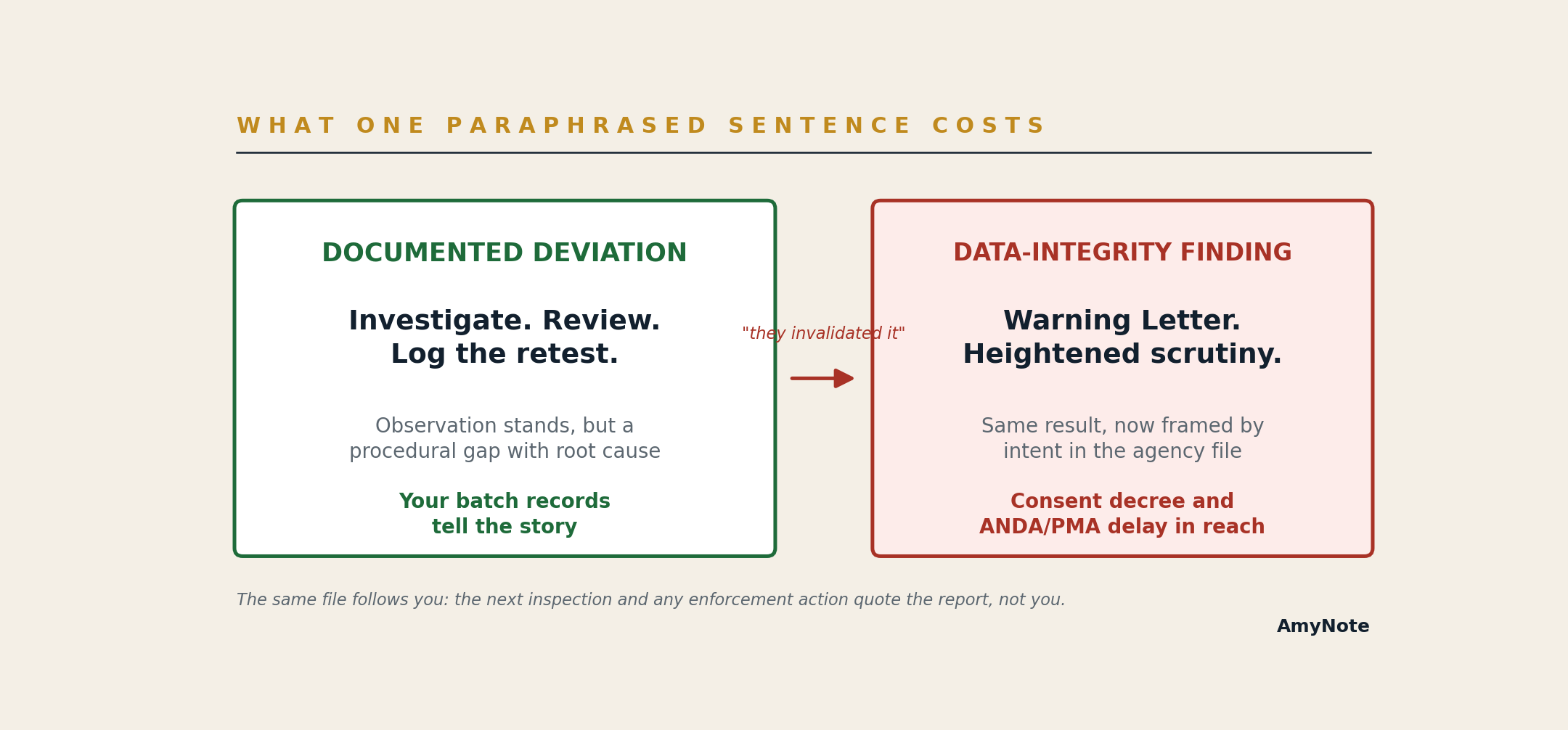
That line carries enormous weight. It is the difference between a procedural gap and a data-integrity finding, the characterization that turns a routine inspection into a Warning Letter, a consent decree, or an import alert. Data-integrity language reframes everything else in the report: reviewers stop reading your quality system as imperfect and start reading it as untrustworthy.
You never receive a transcript. There is no recording of the interview. When you draft your 483 response, you are arguing against the agency's paraphrase from memory — and memory is exactly what a four-day inspection erodes.
Why Current Solutions Fail
Memory fails first. A multi-day inspection covers dozens of exchanges across the floor, the lab, and the conference room, and your analysts were answering questions, not documenting them. By the time the observations are read back at the closeout, the exact wording of a Tuesday-morning exchange in the QC lab is already gone.
Attorney and consultant notes are partial. Even when counsel or a quality consultant shadows the inspection, they capture themes, not exact words. A data-integrity fight turns on precise phrasing about intent and timing — the difference between "we invalidated the result after the investigation confirmed a documented lab error" and "we invalidated the result." One is a compliant OOS procedure; the other is an observation. Notes taken by hand rarely preserve which one your analyst actually said.
Cloud meeting bots do not fit. This is an in-person walk-through of a controlled manufacturing site. Nobody invites a bot into a GMP inspection, and shipping that audio to a server that trains on it creates a second compliance problem while you are trying to solve the first. A recording that leaves your control is not evidence you want to explain in the next inspection.
So most firms finish the closeout with nothing but recollection, and the only detailed record of what was said belongs to the agency.
What Actually Works: Your Own Contemporaneous Record
The firms that respond to a 483 with confidence have their own contemporaneous record of every investigator conversation and every internal quality meeting. Not a summary written from memory after the team debriefs — a verbatim record made while the words were being said.
This is where AmyNote fits. It runs on your own device and captures in-person conversations directly, with no bot joining anything and no one else notified. Transcription runs through the OpenAI Speech API, and analysis runs on Anthropic's Claude models, which can surface every question the investigator asked, every answer your team gave, and every commitment made at the table — the same day, while you can still act on them.
The privacy architecture matters in exactly this scenario. Both OpenAI and Anthropic contractually guarantee zero training on user data. Audio is encrypted in transit and not retained after processing. Transcripts are stored locally on your device with end-to-end encryption, so your record of a federal inspection stays yours.
Why this changes outcomes:
- Paraphrase versus quote. When the observation says your analyst "invalidated" a result, your verbatim transcript shows the documented investigation, the second-analyst review, and the timeline the note left out.
- Response quality rewards proof. A 483 response lives or dies on evidence and root cause. A same-day record of exactly what was discussed is that evidence — not an assertion your team makes weeks later, but a record made in the room.
- The file resurfaces. The EIR and 483 follow your firm into the next inspection and any enforcement action. Your transcript of the same conversation is the counterweight when a reviewer reaches for the old file.
A data-integrity characterization can turn a fixable procedure gap into a Warning Letter, a delayed ANDA or PMA approval, and years of extra scrutiny. The evidence deciding it is often one sentence of paraphrase — and whether you have a better record than the agency's.
Getting Started
A practical sequence most quality organizations can adopt before their next inspection:
- Capture quality reviews and deviation meetings now. Record the internal OOS and deviation discussions where your team builds the narrative, so everyone describes the same investigation the same way under pressure.
- Record inspection-day conversations where policy allows. Confirm your site policy and applicable consent rules with counsel first; in many settings your own participation in the conversation is enough.
- Summarize the same day. Have the AI pull out every question the investigator asked, every answer your team gave, and every commitment made at the table, while the details are fresh and your response window is still open.
- File the record with the inspection documents. When the 483 and EIR arrive, comparing your transcript to the agency's paraphrase takes minutes, not memory — and gives your 483 response its strongest evidence.
Start before the investigator reaches the lobby, not after the 483 issues. Use AmyNote to capture your quality reviews and deviation meetings, then every inspection conversation where policy allows, and have it summarize the commitments the same day. When the observations come back with your words rearranged, you will be the rare firm holding a better record than the agency's. AmyNote at amynote.app offers a 3-day full trial with no credit card.
Originally published as an X Article by @AmyNoteApp.