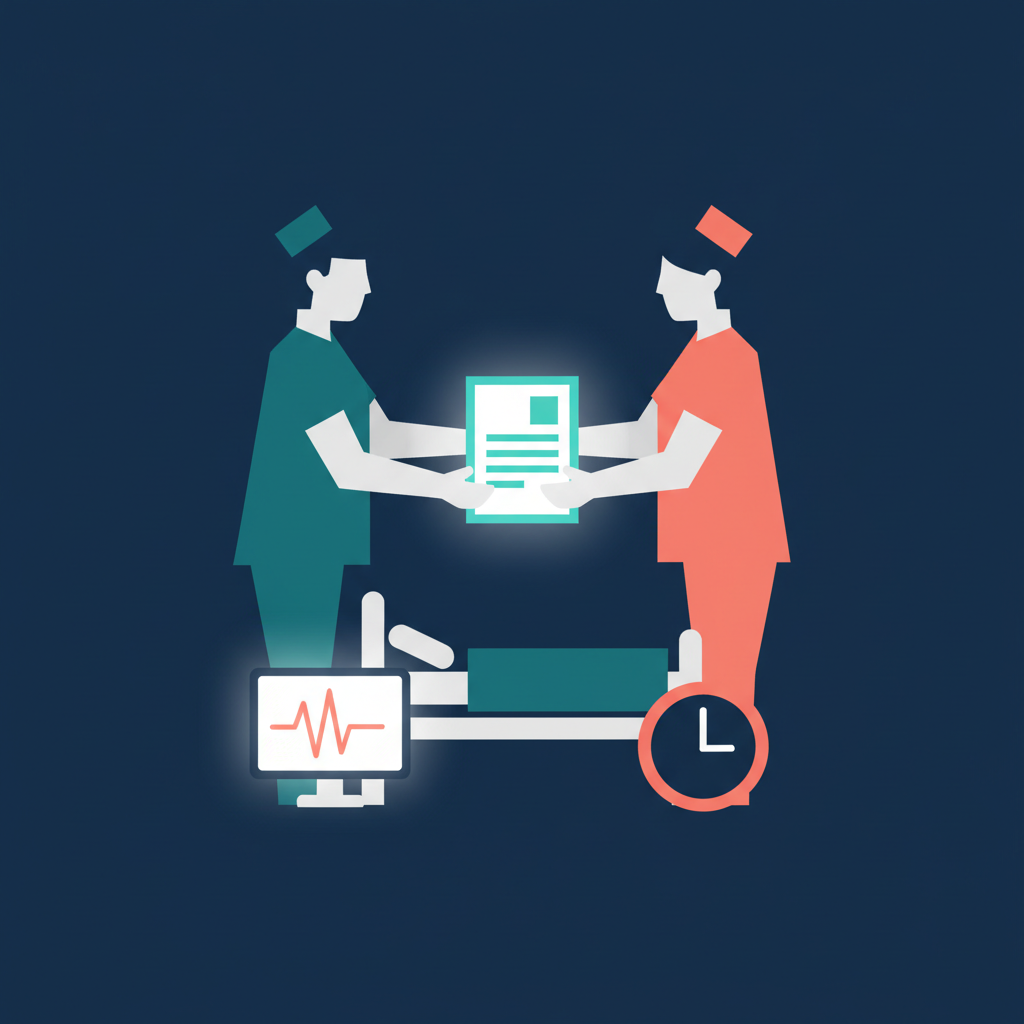
Day two of an unannounced survey. The surveyor stops in the med room on 4 West and asks a night shift nurse to walk through the independent double check on a heparin drip.
The nurse answers for ninety seconds. She points at the pump, pulls up the MAR, and explains exactly what the charge nurse verified and when. It is a good answer — specific, sequenced, and grounded in what actually happened at that bedside.
Your escort catches maybe a third of it in the margin of a legal pad, on the way to the next unit. Nobody did anything wrong. But sixty days from now, when you are drafting corrective action against a finding that turns on this exact exchange, that third is all you have.
The Escort Is the Only Record of What Actually Happened
Tracer methodology moves faster than anyone can write. The surveyor picks a patient and follows that care across units, stopping whoever is closest to the work. The questions are unscripted, the answers are technical, and the whole exchange happens standing up in a hallway or at a bedside — not in a conference room where somebody is assigned to take minutes.
Your escort is doing three jobs at once: keeping pace with the surveyor, pulling the right staff member for the next stop, and capturing the exchange for the team. Those jobs compete. The person tracking which unit comes next and whether the wound care nurse is still on the floor is not the person who can transcribe a ninety-second clinical explanation verbatim.
Whatever lands on that pad becomes the hospital's entire institutional memory of the moment. Not a summary of the record — the record.
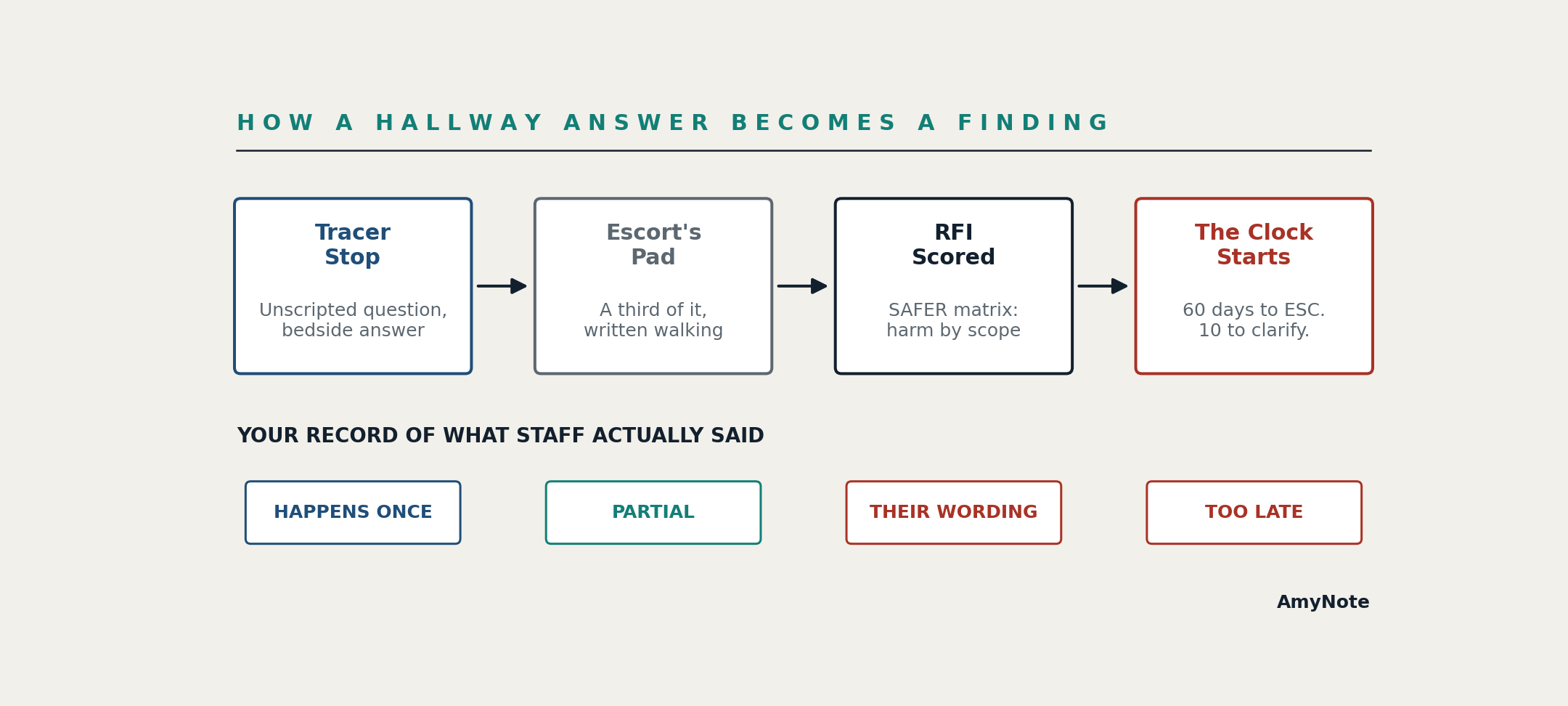
The finding then arrives in the Survey Findings Report as a Requirement for Improvement against a specific element of performance, placed on the SAFER matrix by likelihood of harm and by scope. That placement is not cosmetic. A finding scored as a pattern instead of limited changes what you owe. A high likelihood placement can pull in a measure of success with four months of data behind it — months of collection and reporting that trace back to a ninety-second conversation nobody fully wrote down.
You get sixty days to submit Evidence of Standards Compliance. And if you believe a finding was scored in error, you generally have ten business days to request a clarification, which requires evidence that compliance existed at the time of survey. Not evidence that you fixed it afterward. Evidence about a moment that has already passed, held by people who were walking fast at the time.
How Ninety Seconds Becomes One Line
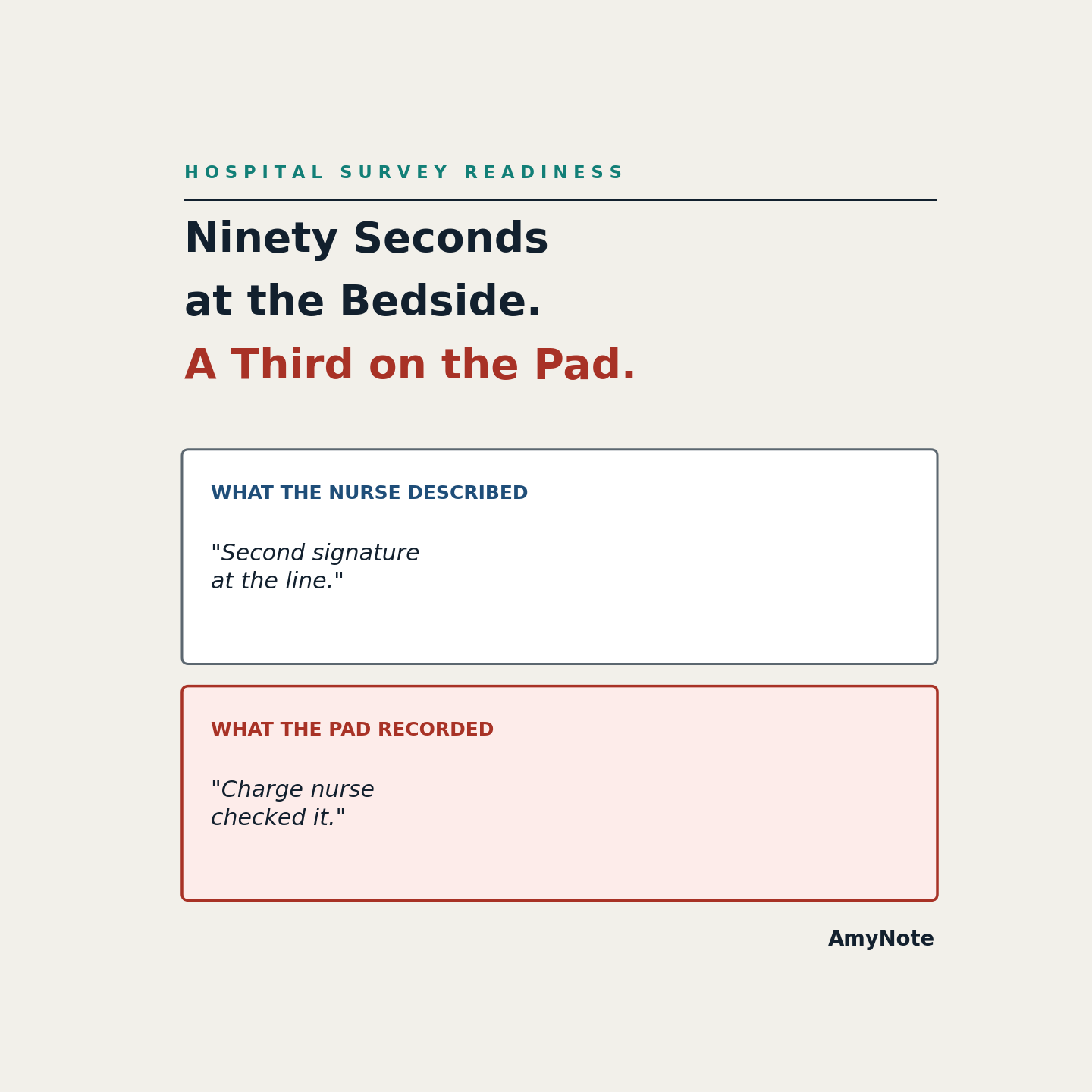
Read the two versions side by side and the problem is obvious in a way it never is in the moment.
What the nurse described was a second signature at the line — two nurses, an actual independent verification, performed the way the policy requires. What made it onto the pad was that the charge nurse "checked it." Both are true statements about the same event. Only one of them establishes that an independent double check occurred.
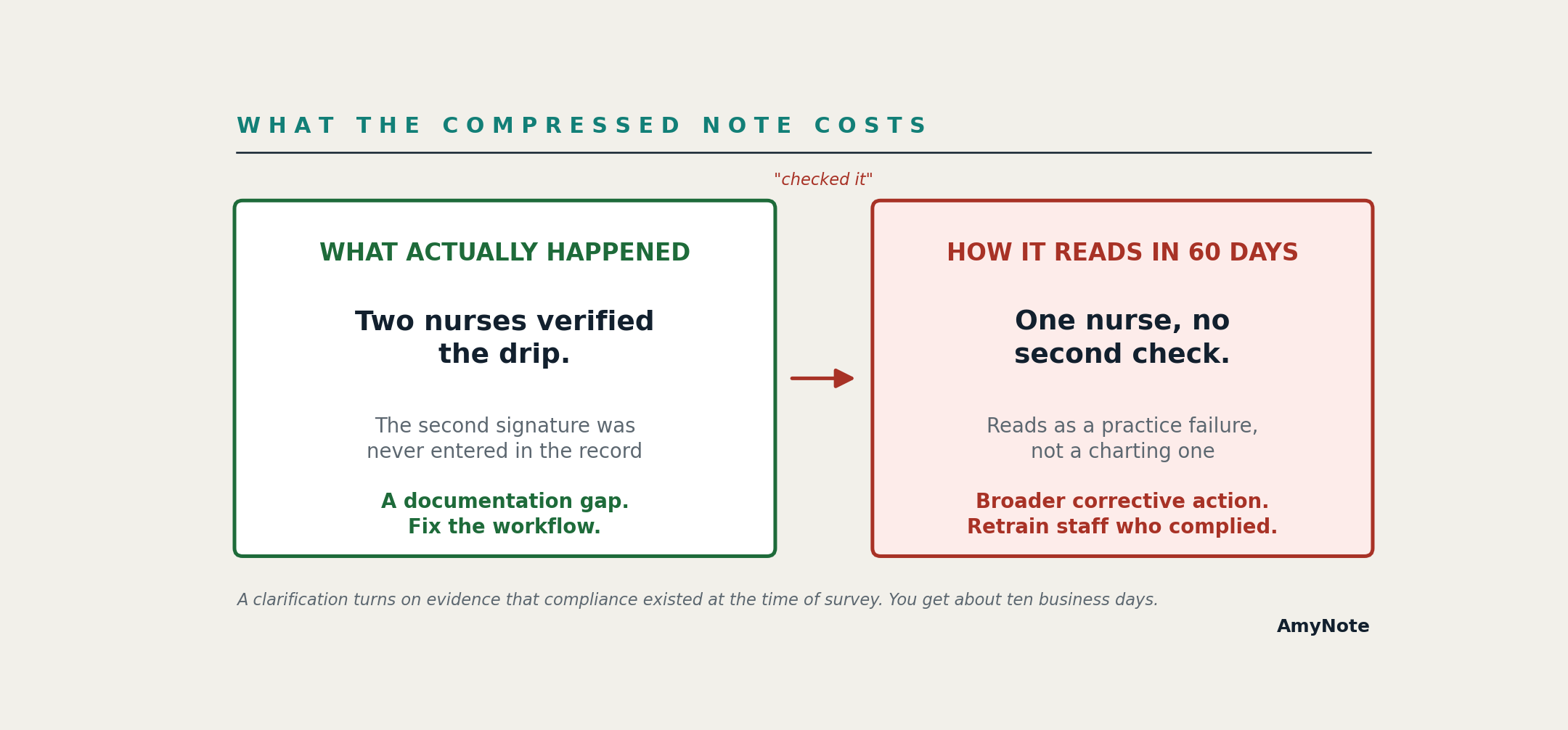
That distinction is the whole finding. If the second nurse verified the line and the signature simply never made it into the record, you have a documentation gap and the fix is a workflow change. If no second verification happened at all, you have a practice failure and the fix reaches the unit's competency and training. Two different corrective actions, two different scopes, two different costs — separated by a clause that got compressed out while somebody was walking.
Why Mock Tracers and Daily Briefings Do Not Close the Gap
You already prepare. You run mock tracers, you brief unit leaders, you assign an escort and a scribe to every surveyor. That work is not wasted, and this is not an argument for doing less of it.
But preparation tells you what might be asked. It does not preserve what was asked. Those are different problems, and only one of them can be solved in advance.
The daily briefing runs hours after the fact and is already a summary. The exit conference is a summary of summaries. Each pass through compresses further, and each pass happens later, when the people who were there have absorbed three more units' worth of detail.
The reconstruction problem is specific. Two weeks later, drafting the ESC, you need to know whether that nurse actually described the second signature or only said the charge nurse "checked it." Nobody remembers at that resolution. Not because anyone was careless — because human memory does not store hallway exchanges at the granularity a regulatory response requires.
So the safe move is to write a broader corrective action than the finding required. You retrain the unit rather than fix the charting step, because you cannot prove the narrower version is the true one. That costs staff time, it costs credibility with a team that knows it did the work correctly, and it commits you to monitoring a problem you may not actually have.
There is a second cost that shows up later. When the same standard comes up at the next survey cycle, your file says you retrained the unit — which reads as an admission that practice was the issue. The record you wrote under uncertainty becomes the history you are held to.
Keep a Contemporaneous Record of Your Own Survey
This is not about recording the surveyor. Do not. It is about the conversation that already happens ten minutes later, when the escort and the unit manager reconstruct the exchange while it is still fresh — the huddle at the nurses' station, the walk back to the command center, the two minutes in the stairwell between units.
That huddle is where the real detail lives, and right now it evaporates. It is not written down anywhere, because writing it down would take longer than the huddle itself and the escort is already late to the next stop.
AmyNote runs on the phone already in the escort's pocket, so there is no bot and nothing new introduced into the survey environment — no device to badge in, no vendor to clear, nothing that changes what the surveyor sees on your floor. It captures the audio, transcribes it with the OpenAI Speech API, and runs the analysis through Anthropic's Claude Opus to surface the unit, the standard, the staff role, and the sequence of what was asked and answered.
That record earns its keep at three moments.
- During the survey. The command center needs to know that evening whether the same gap exists on three other units — while there is still time to look, and before the surveyor gets there.
- At the ESC. You scope corrective action to the finding instead of to the whole department, because you can tell which version of the exchange actually occurred.
- Inside the clarification window. Ten business days is not enough time to reconstruct anything. It is barely enough time to assemble what you already have. The question is whether compliance existed at the time of survey, and the alternative to a contemporaneous record is a hallway memory.
Privacy is the first question in a hospital, so here is the architecture. Both OpenAI and Anthropic contractually guarantee zero training on user data. Audio is encrypted in transit and not retained after processing. Transcripts are stored locally on device with end-to-end encryption. Keep the huddle to staff, standards, and process — the same discipline you already apply to your performance improvement files — and the record stays inside the protections you have built for that category of document.
Getting Started
Do not wait for the next survey window to open. The habit you need on day two of an unannounced survey is not one you can adopt on day two of an unannounced survey.
- Start with the conversations that happen anyway. The mock tracer debrief, the monthly readiness meeting, the huddle after a near miss. Nothing about these involves a surveyor, and all of them build the workflow.
- Confirm your own policy first. Check your organization's recording policy and applicable state consent law before recording anything, and tell people they are being recorded. Where recording is not appropriate, capture a spoken debrief within minutes of the exchange ending, while exact phrasing is still recoverable.
- Summarize the same day. Pull out the unit, the standard, the staff role, and the sequence of question and answer — while nobody is reconstructing anything.
- File it with your readiness documentation. When the Survey Findings Report arrives, comparing your record against the finding takes minutes instead of memory.
AmyNote takes about a minute to set up, and amynote.app offers a 3-day full trial with no credit card.
An accreditation decision, a condition level finding, and your deemed status all trace back to what a few people said in a hallway on a Tuesday. Your staff gave the right answer. The only question is whether anyone kept it — and a third of it on a legal pad is not keeping it.
Originally published as an X Article by @AmyNoteApp.