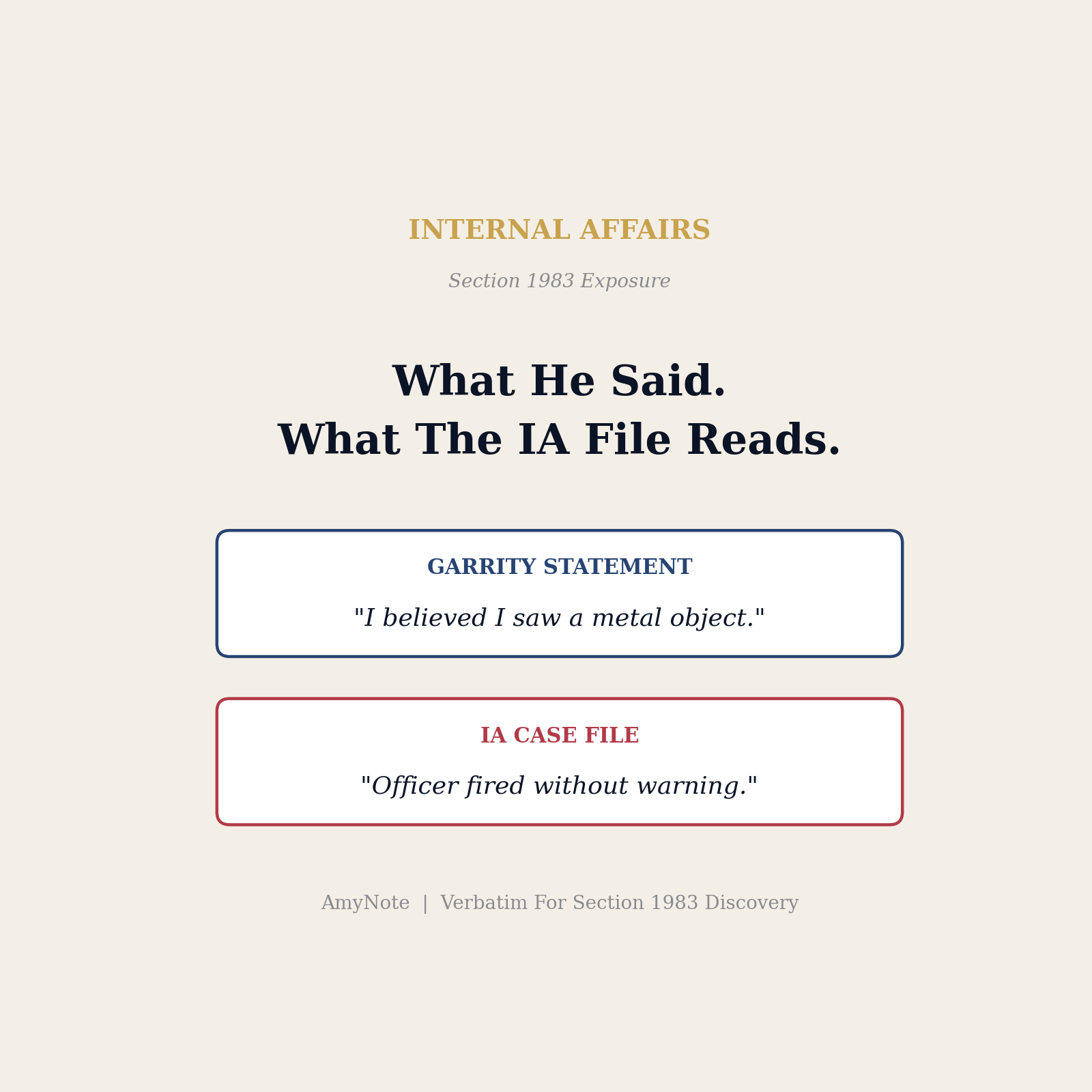
A subject officer sits across from an Internal Affairs investigator under Garrity. He describes a quarter-second decision: a suspect who turned with what looked like a metal object in his hand. The IA case file, typed up that night, will read four words. Officer fired without warning.
Eighteen months later, that case file is produced in a 42 USC Section 1983 civil suit and the audio comes off a shelf in evidence storage. The officer's verbatim words run nine minutes longer than the four-word summary suggests. Plaintiff's counsel plays both. The jury reads both. The verdict is $4.3 million and a city in the press release.
This is not an outlier story. It is the structural shape of how subject officer interviews get documented across U.S. policing in 2026. The audio is mandatory. The typed summary is the working record. The audio is the buried record. Counsel finds the gap. The gap is the case.
The Problem: Two Records, One Set Of Words
Garrity-compelled interviews are the bedrock of police accountability. Every major use-of-force investigation, every civilian complaint review, every POST decertification petition turns on what the subject officer said inside an IA interview room. The audio recording is mandatory in most agencies under departmental general orders and collective bargaining agreements. The investigator's typed summary is not the audio.
The summary is a narrative drafted under deadline, filtered through the investigator's evaluation of the officer's credibility, and entered into IAPro, Blue Team, or IA Pro Symphony as the canonical case record. It is what the chief reads to approve discipline. It is what the city attorney reads to assess exposure. It is what the press office reads to draft the statement.
Eighteen months later that case file is produced in a 42 USC Section 1983 civil rights suit, an 18 USC Section 242 federal indictment, a POST decertification hearing, or a public records request. Counsel for the city, counsel for the officer, the union representative, and the plaintiff all work from the same typed summary. The audio sits in evidence storage. Nobody plays it — until plaintiff's counsel does, side by side with the file note, in deposition or on cross.
What The Gap Actually Looks Like
The gap rarely shows up as an outright contradiction. It shows up as omission, paraphrase drift, and the natural compression that happens when a ninety-minute interview gets typed into a one-page bullet list on the same shift the investigator has three other cases to staff.
- Omission. The officer describes a half-second between "show me your hands" and the suspect turning. He repeats it three times across the interview. The summary captures the command and the discharge but not the turn. The turn is the entire perception-action chain that justifies the use of force. It does not make the page.
- Paraphrase drift. The officer says "I believed I saw a metal object in his right hand." The summary types "Officer saw metal object." The modifier and the conditional vanish. In a Section 1983 cross, the difference between believed I saw and saw is the difference between an honest perception under Graham v. Connor and a contradicted factual claim that opens the door to a Monell pattern argument.
- The forced determination. The case file template includes a credibility paragraph that demands a finding. The investigator, syncing fact and template, types "officer's account inconsistent with witness statements" even though the recorded statement contains three separate references to a metal object that two witnesses independently corroborated. The template wrote the finding. The audio remembers everything.
None of this is bad-faith conduct in the moment. It is the predictable, repeated output of an IA operation that asks its investigators to be both interrogator and stenographer in the same shift, then files the audio to an evidence shelf nobody reopens until discovery.
Why Current Solutions Fail
IAPro narrative fields are written for a chief's reading speed, not for a federal jury. The investigator compresses a ninety-minute interview into one page of bullet points. Modifiers vanish. Conditional language flattens to declarative. "I believed I saw" becomes "Officer saw." The case management system was designed to surface dispositions for trend analysis and early-warning thresholds, not to preserve verbatim testimony for civil rights litigation three years downstream.
Audio archive systems retain the recording but index it by case number, not by what was actually said. There is no full-text search inside the audio. If the chief wants to find the officer's exact words on perception, somebody listens to ninety minutes of tape. Most chiefs never ask. Most plaintiffs' counsel do.
Union counsel does not get a transcript at the time of the interview. They get one if a litigation hold triggers transcription months later, by which point the typed summary has already shaped the chief's discipline decision, the city attorney's exposure assessment, and the press release. The narrative is set before the verbatim record exists.
The court-reporter approach used in civil depositions costs around $2,000 per officer interview. Most agencies cannot run it on every IA case, and contract terms with stenographic vendors do not accommodate weekend or overnight callouts when a critical incident hits. Verbatim documentation defaults to: nobody has it.
What Section 1983 Discovery Looks Like When The Gap Is There
The Section 1983 framework asks whether a state actor violated a clearly established constitutional right. The officer's perception at the moment of force is, under Graham v. Connor, the central factual question. The plaintiff's lawyer does not need to prove the officer lied. The lawyer needs to show the official record does not match the officer's own contemporaneous words.
The Garrity-compelled interview is the single most powerful piece of evidence on that point. It is verbatim. It is contemporaneous to the incident. It is compelled under threat of termination, which means the officer cannot later argue the words were taken out of context. And it is sitting in an evidence archive that the agency's own retention policy guarantees will still be there when discovery requests arrive in year two.
When the IA file summary and the audio diverge, the plaintiff's lawyer does not need to allege motive. The divergence does the work. The summary is the agency's narrative. The audio is the underwriter of that narrative. A jury that reads both and sees the gap will fill in the motive on its own. Monell claims that survive past summary judgment frequently turn on exactly this pattern across multiple files.
What Actually Works
Verbatim audio capture at the time of the interview, transcribed on the investigator's own laptop or phone, with the IA narrative cited line by line to the transcript.
AmyNote runs Whisper-grade transcription locally on the IA investigator's device through OpenAI's latest Speech API, with speaker diarization that separates investigator and subject officer turn by turn. The transcript saves with timestamps to the case folder at the moment the interview ends. The IA narrative draft pulls bullet points from the transcript, and every claim in the narrative cites a specific transcript line. When the chief reads the case file, the chief can click any sentence and hear the officer say it.
When the file lands in Section 1983 discovery two years later, the case file already contains the officer's exact words, indexed and searchable. Plaintiff's counsel cannot impeach the officer by reading the summary against the audio. The summary and the audio match. The cross-examination collapses before it starts.
Privacy is non-negotiable for IA work. Both OpenAI and Anthropic contractually guarantee zero training on user data. Audio is encrypted in transit; processing copies may be retained to deliver and recover requested features. Transcripts stored locally on device with encrypted transport. The recording never sits on a third-party server, never traverses a vendor cloud, and never appears in a public records request from a downstream subprocessor. The investigator's device is the system of record.
The Documentation Pattern That Holds Up On Cross
A defensible Garrity-interview workflow has four properties. None of them are about the technology and all of them are about discipline.
- One audio, one transcript, one summary, all linked. The summary cites transcript lines. The transcript references the audio file. The audio file lives in the IAPro record, not on a shelf in evidence nobody reopens.
- The summary is generated, not remembered. The summary is drafted from the transcript by an AI model that can be re-run, audited, and reviewed. It is not typed from notepad scratch the morning after the interview.
- The credibility paragraph is grounded. Every assertion about consistency, demeanor, or candor either cites a transcript line or is marked as the investigator's evaluative judgment, separately captioned. The template never forces an undocumented finding.
- The privacy posture matches the discovery posture. The Garrity-compelled statement is among the most sensitive documents an agency generates. The transcription pipeline must be contractually zero-training, the audio must not be retained by third parties, and the transcripts must be encrypted at rest on the investigator's device.
Agencies that adopt this pattern do not eliminate Section 1983 litigation. They eliminate the specific kind of Section 1983 litigation that turns on the gap between the file and the recording. That is the most expensive category, and it is the category that produces the punitive verdicts and the consent decrees.
Getting Started
Open AmyNote at the start of the next subject officer interview. The transcript writes itself in real time. The narrative draft cites every fact to a timestamp. The case file produced two years later in federal court matches the audio because it is the audio, summarized and cited.
Bad faith lives in the gap between what was said and what was typed. AmyNote closes the gap.
Originally published as an X Article.