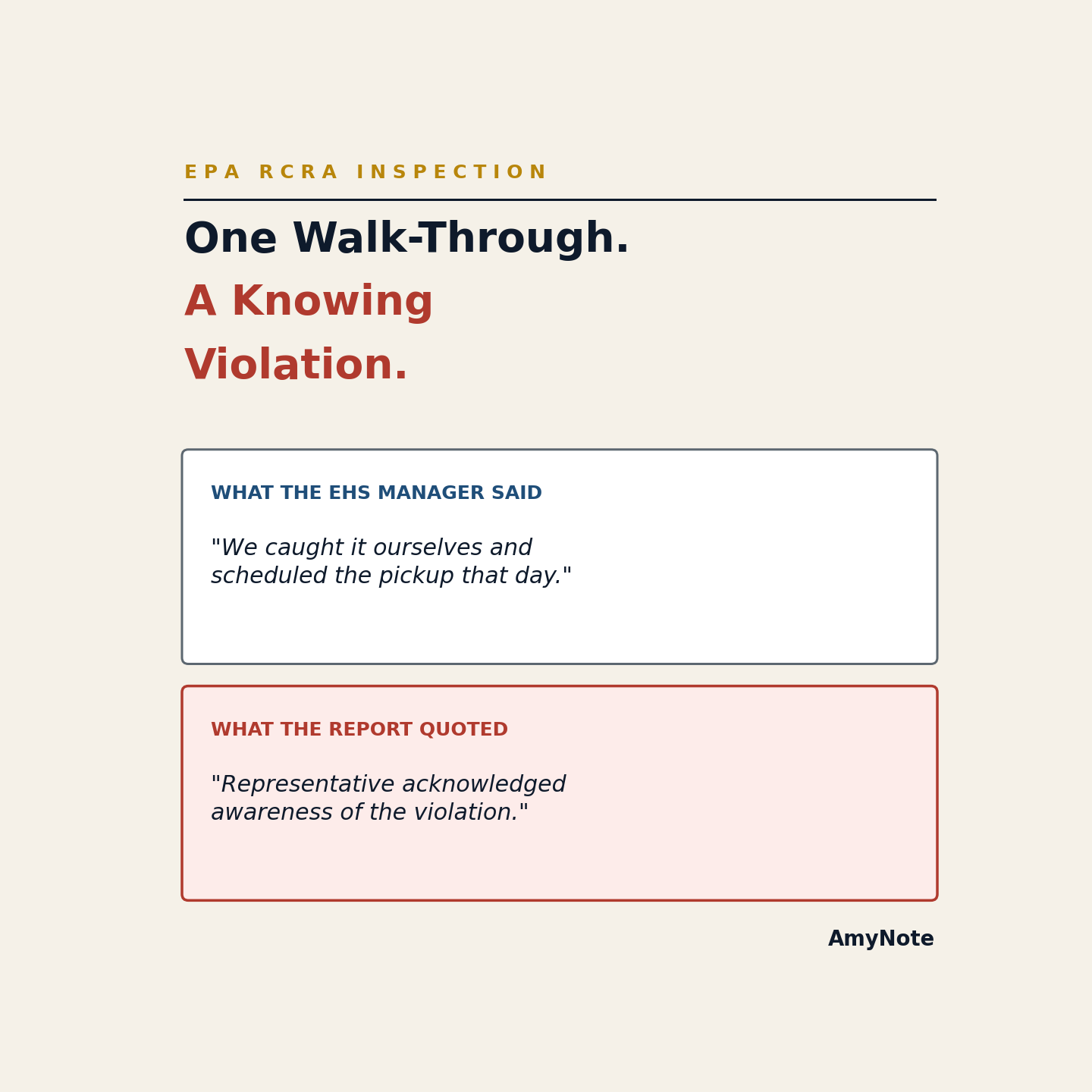
A Phase I site visit produces two records. One is the written report a buyer will lean on for CERCLA liability protection. The other is whatever the environmental professional managed to write down while the facility manager pointed at a patch of fresh asphalt and explained what used to sit under it.
Only one of them is signed. Only one is discoverable years later. They are almost never the same record.
The Problem
Under 40 CFR Part 312, the EPA standard for All Appropriate Inquiries, interviews are not background color. Section 312.23(b) requires the environmental professional to interview the current owner and occupant, and where a property has multiple occupants, to interview the major occupants plus those likely to use, store, treat, handle, or dispose of hazardous substances, or who have likely done so in the past.
Section 312.23(c) widens the net further. The inquiry must also reach one or more of the following: current and past facility managers with relevant knowledge, past owners or operators, or employees of current and past occupants. The rule is written that way for a reason. Institutional memory does not live with whoever happens to hold the deed today.
Those conversations are frequently the only source for four of the seven information categories that section 312.20(e)(1) requires the inquiry to seek out: past property uses and occupancies, past uses of hazardous substances, waste management and disposal activities, and past corrective actions.
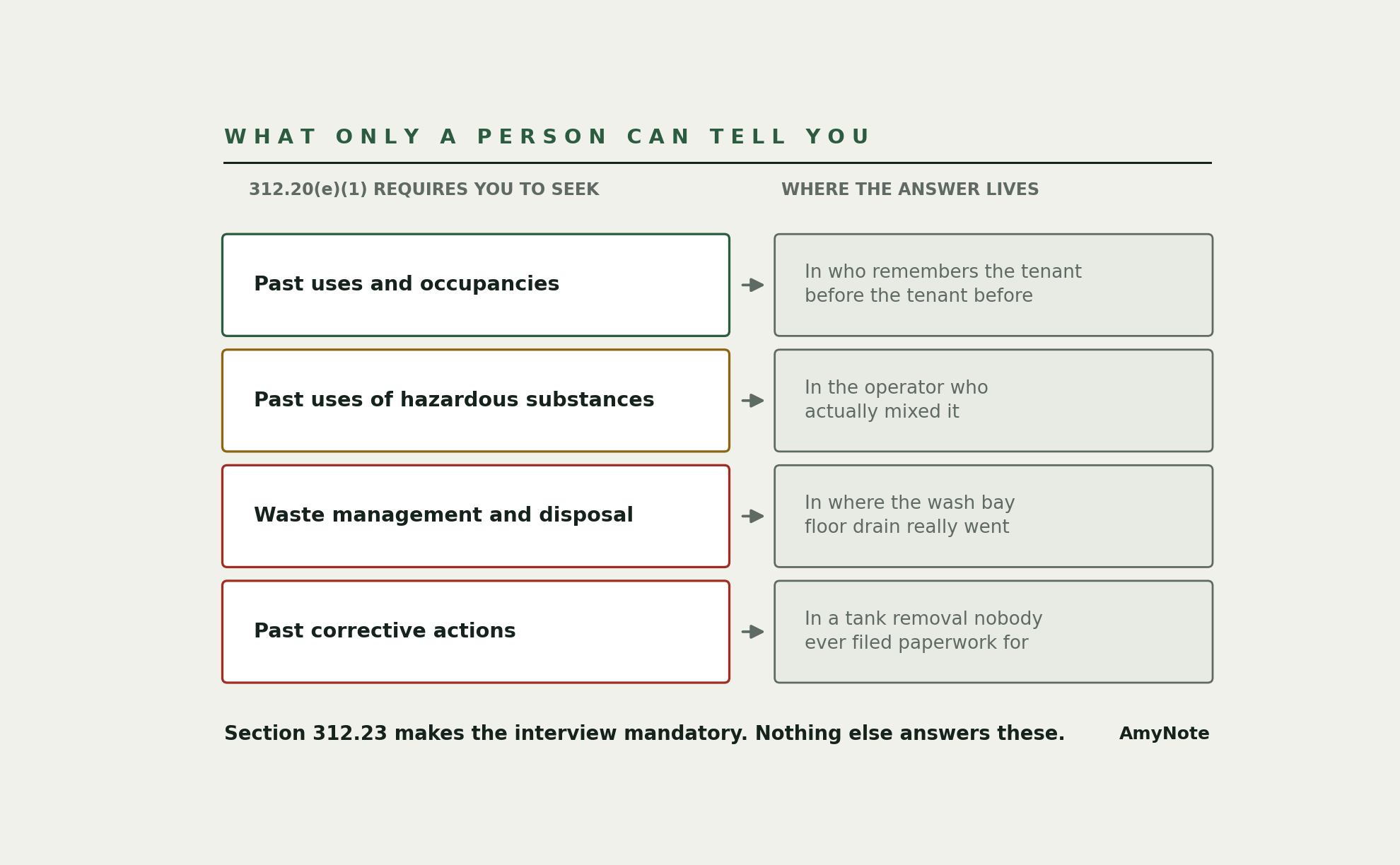
This is worth sitting with, because it inverts how most people picture a Phase I. The database search, the historical aerials, the Sanborn maps and the regulatory file review all feel like the substance of the assessment. They are the part that generates paper. But an aerial photograph shows you a building. It does not tell you that the wash bay floor drain ran to a dry well until 1994.
Exactly one person knows that. He says it once, mid walkthrough, over a running compressor, and he retires in March.
Why Current Solutions Fail
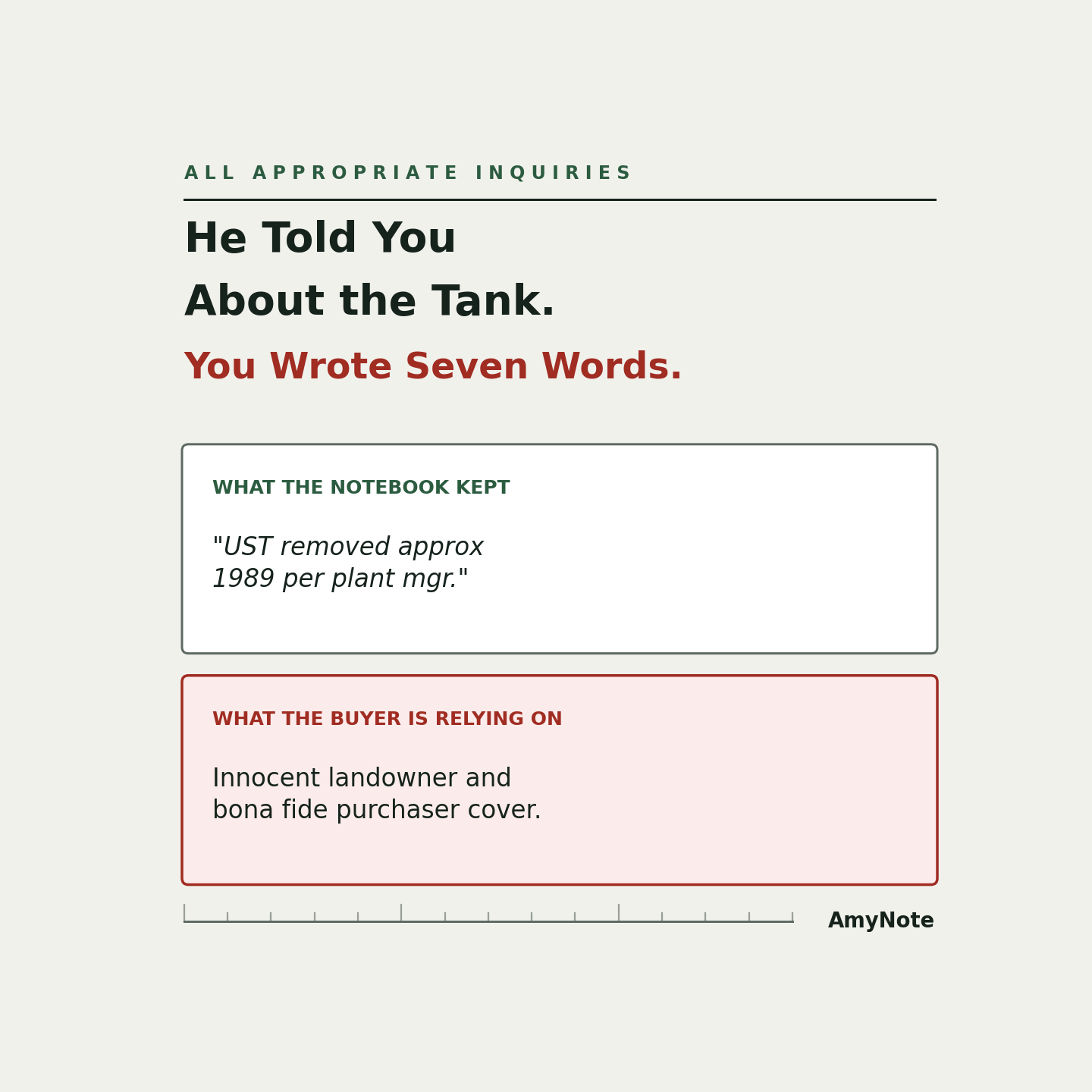
The field notebook compresses a five minute answer into seven words: “UST removed approx 1989 per plant mgr.” Everything that made the answer useful is gone — the hedging, the approximate location, the second tank he mentioned and then talked himself out of, the fact that he said “we think” rather than “we know.”
That compression is not carelessness. It is what writing by hand does while a person is still talking and walking. The professional is simultaneously navigating a live facility, watching for staining and stressed vegetation, and trying to hold the next question in mind. Shorthand is the only thing that fits in that moment. The problem is that the shorthand then becomes the permanent record of a conversation that the regulation treats as a primary source.
Voice memos survive, but nobody transcribes forty minutes of plant floor audio, so they become an archive no one opens. Mailed questionnaires come back with one word answers and no way to ask the follow up — and the follow up is usually where the finding is. “Any known releases?” gets a “no.” It is the next question, the one about why that section of floor was recoated, that produces the answer worth writing down.
Then there is the clock. Section 312.20(b)(1) puts interviews in the short list of components that must be conducted or updated within 180 days of and prior to the date of acquisition, alongside lien searches, government records reviews, visual inspections, and the professional’s own declaration. That sits inside the broader one-year window in section 312.20(a).
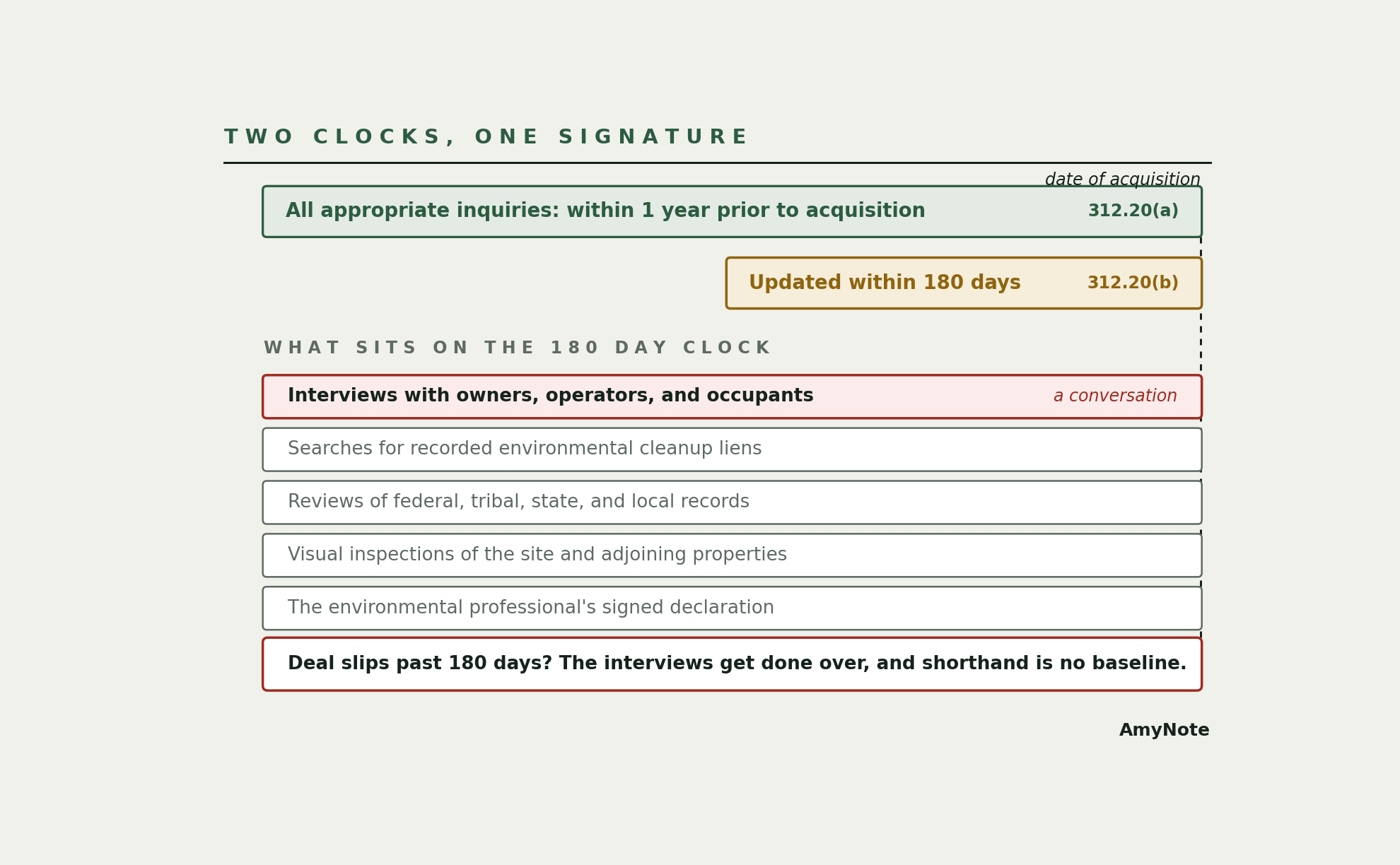
Deals slip past 180 days routinely. Financing restructures, a title issue surfaces, a lender changes its mind about the environmental condition. When yours slips, you must refresh the interviews — and shorthand gives you no baseline for comparison. If the plant manager says something different the second time, you have no reliable way to know whether the story changed or your seven words were simply an incomplete rendering of it the first time.
What Actually Works
Treat the spoken record as a deliverable of the site visit, not as a memory aid. Capture the interview as audio, get a speaker attributed transcript the same day, and draft the report from the transcript rather than from recall. Three things the regulation actually cares about get better immediately.
The opinion. Section 312.21(c)(1) requires a written opinion on whether the inquiry identified conditions indicative of releases or threatened releases. An opinion assembled from a transcript can rest on what the operator actually said about the drum storage pad, and when he said it happened. An opinion assembled from memory rests on the professional’s recollection of a conversation held weeks earlier, on a day that included three other sites.
The data gaps. Section 312.20(g) and section 312.21(c)(2) require you to identify data gaps, name the sources you consulted to close them, and comment on their significance. A data gap is not only an unreturned phone call. It is also the retired plant manager who could not remember whether the tank was steel or fiberglass. A transcript preserves the difference between “he said no” and “he did not know,” and that difference is the whole substance of the required comment.
The declaration. Section 312.21(d) makes you sign a statement that you developed and performed the inquiries in conformance with Part 312. Signing that over a reconstructed memory of a conversation is a materially different risk than signing it over a record of one. The signature is the same either way. What stands behind it is not.
AmyNote runs this on the phone already in your pocket. On device capture keeps working in a plant with no usable wifi, Whisper class transcription with speaker separation turns the walkthrough into an attributable record, and semantic search lets you pull every mention of a tank, a drain, or a solvent across a whole portfolio of assessments instead of one file at a time.
That last capability matters more at portfolio scale than at single-site scale. An environmental professional carrying forty assessments a year accumulates a searchable corpus of what operators in a given sector actually say about their own housekeeping — which is the kind of pattern no individual field notebook has ever been able to surface.
Both OpenAI and Anthropic contractually guarantee zero training on user data. Audio is encrypted in transit and not retained after processing. Transcripts are stored locally on device with end to end encryption.
Getting Started
Pick the next site visit. Record the owner interview and the facility manager walkthrough, then write your section 312.21(c) report language from the transcript instead of from the notebook. Compare the two when you are done — the gap between what you wrote in the field and what was actually said is the clearest argument for the change, and you only need to run it once.
AmyNote handles capture and transcription; the professional judgment stays yours. The first time a buyer’s counsel asks what exactly the operator said about that dry well, you will have the sentence instead of seven words of shorthand.
Originally published as an X Article by @AmyNoteApp.