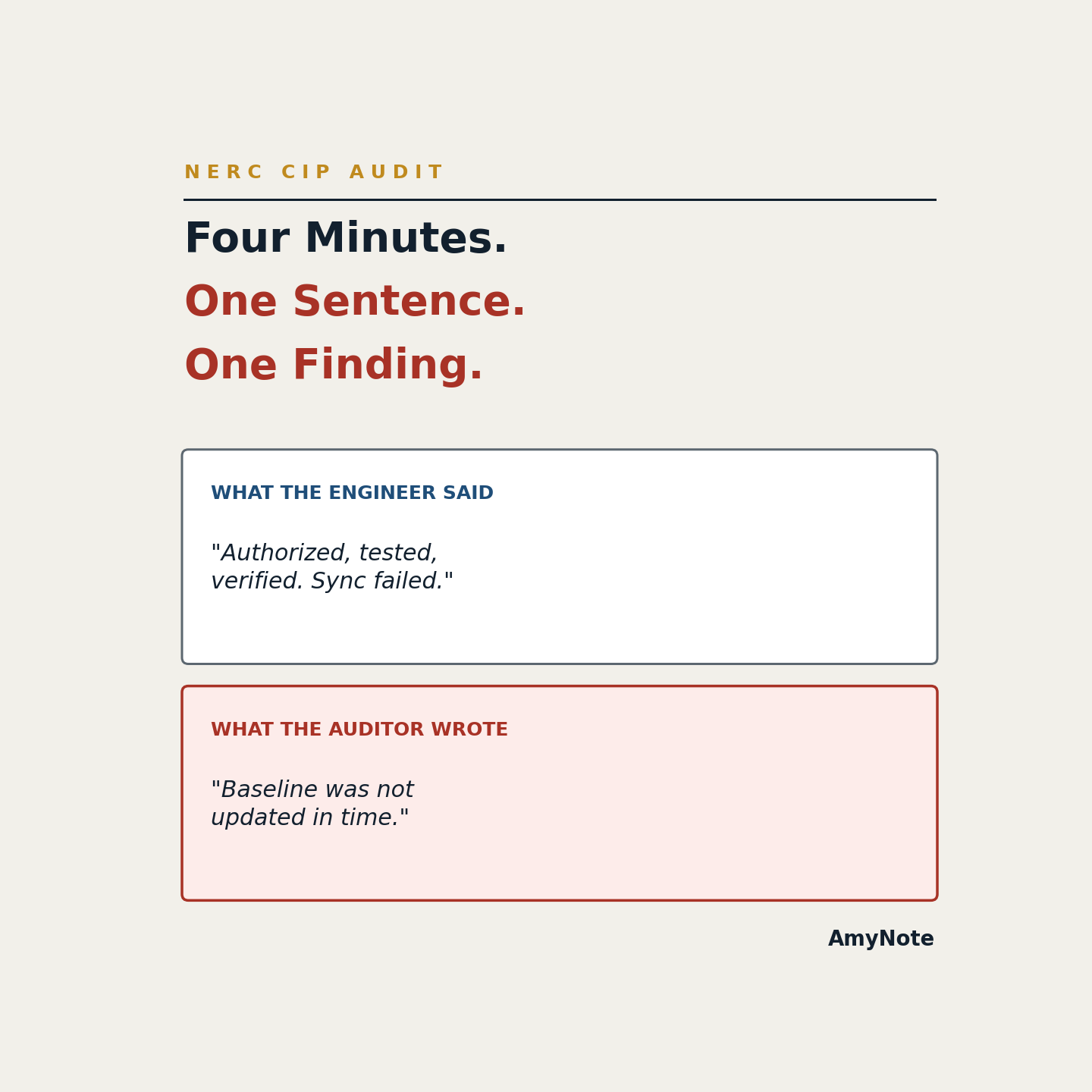
The Regional Entity audit team was on site for two weeks. Your EMS engineer answered one question about how a firewall rule got changed, and the answer ran four minutes and covered three systems, a change ticket, a lab test, and a configuration database that failed to sync over a holiday weekend.
What went into the auditor's notes was a single sentence. That sentence is now a Potential Noncompliance in your draft audit report.
Nobody lied. Nobody was careless. Your engineer gave a complete, accurate, technically precise answer, and the person writing it down was doing exactly what auditors do: converting a long spoken explanation into a line that fits a finding. The nuance did not survive the compression — and the compressed version is the one that travels.
Your Answer Gets Compressed Before It Gets Recorded
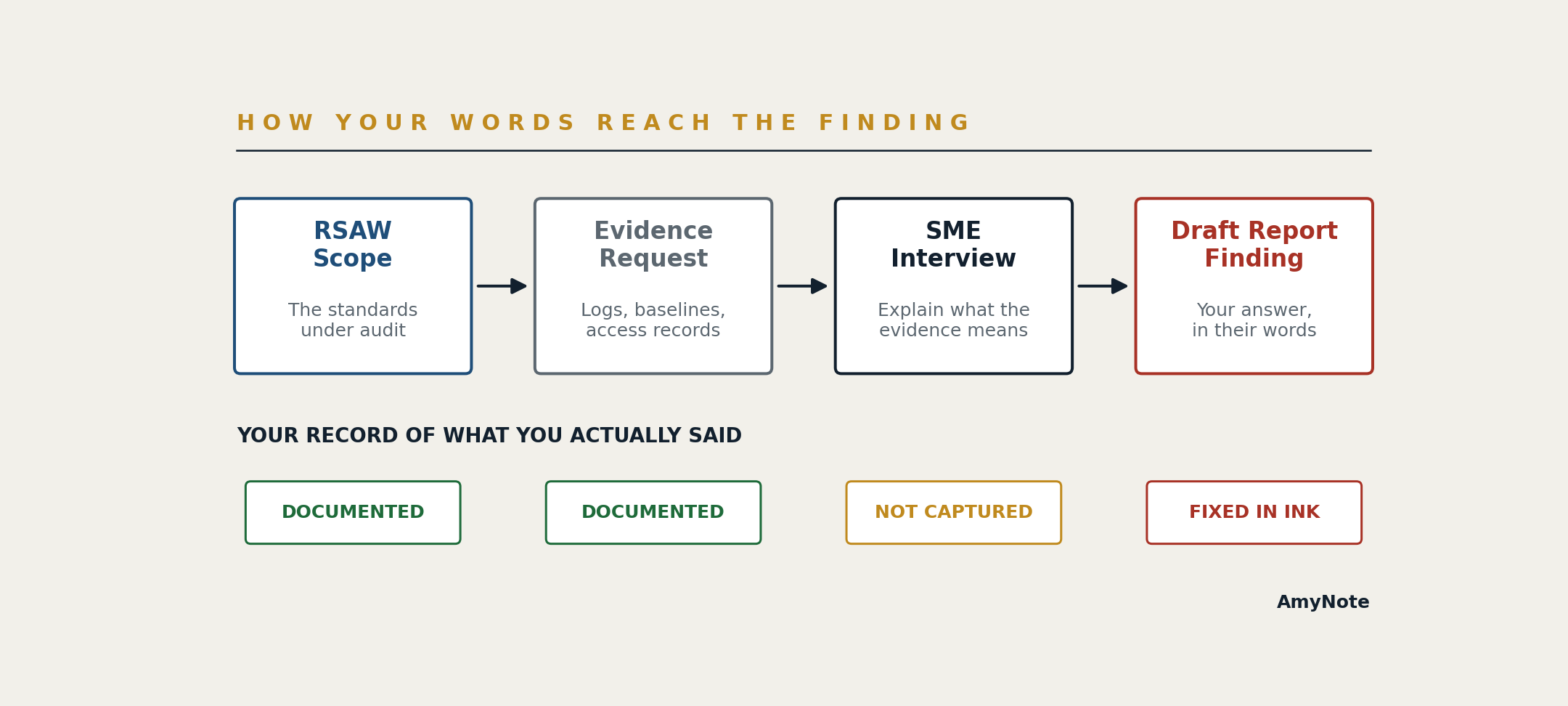
A CIP compliance audit is not a document review with people attached. The audit team works from the Reliability Standard Audit Worksheets, pulls your evidence, and then sits down with the CIP Senior Manager, the EMS and SCADA engineers, the substation technicians, and whoever runs badge access at the control center. The evidence establishes what happened. The interview establishes what it means. That second part is where audits are actually decided, and it is the part nobody transcribes.
Consider the exchange that generated the finding. Your engineer explains the whole thing. The change was authorized under a pre-approved template. It was tested in the lab. The ports were verified after the cutover. The CIP-010 baseline document lagged four days behind the change because the configuration database sync failed over a holiday weekend, and the discrepancy was caught by your own internal controls before anyone from the Regional Entity asked about it.
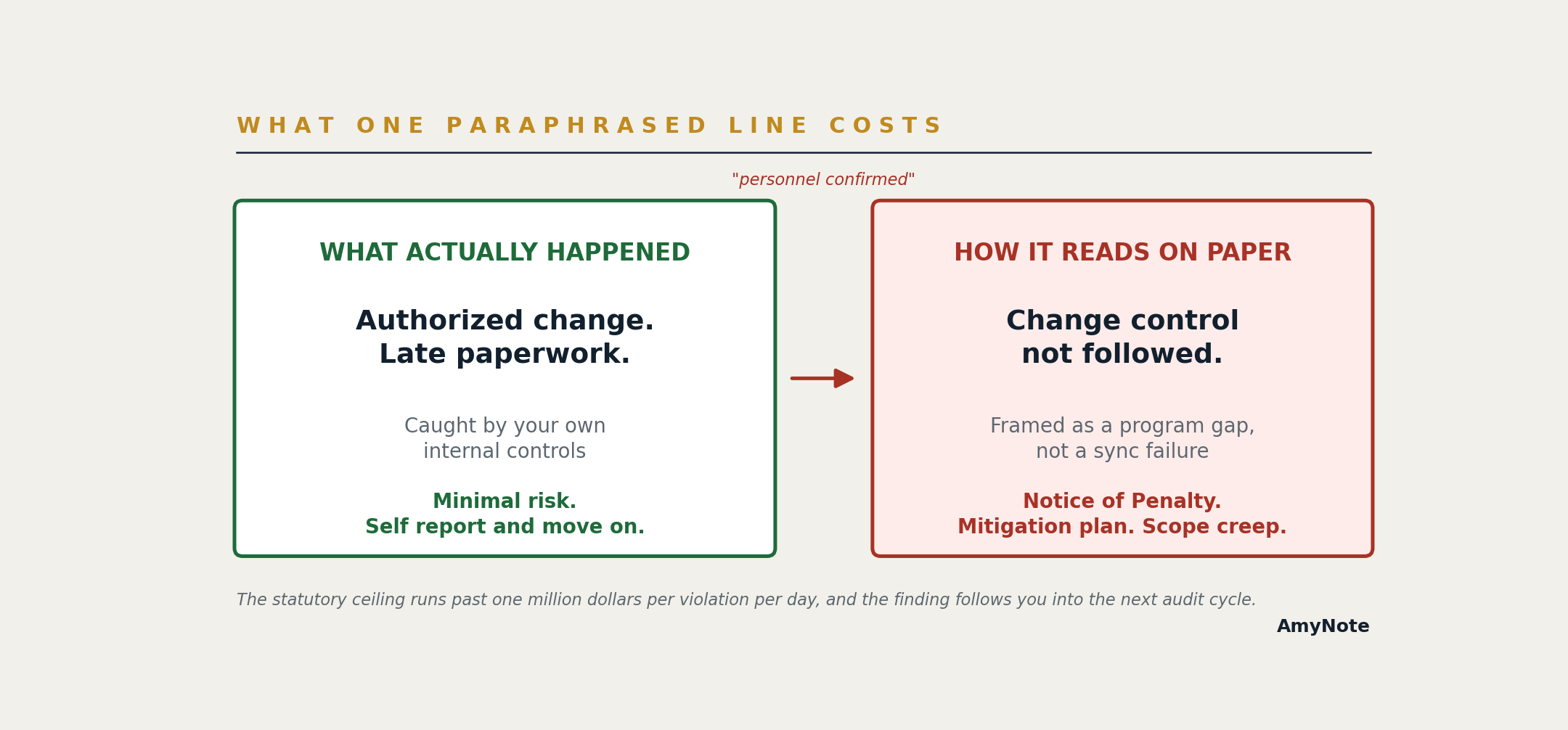
That is a documentation timing problem, not an unauthorized change. The distinction is the entire difference between a low-risk issue you self-report and close, and a serious finding that reframes your whole change management program.
What the auditor writes down is: "Entity personnel confirmed the baseline configuration was not updated within the required interval following the change."
Read that sentence cold, the way a reviewer three steps removed from the room will read it. Every word is defensible. It is also missing the authorization, the testing, the verification, the cause of the lag, and the fact that your controls caught it. What remains reads like an admission that your process does not work.
Why One Sentence Carries So Far
A Potential Noncompliance in a draft audit report is not the end of the process, but it sets the terms of everything after it. The wording drives how the Regional Entity characterizes risk. Risk characterization drives whether the matter is dispositioned as a compliance exception, a self-logged issue, or a violation headed for a Notice of Penalty filed with FERC. And the framing of the underlying problem drives the scope of your mitigation plan — which is to say, how much engineering work your team is now committed to performing, on a schedule you agreed to under pressure.
Those consequences all rest on a characterization your own engineer would dispute if anyone showed it to him in time. A configuration database sync failure gets you a fix to the sync monitoring. "Change control not followed" gets you a program-level mitigation plan, an extended evidence obligation, and a finding that follows the registered entity into the next audit cycle.
The penalty exposure is not theoretical. The statutory ceiling runs past one million dollars per violation per day, and a single settlement has covered more than a hundred violations. But the money is usually not what hurts most. What hurts is the mitigation scope, the follow-up evidence burden, and the fact that a mischaracterized finding becomes the starting assumption of the next audit.
Why the Usual Preparation Does Not Close This Gap
Every registered entity prepares. You run mock audits. You build evidence binders indexed to the RSAWs. You hold subject-matter-expert prep sessions where the compliance team coaches engineers on how to answer precisely and not volunteer scope. And you put a compliance lead in the room to take notes during every interview.
That person cannot do the job you need done. They are simultaneously fielding evidence requests, tracking which RSAW the team is working through, watching the clock on a two-week schedule, and managing which SME is needed in which room next. Nobody can listen for a four-minute technical distinction and transcribe it accurately at the same time. By hour nine of an audit day, the notes are five bullets and an action item — and the five bullets record the topic, not the phrasing.
And you do not get the auditor's record. You get the draft report, weeks later, after the finding is already framed and worded. Audit interviews are generally not recorded by the Regional Entity, and where any recording exists, it is not yours. By the time you can read the characterization, the only account of what your engineer actually said is what your engineer can remember weeks after the fact — about a conversation he did not know was going to matter.
There is a second reason the gap persists in this industry specifically: the standard corporate answer does not apply. Cloud meeting bots assume a scheduled video call with a link to join. A CIP audit interview happens in a conference room at a control center, or standing in a substation yard, or at a workstation while someone pulls up a change ticket. There is no meeting to invite a bot to, and nobody is badging a recording appliance through physical security into a facility governed by CIP-006.
Capture Your Own Side of Every Interview
The fix is not adversarial. It is just symmetric. They keep a record of the conversation. You should keep one too. Nothing about that changes the tone of an audit — it changes what you can say six weeks later when the draft report arrives.
AmyNote runs on the phone already in your pocket, so there is no bot joining a call and no hardware to badge through physical security. It records the audio in the room, transcribes it with the OpenAI Speech API, and runs the analysis through Anthropic's Claude Opus to surface the commitments, dates, system names, ticket numbers, and standard citations that came up.
That record earns its keep at three specific moments:
- During the audit. When a data request follows up on an interview, you answer the same day with the qualifier the auditor missed — before the finding gets drafted. This is the cheapest possible moment to fix a mischaracterization, and it is the moment you currently have no way to reach.
- At draft report review. Your response cites the actual answer instead of a recollection. "Our engineer stated the change was authorized under template CM-14, tested on the 12th, and that the baseline lag resulted from a sync failure identified by internal control ICP-3" is a different document than "we believe the finding mischaracterizes our testimony."
- When the issue is real. If it turns out to be genuine noncompliance, an accurate transcript lets you scope it correctly. Scope is what drives your mitigation plan and your risk assessment, and over-scoping a mitigation plan out of uncertainty costs your team quarters of work.
Privacy is the first question in this industry, so here is the architecture. Both OpenAI and Anthropic contractually guarantee zero training on user data. Audio is encrypted in transit and not retained after processing. Transcripts are stored locally on device with end-to-end encryption. That matters when the conversation touches BES Cyber System Information and your own CIP-011 information protection program governs how it gets handled — a recording of an audit interview is BCSI, and it needs to live somewhere your program can account for.
Getting Started
Do not wait until the audit team is in the lobby. The habit is worth more than the tool, and habits do not form under audit conditions.
- Start with the conversations that happen all year. Internal control testing, self-assessments, spot checks, and the vendor calls that feed your CIP-013 supply chain evidence. None of these are adversarial, and all of them produce facts you will need to state precisely later.
- Capture your own SME prep sessions. When your engineers rehearse how they will explain change management, you get a clean record of what your program actually is, in their words, before anyone is under pressure.
- Set the ground rules first. Tell people they are being recorded, confirm your policy and applicable consent rules with counsel, and follow your own CIP-011 program on where the file lives and who can access it.
- Review the same day, not at draft report. Have the AI pull out every question asked, every commitment made, and every system, date, and standard cited — while the audit is still open and a follow-up data request can still fix the record.
The statutory penalty ceiling runs past one million dollars per violation per day, and a single settlement has covered more than a hundred violations. Your engineer's full four-minute answer is worth considerably more than the one sentence somebody else wrote down. AmyNote at amynote.app takes about a minute to set up and offers a 3-day full trial with no credit card.
Originally published as an X Article by @AmyNoteApp.