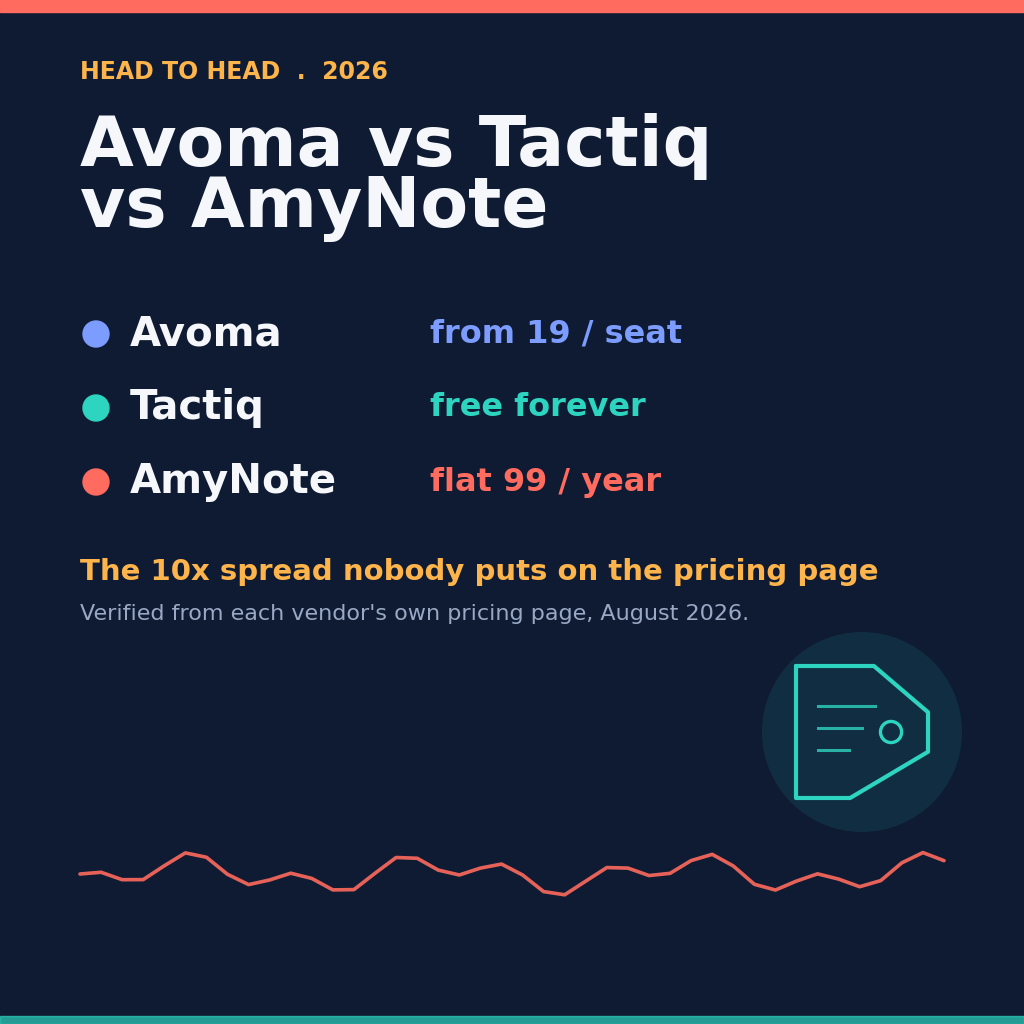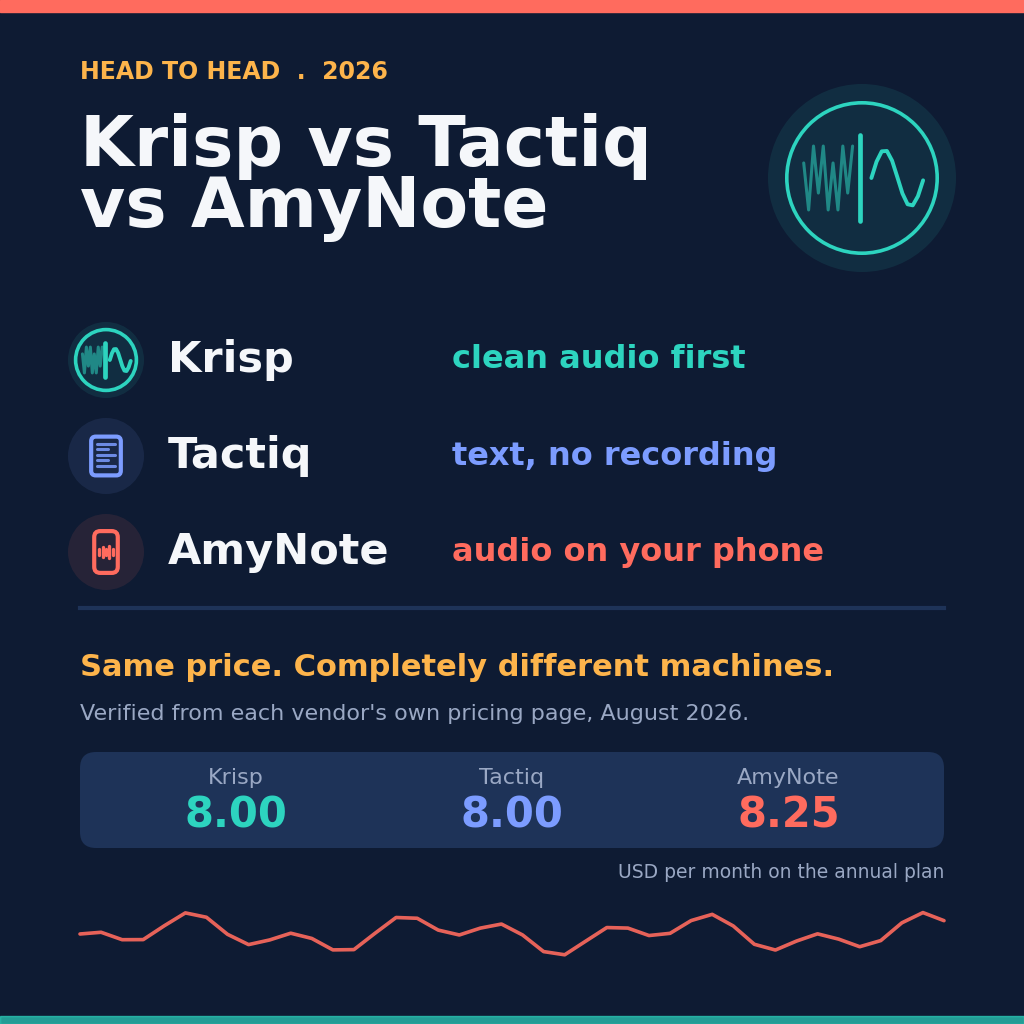
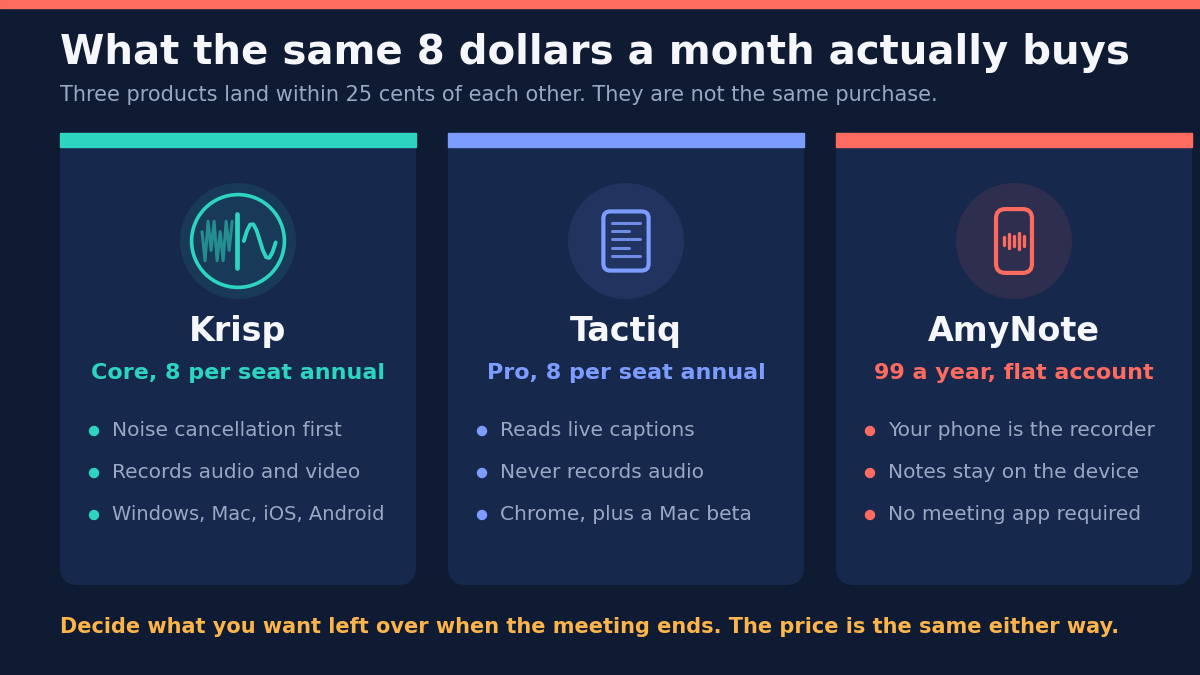
Krisp Core costs 8 dollars per user per month on the annual plan. So does Tactiq Pro. AmyNote costs 99 dollars a year, which works out to 8.25. Three of 2026’s most talked-about meeting tools land within 25 cents of each other, and a buyer staring at a spreadsheet could be forgiven for flipping a coin.
That would be a mistake. One is an audio product that learned to take notes, one is a text product that never touches audio, and one is a recorder that lives in your pocket. The price is a coincidence. The artifact you walk away with is the decision.
The Quick Verdict
Choose Krisp if the audio itself is the problem. Krisp began as noise cancellation and still leads with it. If your calls happen in a coworking space, a call center, or a house with a dog, it fixes the input before anything downstream has to guess.
Choose Tactiq if you live in Google Meet and want zero friction. It is a Chrome extension that reads the live captions. Nothing joins your call, nothing installs, and the free plan never expires.
Choose AmyNote if the meetings that matter are not on a screen. It records with the phone in your hand, handles 140-plus languages, and charges one flat account price rather than per seat.
What We Compared
Every number below was read this month from each vendor’s own pricing page, in a live browser, with the billing toggle clicked both ways. That matters: Krisp and Tactiq render prices in JavaScript and default to the annual view, so the figure most review sites quote is the discounted one.
We looked at what each tool captures, what one person really pays, and where the caps sit. We did not score transcription accuracy, which depends more on microphone quality than on the vendor — a benchmark number produced in a quiet room would not survive contact with your actual meetings.
Krisp: Strengths and Weaknesses
Strengths. Krisp is the only tool here that treats sound as the primary problem, and noise cancellation is unlimited on every tier. It does far more than its reputation suggests: unlimited transcription and AI notes, video recording, in-person meeting support, custom vocabulary, transcription of uploaded files, and AI chat across meetings. It offers bot-free capture or an optional bot, and MCP integration sits on Core rather than a premium tier. Platform coverage is the widest here — Windows, macOS, iOS, Android and a browser extension — at 4.7 on G2.
That breadth is the thing most buyers underestimate. People shortlist Krisp as “the noise cancellation one” and then discover it is also a complete meeting notes product, on more operating systems than either alternative here.
Weaknesses. The language list is the narrowest by a wide margin. Krisp advertises transcripts and summaries in 16-plus languages, and its published list does not include Japanese, Chinese or Arabic. For teams meeting in those languages, that is disqualifying on its own, and no amount of platform coverage compensates for it.
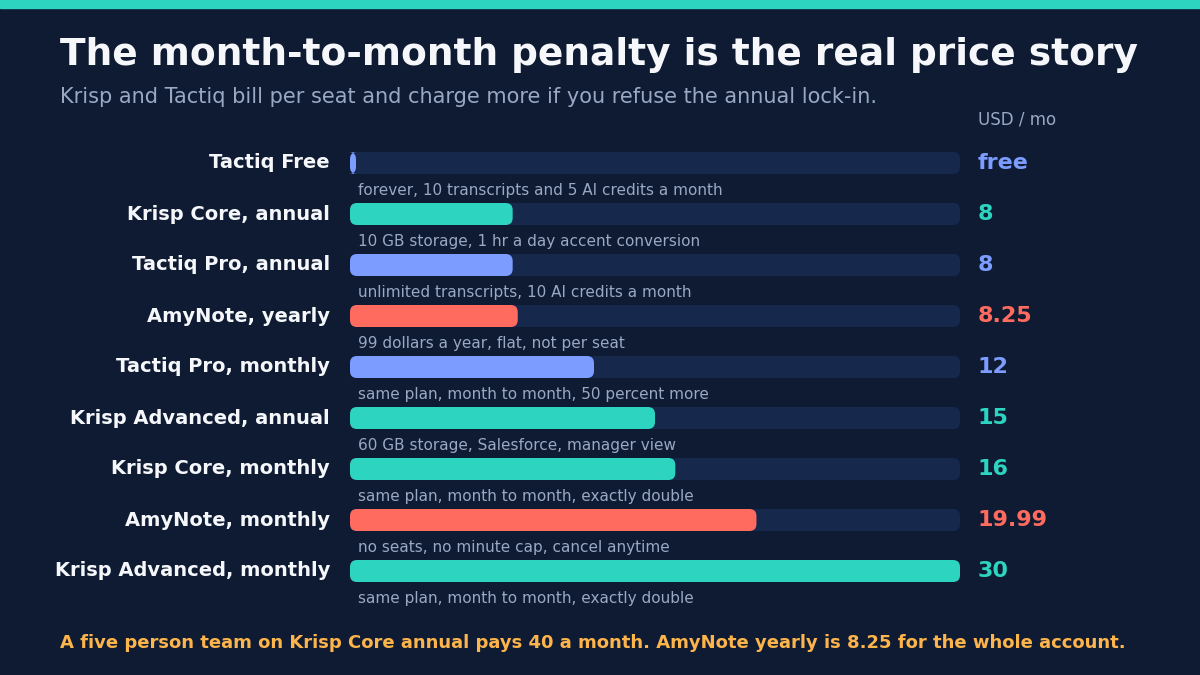
Billing punishes anyone who will not commit to a year: Core is 8 dollars annual and 16 monthly, Advanced is 15 and 30, a straight doubling on both tiers. The free plan is now a 7-day trial, and HIPAA, SSO and SCIM are Enterprise-only.
Tactiq: Strengths and Weaknesses
Strengths. Tactiq has the lowest-friction start of anything here. Install a Chrome extension, join a Google Meet, Zoom or Teams call, and the transcript appears with no bot and no extra attendee in the room. The free plan is genuinely free forever with no credit card, which neither rival offers, and includes 10 transcripts and 5 AI credits a month; Pro at 8 dollars annual removes the transcript cap. Coverage is solid at 60-plus languages, with over a million Chrome installs and 4.8 stars across 3,000-plus reviews.
Weaknesses. Tactiq never records audio or video. It keeps text and only text, so when the transcript garbles a name, a number or a technical term, there is nothing to go back and listen to. For a standup that is fine. For a client call or a supplier negotiation, it is the sharpest single strike against the product — and it is architectural, not a roadmap item.
It is also tethered to the browser. The native Mac app is still beta and handles Zoom desktop calls only; the download page says twice that it cannot yet do Google Meet or Teams. There is no mobile app, so in-person conversations are out of scope entirely.
AI is metered by credits below the Team tier, and at the cap transcription continues while AI pauses until the month resets. The failure mode is worth picturing: a pile of raw transcripts you cannot summarize, arriving in the last week of the month.
AmyNote: Strengths and Weaknesses
Strengths. AmyNote assumes the meeting that matters may not be on a screen. The phone in your pocket is the recorder, so a client lunch or a factory-floor walkthrough is captured the same way a video call is. It transcribes 140-plus languages and translates into 100-plus, with tuning for East Asian and Arabic speech, roughly nine times the reach of Krisp. Speaker identification persists across sessions, so you name someone once and the app recognizes them later. Pricing is a flat 99 dollars a year, with no per-seat charge, no minute caps and no credit meters.
On privacy, both OpenAI and Anthropic contractually guarantee zero training on user data. Audio is encrypted in transit and not retained after processing. Transcripts are stored locally on the device with end-to-end encryption.
Weaknesses, stated plainly. AmyNote is iOS only. No Android, no Windows, no Mac, no browser extension. If your team is on Android or works from a Windows desktop, Krisp is the better answer and it is not close.
There are no CRM integrations, no video recording, and no team controls, SSO or admin console, which rules it out for a centralized rollout. The three-day trial is short next to Tactiq’s permanent free tier, and 10,000-plus downloads is real traction but not a million Chrome installs.
The Month-to-Month Penalty Is the Real Price Story
The headline 8 dollars is an annual-plan number for two of the three, and the gap opens the moment you decline the lock-in.
Krisp Core is 8 annual and 16 monthly — exactly double. Krisp Advanced is 15 and 30, also exactly double. Tactiq Pro is 8 annual and 12 monthly, a 50 percent premium. AmyNote is 8.25 on the yearly plan and 19.99 month to month, with no seats and no minute cap either way.
So the honest comparison depends on a question the pricing page does not ask: how sure are you that you will still be using this in eleven months? If the answer is “very,” the annual numbers are real. If you are trialling three tools this quarter, compare 16, 12 and 19.99 instead, and the ordering shifts.
Side by Side
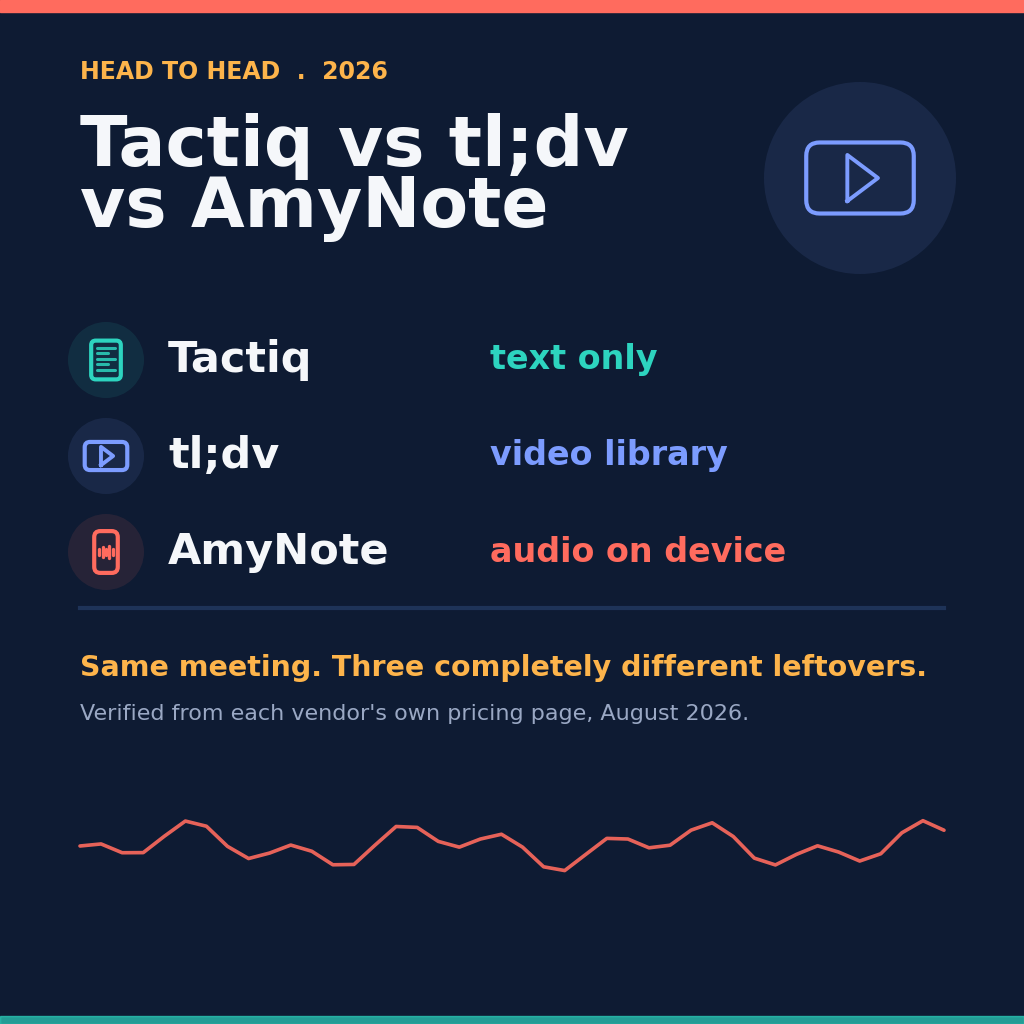
- What survives the meeting. Krisp keeps audio, video and text. Tactiq keeps text only. AmyNote keeps audio and text on the device, and is the only one designed first for in-person meetings.
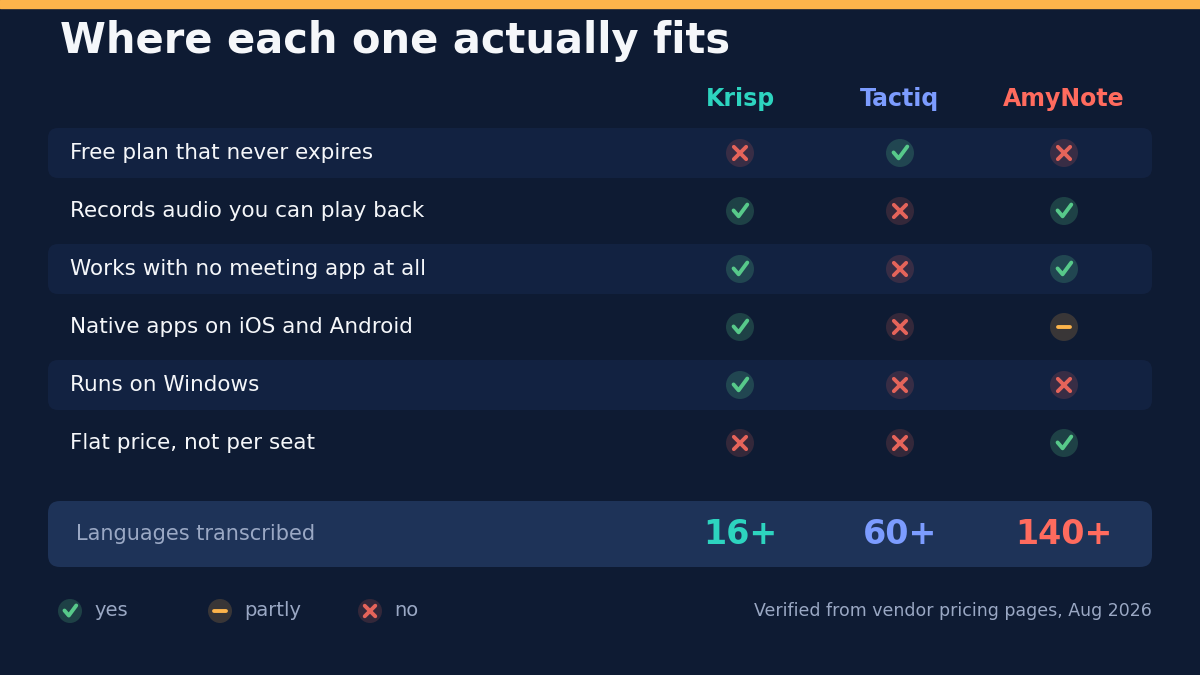
- Free plan that never expires. Tactiq yes. Krisp no, 7-day trial. AmyNote no, 3-day trial.
- Real monthly cost. Krisp Core 8 annual or 16 monthly. Tactiq Pro 8 annual or 12 monthly. AmyNote 8.25 yearly, for the account rather than the seat.
- Languages transcribed. Krisp 16-plus. Tactiq 60-plus. AmyNote 140-plus.
- Runs on Windows. Krisp yes. Tactiq only through the browser. AmyNote no.
- Team and compliance. Krisp has SSO and HIPAA at Enterprise, Tactiq SAML SSO at Business, AmyNote none of it yet.
- Scaling to five people. Krisp and Tactiq both cost 40 a month; AmyNote stays at 8.25 because it does not charge per seat.
Three Teams, Three Answers
The grid reads more clearly as scenarios, with the arithmetic done from the prices above.
A distributed support team on Windows and Android, working from noisy homes. Krisp is the answer before language or price enters the conversation, because it is the only one of the three that runs on both of those platforms at all. Core at 8 a seat annually also fixes the noise problem that made the transcripts unreliable in the first place. Five seats is 40 a month.
A startup that lives in Google Meet and spends nothing. Tactiq Free covers 10 transcripts and 5 AI credits a month, forever, with no card. Nothing joins the call and there is no install beyond a Chrome extension. If nobody ever needs to re-listen to a call, this is the cheapest correct answer in the category, and Pro at 8 removes the transcript cap when the team outgrows it.
A two person consultancy meeting clients in person, in Japanese and English. Krisp is out on languages — its published list does not include Japanese. Tactiq is out on capture, since there is no mobile app and no in-person support. That leaves AmyNote at 8.25 a month for the account, covering 140-plus languages, with the phone as the recorder. The catch is iOS: if either consultant carries an Android phone, this scenario needs a different answer.
The Bottom Line
Krisp is right when audio quality is the bottleneck and your team spans Windows and Android. It is the most complete product here, and the 16-language ceiling is the price of that.
Tactiq is right for browser-based teams who want minimum friction and a free tier that never runs out, as long as you accept that a garbled line is gone for good.
AmyNote is right when the conversations that matter happen away from a screen, when the languages in the room are not on anybody’s short list, and when a flat annual price beats per-seat math. It is iOS only with no team tooling, and if either is a blocker, one of the other two is your answer.
If neither is, the trial at amynote.app runs three days with no limits and no credit card.
Originally published as an X Article by @AmyNoteApp.