A sales lead sits down for coffee with a prospect. No Zoom link, no calendar invite, no bot to send. Thirty minutes later there is a verbal commitment, two objections worth remembering, and a competitor name mentioned exactly once. None of it is written down.
That gap is why bot-free recording stopped being a niche feature in 2026. The category was built around a robot that dials into your video call, which works fine right up until the meeting is a hallway conversation, a client lunch, or a phone call taken in a parking lot.
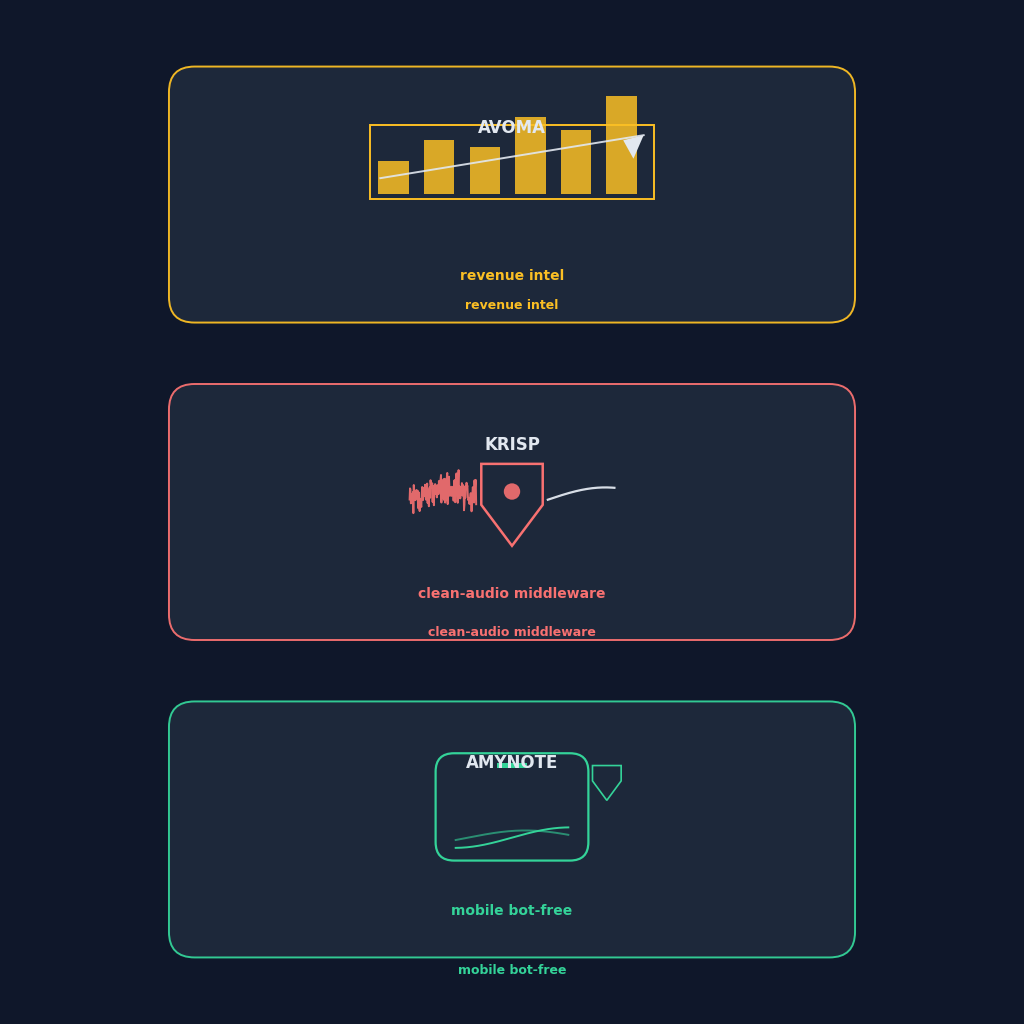
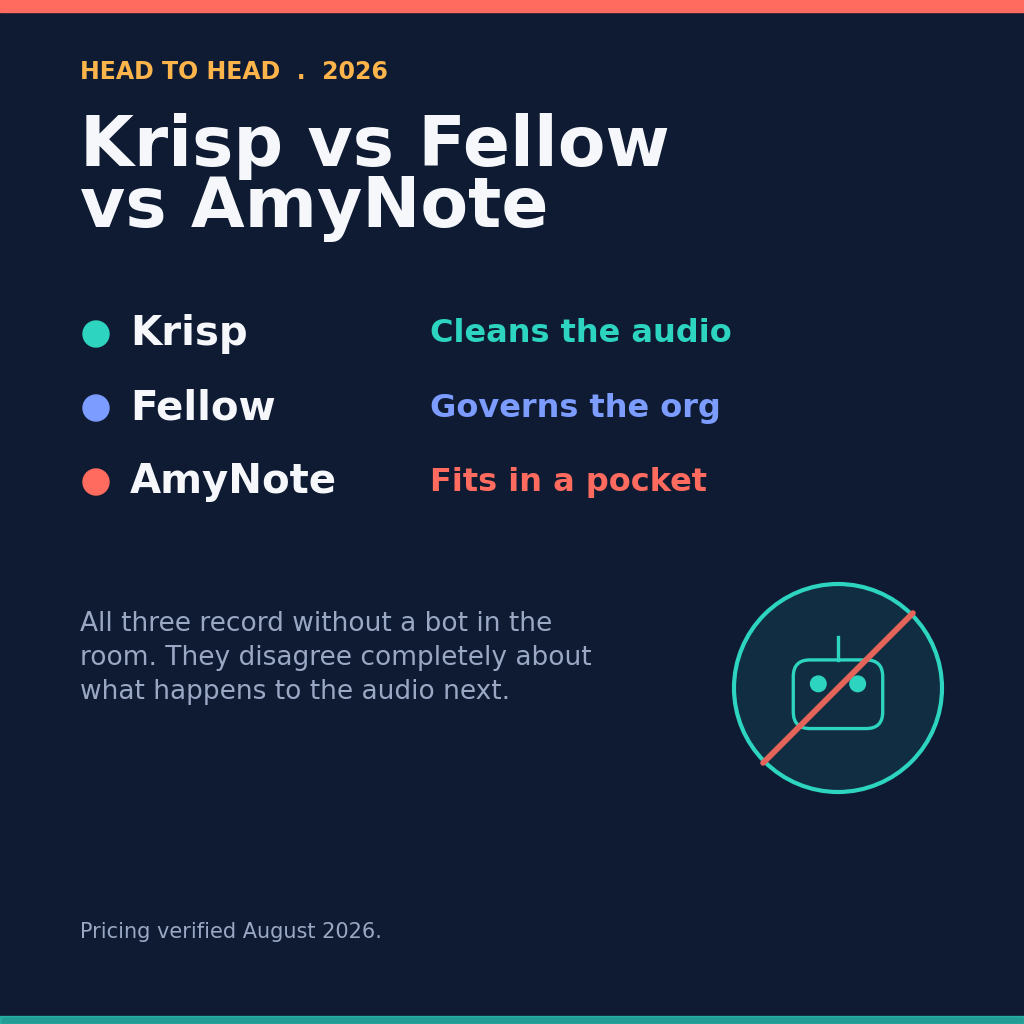
Krisp, Fellow, and AmyNote all capture a conversation without a bot announcing itself to the room. That is the entire extent of their agreement. They disagree completely about what happens to the audio next — and that disagreement, not accuracy, is what you are actually choosing between. All prices below were verified against vendor pricing pages in August 2026.
Quick Verdict
Choose Krisp if bad audio is your actual problem. Noise cancellation is its original product and still its best one, and the AI notes ride on top of a cleaner signal than anyone else starts with. Check the language list before you commit, because it is short.
Choose Fellow if the recording has to satisfy someone other than you. It has the broadest platform coverage of the three and the most complete compliance stack, though the parts you probably want are gated to the expensive tier.
Choose AmyNote if the conversations are in person, multilingual, and yours alone. It is the only one of the three priced per account rather than per seat, and the only one that keeps transcripts on your device. It is also iOS only, which disqualifies it outright for a lot of teams.
What We Compared
Four things that actually change a purchase decision: what bot-free capture includes at each tier, real cost at realistic team sizes, language coverage, and where the transcript ends up sitting when the meeting is over.
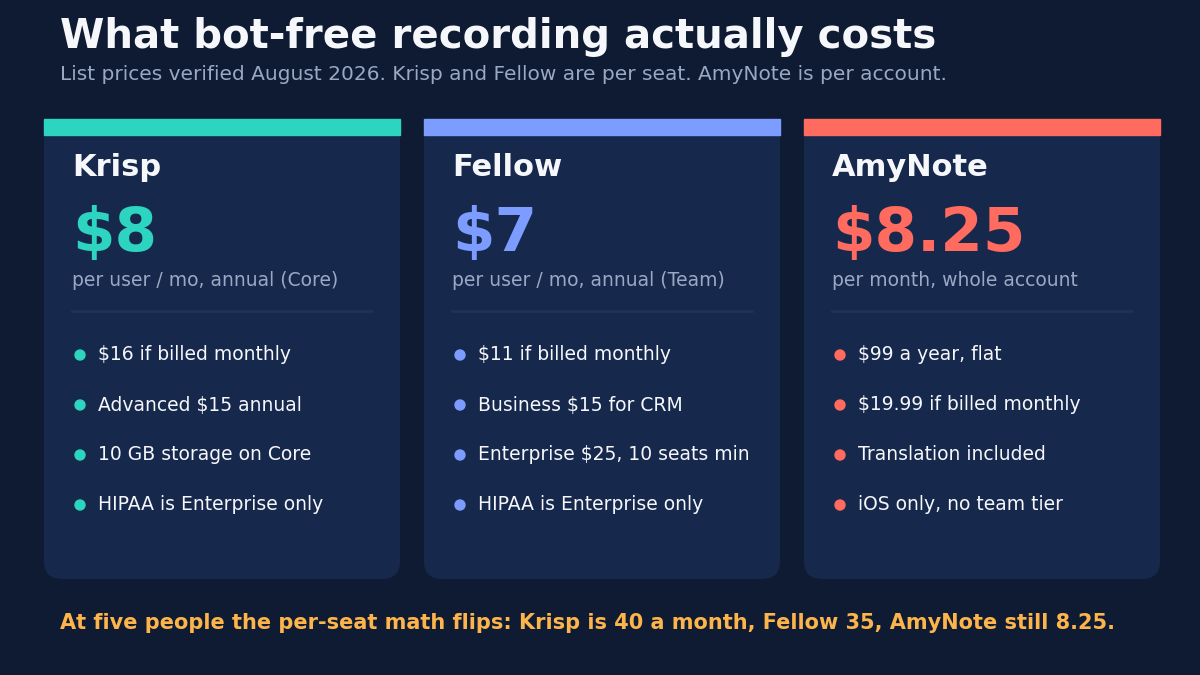
Where annual and monthly billing differ, both are shown, because the gap is large enough to reorder the ranking. Krisp doubles from 8 dollars to 16 when you pay monthly. That is not a rounding difference — it is the whole comparison, inverted, for anyone who cannot commit to a year.
Transcription accuracy is deliberately not on the list. All three sit in a similar band on clean audio, and word error rate is not what anyone regrets six months in. What people regret is a language that turned out not to be supported, a per-seat bill that tripled when two colleagues wanted access, or a transcript sitting in a cloud their legal team never reviewed. Those are structural differences, and structural differences are the ones you cannot fix later.
Krisp: Audio First, Notes Second
Krisp came at this category sideways. It started as AI noise cancellation — the utility running underneath every other call app rather than competing with them — and added the meeting assistant later. That history explains both its strengths and the shape of its gaps.
Strengths. Noise cancellation is best in class, and everything else sits on top of it. This matters more than it sounds, because transcription accuracy is downstream of audio quality: a tool that hears the room better has less to guess at. Krisp records in-person conversations and online calls without a bot, and claims 96 percent accuracy. Core at 8 dollars per user per month annually includes unlimited AI note-taking, custom vocabulary, and integrations with Slack, Notion, Zapier, Teams, and HubSpot. Accent conversion, which nobody else here offers, is included at one hour per day.
Weaknesses. Language coverage is the narrowest here by a wide margin: 17 languages, with no Japanese, Chinese, or Arabic. If your meetings are not in a European language, Krisp is not a candidate, and no amount of audio quality compensates for a language the model does not transcribe. Storage is capped at 10 GB on Core, Salesforce requires Advanced at 15 dollars, and HIPAA and SSO are Enterprise only. Monthly billing is a straight doubling to 16 dollars.
Worth flagging: Krisp's pricing page now leads with a 7-day free trial rather than the perpetual free plan it previously offered. If you are working from a recommendation written before 2026, budget for the paid tier.
Fellow: Built to Be Administered
Fellow is the enterprise answer. It treats recording as a governed activity — something an administrator configures, a policy constrains, and an auditor eventually reviews — rather than as a personal convenience.
Strengths. Fellow offers four recording methods: a note-taker bot, botless desktop recording, Zoom native capture, and mobile recording from the iOS and Android apps. The botless path is the interesting one, because it captures at the device level rather than through a platform integration. That distinction has a practical consequence: it also works for Slack huddles, WhatsApp calls, and FaceTime — conversations no bot has an invitation to. Transcription covers 99 languages. Team is 7 dollars per user per month annually, the cheapest entry point here, and Fellow is SOC 2 Type II certified.
Weaknesses. The free plan is close to unusable: 5 AI notes and 5 AI recordings per user, and those are lifetime allowances, not monthly ones. You will exhaust it in an afternoon of evaluation. Advanced CRM with Salesforce and HubSpot requires Business at 15 dollars. HIPAA, BAA, and single sign-on are Enterprise only at 25 dollars per user with a 10 seat minimum — a floor of 250 dollars a month before anyone has recorded anything, and a steep jump if compliance is the reason you started shopping in the first place.
Price the tier you will actually end up on. Teams routinely evaluate Fellow at 7 dollars and deploy it at 25, because the features that made it the right answer live at the top.
AmyNote: Deliberately Narrow
AmyNote is the narrowest of the three by design. It is a phone app for capturing in-person conversations, and it does not pretend to be a team platform. That is a constraint, not an oversight, and it is worth evaluating it as one.
Strengths. Transcription covers 140 or more languages with translation into 100 or more — the broadest here, and tuned for East Asian and Arabic speech, exactly the coverage Krisp does not have. Pricing is flat per account rather than per seat: 99 dollars a year, or 19.99 monthly, with a 3-day free trial and no credit card. Translation is included rather than sold as an add-on, which is where multilingual comparisons usually go wrong. Speaker identification carries across sessions, so a recurring participant stays labeled instead of resetting to Speaker 1 every time. Semantic search runs across every transcript you have recorded, which is what turns a pile of recordings into something you actually consult.
Weaknesses, stated plainly. AmyNote is iOS only. No Android app, no desktop app, which rules it out for most organizations before any other criterion matters. There are no CRM integrations, no video recording, and no team tier, so no admin console and no SSO. Brand recognition is small next to the other two. If you need a recording your legal department signs off on, Fellow is the answer, not AmyNote.
On privacy. Transcription runs through OpenAI's Speech API and AI analysis is powered by Anthropic's Claude Opus. Both providers contractually guarantee that user data is never used for model training. Audio is encrypted in transit, processed, and not retained on provider servers after processing. Transcripts are stored locally on the device with end-to-end encryption. Krisp and Fellow both store transcripts in the cloud by default — which is the correct architecture for a team that needs shared access and administrative recovery, and the wrong one for a person who would rather the file simply not leave the phone.
What “Free” Actually Means Here
All three advertise something free, and all three mean something different by it. This is the fastest way to lose two weeks of evaluation, so it is worth being precise.
| Tool | What “free” means | What it is good for |
|---|---|---|
| Krisp | 7-day trial of the paid tiers, replacing the older perpetual free plan | One week to test, then you are on a paid plan |
| Fellow | 5 AI notes and 5 AI recordings per user, for the lifetime of the account | An afternoon of evaluation, and then it stops |
| AmyNote | 3 days, full product, no credit card — then one flat price | Testing it against a real, unmodified work week |
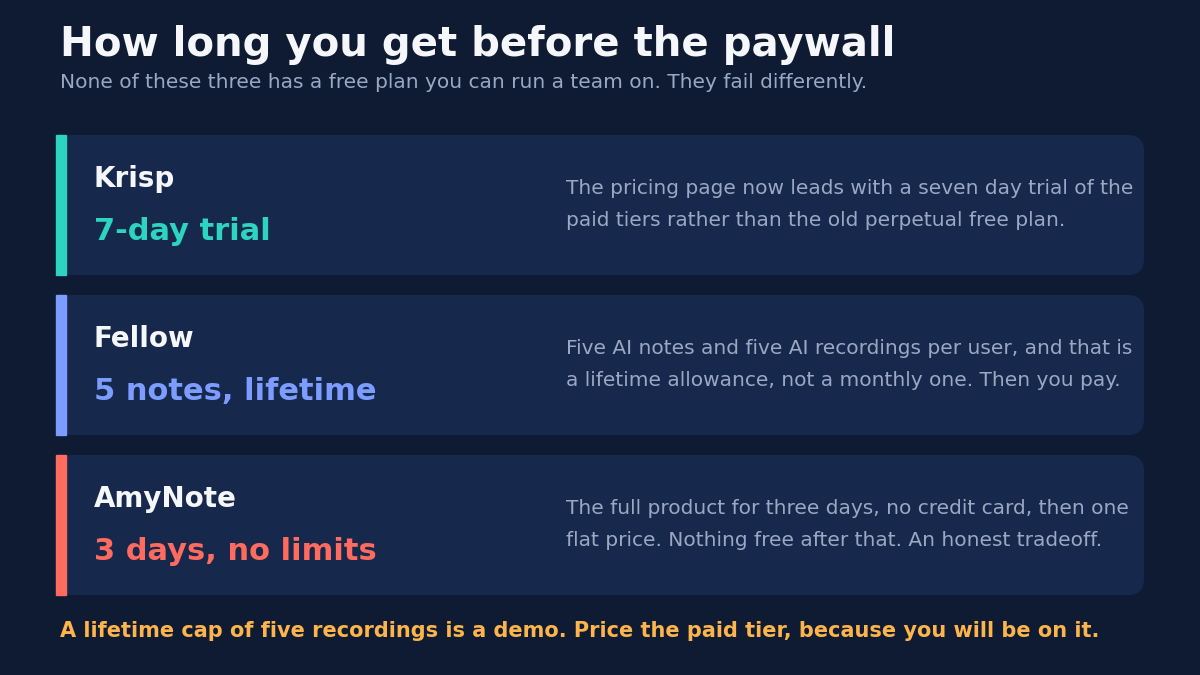
None of these three has a free plan you can run a team on. They just fail differently, and only one of them is structured so that the free period tells you anything about the paid product.
Where the Three Actually Diverge
Strip out the marketing and the differences collapse into a short list of yes-or-no questions. Each of these has eliminated a tool for somebody this month.
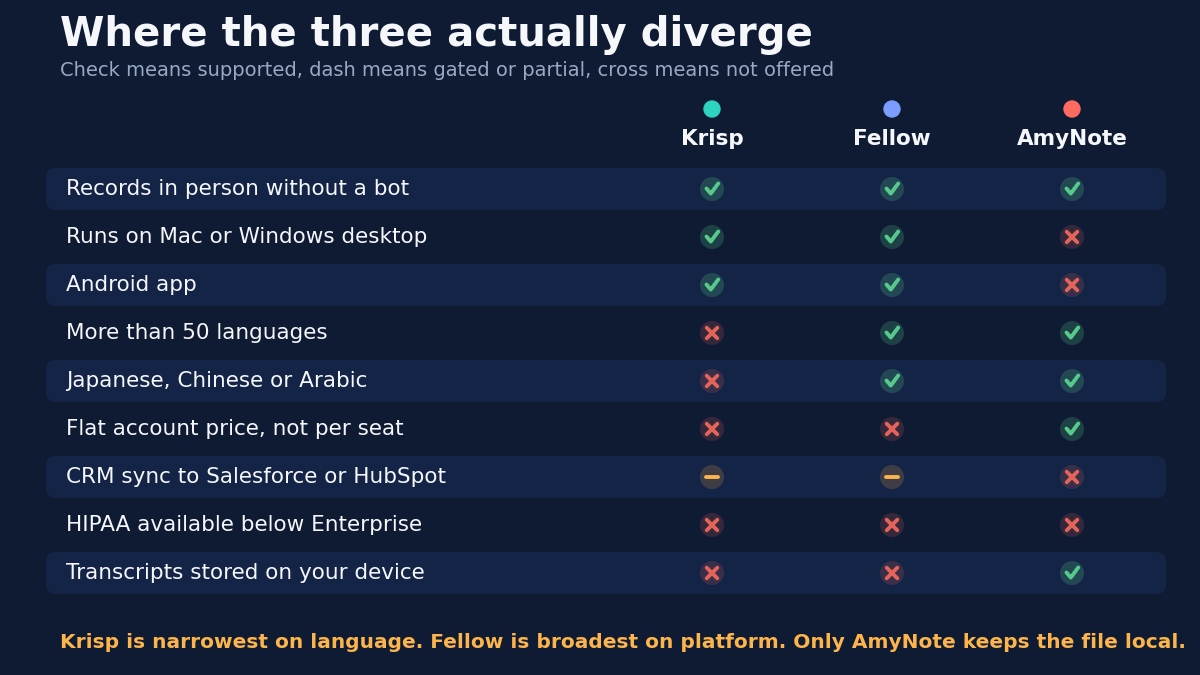
Read that matrix as a set of disqualifiers rather than a scorecard. Nobody buys a note-taker because it checks eleven boxes; they rule out the two that fail the one box that matters to them, and buy whatever is left standing.
Side by Side
- Cheapest entry point. Fellow at 7 dollars per user per month annually, then Krisp at 8, then AmyNote at an effective 8.25 flat.
- Cheapest for five people. AmyNote at 8.25 a month total, against 35 for Fellow and 40 for Krisp. Per-account pricing wins the moment more than one person needs it.
- Language coverage. AmyNote at 140 or more, Fellow at 99, Krisp at 17.
- Bot-free in person. All three — but only Krisp and Fellow have desktop apps.
- Free tier that survives a real week. None of them. Fellow caps at 5 lifetime recordings, Krisp now offers a 7-day trial, AmyNote offers 3 days.
- Compliance. Fellow is the only one with HIPAA and SSO, both Enterprise only at 25 dollars.
- Local transcript storage. AmyNote only.
- Audio quality tooling. Krisp only, and it is not close.
How to Decide in Ten Minutes
Most of this decision collapses into four questions, asked in order. Answer them honestly and the shortlist writes itself before you have opened a single trial.
- What language are the meetings in? If Japanese, Chinese, or Arabic appears anywhere on the list, Krisp is out at question one and nothing further about it matters. This is the single fastest disqualifier here.
- Does anyone other than you have to approve where recordings live? If yes, you are buying Fellow, and you are buying Enterprise. HIPAA and SSO do not exist below that tier, and a tool without them will not clear review no matter how well it performs in a pilot.
- Is anyone on Android or a desktop? If yes, AmyNote is out. It is iOS only, and there is no partial version of that constraint.
- Is the audio itself the problem? Cafes, open floors, bad headsets, a phone on a table between four people. If that is your daily reality and your languages are covered, fix the signal first with Krisp and treat the notes as the bonus.
Whatever survives all four is your answer. Usually only one does.
The Bottom Line
These three are not competing for the same buyer, which is the most useful thing to know before comparing prices. A head-to-head that ranks them on a single axis is measuring the wrong thing.
Krisp is an audio company that added notes. If your recordings are ruined by cafe noise or a bad headset, fix that first and take the notes as a bonus — but check the language list before committing, because 17 languages is a hard wall, not a roadmap item you can wait out.
Fellow is an enterprise platform that added botless capture. Buy it when the recording has to be governed, and price the Enterprise tier honestly, because HIPAA and SSO live there and a 10 seat minimum is a real floor.
AmyNote is a personal tool for multilingual in-person conversation. It wins on language coverage, flat pricing, and keeping the transcript on your own device. It loses immediately if you need Android, a desktop app, or a team console. Those are real constraints, and they are precisely why it costs one flat price instead of a per-seat fee. Three days free at amynote.app, no credit card, no seats to count.
Pick the one whose weaknesses you can live with for the next six months. All three do the bot-free part fine — that was never the hard part of this decision.
Originally published as an X Article by @AmyNoteApp.