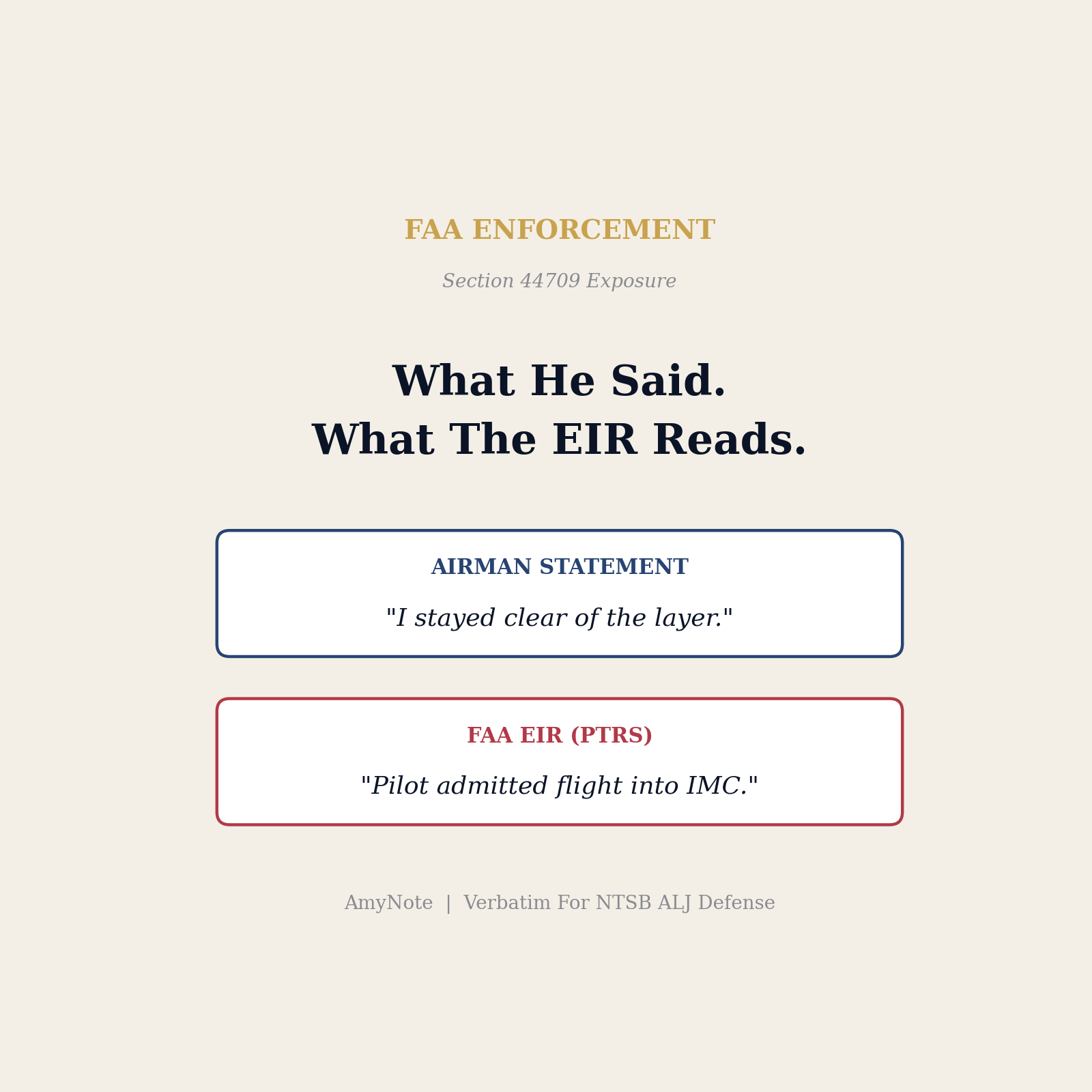
A Part 91 pilot picks up the phone on a Tuesday afternoon. An FAA Aviation Safety Inspector wants to talk about a flight three weeks earlier. The pilot explains, carefully, that he climbed to stay clear of a building cloud deck, never entered the layer, and broke off the approach when visibility dropped below personal minimums. Forty-five minutes of conversation. The inspector types five words into the case file: Pilot admitted flight into IMC.
Eighteen months later, the FAA issues a Notice of Proposed Certificate Action. Not a thirty-day suspension. Emergency Revocation under 49 USC 44709, stripping every certificate the airman holds while the appeal runs. The Notice cites specific statements lifted from the inspector's narrative. The NTSB Administrative Law Judge reads those statements. The airman's attorney reads those statements. The audio, if it exists at all, sits on a regional office drive that nobody opens.
This is not an outlier story. It is the structural shape of how airman enforcement interviews get documented across U.S. general aviation in 2026. The audio is optional. The typed PTRS narrative is the working record. The PTRS narrative is the buried record nobody re-listens to. Defense counsel finds the gap. The gap is the case.
The Problem: Five Words Carry the Case
FAA enforcement begins with an interview. The Aviation Safety Inspector calls the airman, or invites the airman to the Flight Standards District Office, and works through a long series of open-ended questions about altitude, visibility, intent, training currency, equipment configuration, and the chain of decisions that led to the event. Some inspectors record the conversation under 14 CFR Part 13 enforcement and 8900.1 Compliance Action protocols. Most type contemporaneous notes directly into the Program Tracking and Reporting Subsystem or the Safety Management System.
Those notes become the Enforcement Investigative Report. The EIR is the case file. It is what the FSDO manager reads to recommend action. It is what Regional Counsel reads to build a litigation theory. It is what AGC-300 reads when the case escalates. By the time defense counsel sees a copy, the inspector's wording has already framed every downstream decision.
Six to eighteen months later, the FAA issues a Notice of Proposed Certificate Action. The proposed sanction quotes airman statements directly out of the EIR. The NTSB ALJ takes the EIR at face value during pre-hearing motions. The airman's lawyer is left arguing about words the airman cannot prove he never said.
What The Gap Actually Looks Like
The gap rarely shows up as outright fabrication. It shows up as the predictable compression of a forty-five minute conversation into half a page of bullet points typed under deadline.
- Conditional language flattens. The airman says "I believed I was clear of the cloud bases." The EIR types "Pilot admitted IMC encounter." The modifier and the perception caveat both drop. At the NTSB hearing, the difference between believed I was clear and admitted IMC is the difference between an honest decision under instrument conditions and a violation of 91.155 that supports revocation.
- Sequence collapses. The airman describes a sequence: climbed to stay above the layer, requested a higher altitude from ATC, broke off the approach when visibility dropped. The EIR records the outcome (descent, missed approach, off-airport landing) without the decision chain. The chain is what shows airmanship. The outcome alone reads as recklessness.
- The template forces a finding. The PTRS narrative field includes a structured determination that an investigator under workload pressure fills in from impression rather than transcript. Once the typed determination is in PTRS, every downstream FAA reader treats it as fact.
None of this is bad-faith conduct in the moment. It is the predictable output of a system that asks inspectors to be both interrogator and stenographer on the same shift, then files the audio to a drive nobody opens until counsel files a discovery request.
Why Current Solutions Fail
The Pilot Bill of Rights 2 entitles the airman to the Report of Investigation before responding to the Letter of Investigation. The airman gets a paper file. The airman does not get a verbatim transcript of the original interview. The inspector's narrative summary is treated as the authoritative record of what was said.
PTRS narrative fields were designed for inspector productivity and trend reporting, not for litigation under the Federal Aviation Regulations. The inspector compresses a forty-five minute interview into half a page. Hedges drop. Conditional language flattens. "I believed I was clear of the clouds" becomes "Pilot admitted IMC encounter." The compressed sentence then propagates: into the EIR, into the Letter of Investigation, into the Notice of Proposed Certificate Action, into the Order Suspending or Revoking Certificate, and into the FAA's filings at the NTSB.
AOPA Legal Services Plan counsel and dedicated aviation enforcement firms typically receive the case months after the interview, when the inspector's wording has already shaped the FSDO recommendation and the Regional Counsel attorney's litigation theory. By the time defense counsel hears the airman's actual recollection of the call, the file already says something else. Untangling that gap is expensive, slow, and frequently impossible at the ALJ level.
A court reporter at the FSDO costs more than most Part 91 pilots will spend on their entire defense. Stenographic vendors do not contract for short-notice FSDO callouts. Verbatim documentation defaults to: the inspector's typed summary, and nothing else. The airman's only contemporaneous record is the airman's memory, three weeks after the fact, in a phone call where he is also trying to defend himself.
What The NTSB Hearing Actually Turns On
NTSB ALJ hearings on certificate action read the EIR as the agency's contemporaneous record. The airman does not need to prove the inspector lied. The airman needs to show the official narrative does not match the airman's own words at the time. The ASI interview is the single most powerful piece of evidence on that point. It is contemporaneous to the inspector's typed file. It is the airman's own voice. It is the moment the FAA built its case theory.
When the EIR narrative and a verbatim recording diverge, the ALJ does not need to be persuaded the inspector acted in bad faith. The divergence does the work. The EIR is the agency's narrative. The recording is the underwriter of that narrative. An ALJ who reads both, with the gap highlighted, has the predicate to find the FAA's evidence insufficient under the preponderance standard. Emergency Revocation orders fall apart on exactly this pattern.
What Actually Works
Verbatim audio capture at the airman's end of the call, transcribed locally on the airman's device, with every statement that ends up in correspondence cited line by line to the recording.
AmyNote runs Whisper-grade transcription locally on the airman's Mac or iPhone during the FSDO interview, the LOI response prep call with counsel, and any follow-up conversation with the inspector. Speaker diarization separates inspector and airman turn by turn. Anthropic Claude Opus then drafts the LOI response, pulling each factual assertion from a timestamped line in the transcript. When counsel files the response, every claim about what was said cites a specific minute and second of the underlying audio.
When the FAA proposes Emergency Revocation eighteen months later, the airman's counsel files an Answer at the NTSB attaching the verbatim transcript and the audio file. The proposed order cites "Pilot admitted IMC." The transcript shows the actual sentence was "I climbed to stay clear of the layer, I never penetrated it." The ALJ reads both. The FAA's foundational fact collapses. The case for revocation collapses with it. The airman keeps the certificate.
Privacy is non-negotiable for enforcement defense. Both OpenAI and Anthropic contractually guarantee zero training on user data. Audio is encrypted in transit; processing copies may be retained to deliver and recover requested features. Transcripts are stored locally on device with encrypted transport. The recording never sits on a third-party server, never traverses a vendor cloud, and never appears in the FAA's discovery production from a downstream subprocessor. The airman's device is the system of record.
The Documentation Pattern That Holds Up At The NTSB
A defensible airman-interview workflow has four properties.
- The airman has the audio. Recording laws in most U.S. jurisdictions permit a party to record a conversation to which they are a party. The airman should record every FAA conversation with the inspector's consent, and the recording lives on the airman's device, not in any FAA file.
- The transcript is contemporaneous. The transcript is generated within minutes of the call, before memory blurs, and saved with timestamps that match the audio.
- The LOI response is grounded. Every factual assertion in the LOI response, and every later filing at the NTSB, cites the transcript by minute and second. There is no "the airman recalls saying" — there is only "the airman said, at 14:23 of the recording."
- The privacy posture matches the discovery posture. Enforcement defense materials are among the most sensitive documents an airman generates. The transcription pipeline must be contractually zero-training, the audio must not be retained by third parties, and the transcripts must be encrypted at rest on the airman's device.
Airmen who adopt this pattern do not eliminate FAA enforcement actions. They eliminate the specific category of enforcement action that turns on the gap between the EIR and what the airman actually said. That category includes most Emergency Revocations under 49 USC 44709 in the Part 91 and Part 135 space — the category that takes certificates and ends careers.
Getting Started
Open AmyNote on the airman's laptop or phone before the next FSDO call. Record the interview with consent. The transcript writes itself in real time. The LOI response cites every factual claim to a timestamp. When the Notice of Proposed Certificate Action arrives months later, the gap between what the airman said and what the inspector typed is already on the record before the NTSB ALJ ever reads the file.
Certificates live and die in that gap. AmyNote closes it.
Originally published as an X Article.