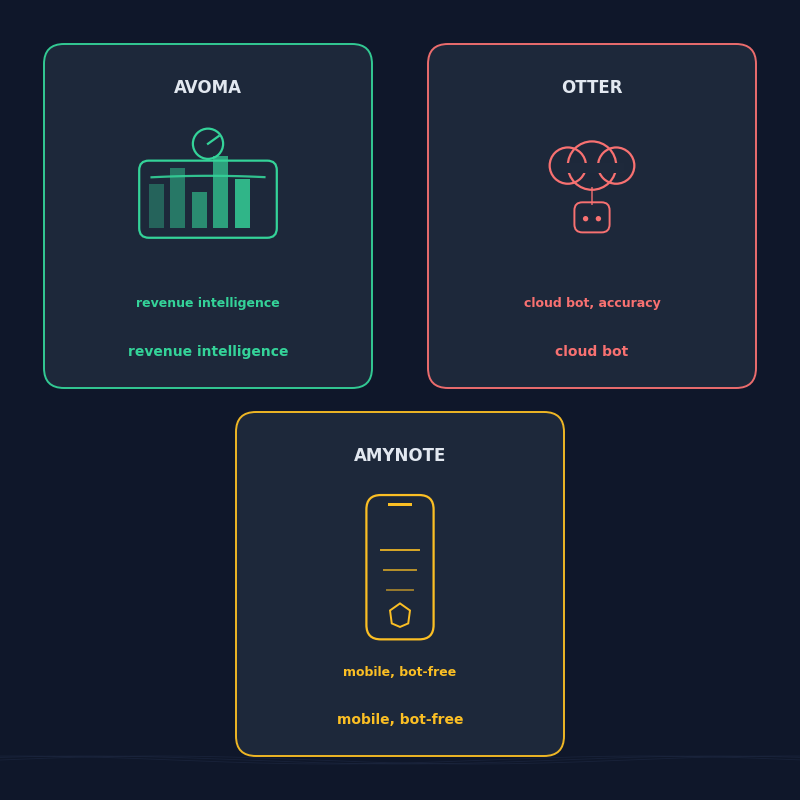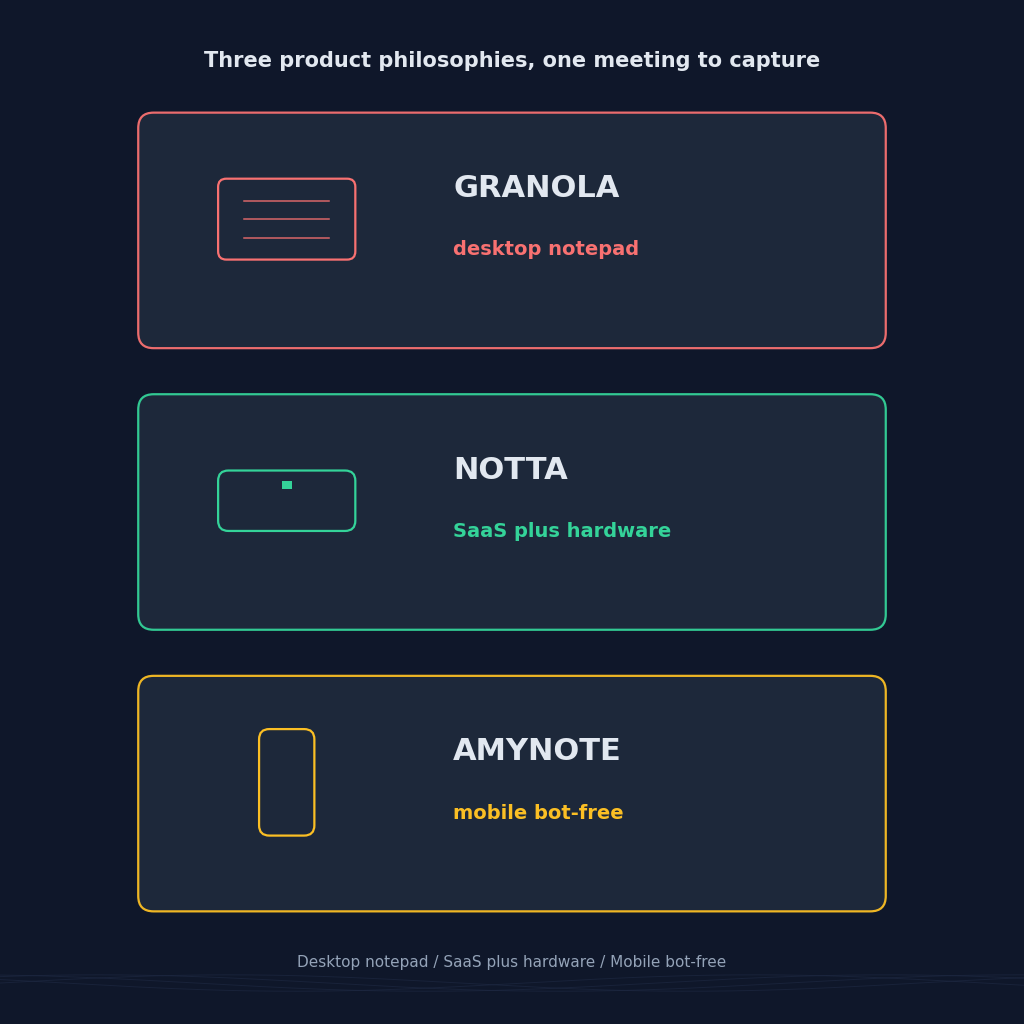
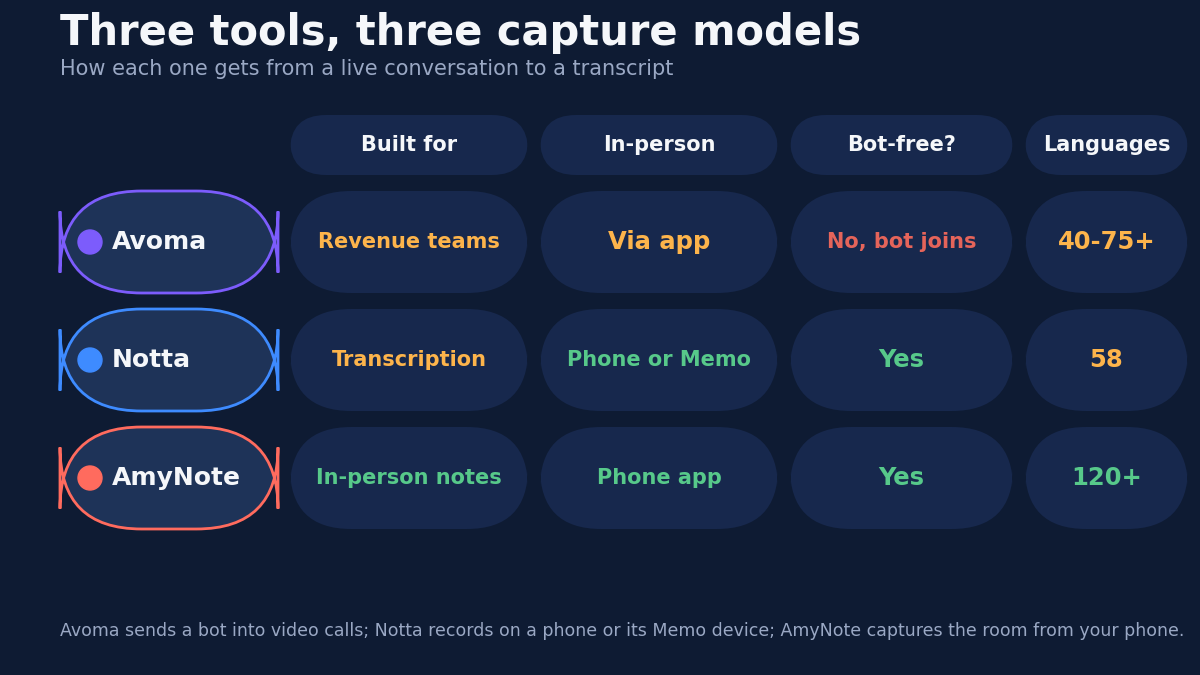
Three tools show up when people search for an AI note-taker, and they could not be more different. Avoma sends a bot into your video calls and turns the transcript into deal coaching for a sales team. Notta records on your phone or a pocket-sized Memo device and hands you a clean transcript in dozens of languages. AmyNote skips the bot and the hardware entirely and captures the conversation from the phone already in your pocket. Same category, three very different bets on how work actually happens. Here is how they compare in 2026, with verified pricing and the fine print each one would rather you skimmed. Every number below was checked against current vendor pages in August 2026.
Quick Verdict
Pick Avoma if you run a sales or revenue team, live inside a CRM, and want call scoring and deal intelligence, not just notes. Pick Notta if you mostly transcribe and you want a cheap, reliable app with an optional hardware recorder. Pick AmyNote if your important conversations happen in a room instead of on a video call, span more than one language, and you do not want a bot announcing itself or a vendor training on what was said.
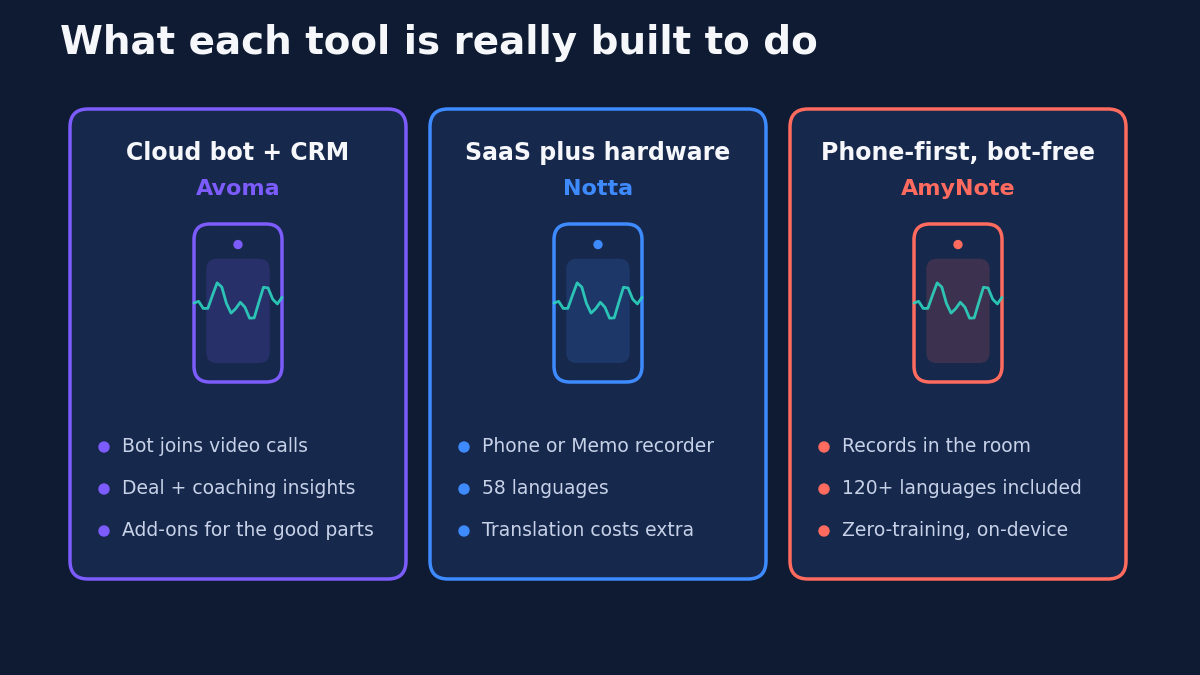
The short version: Avoma is a revenue platform that happens to take notes, Notta is a transcription app with a device add-on, and AmyNote is a bot-free capture tool built for the phone and for privacy. None of them is trying to win the same argument — which is exactly why picking on price alone is how buyers end up disappointed.
What We Compared
All three claim to turn a conversation into usable notes, so the question is not whether they transcribe. It is how they capture, what costs extra, and who touches your data afterward. We looked at capture model, real pricing including add-ons, language coverage, and the data policy each one runs by default. Those four axes decide far more about your daily experience than the marketing feature grid does, because a headline price with the useful features bolted on as paid modules is a different product than it first appears.
Avoma: Strengths and Weaknesses
Avoma is built for revenue teams, and it shows. A bot joins your Zoom, Meet, or Teams call, records it, and then layers on conversation intelligence: call scoring, talk-pattern analysis, objection tracking, and deal-risk signals that sync back to your CRM. For a sales org replacing three separate tools — a recorder, a coaching layer, and a CRM logger — that consolidation is the real pitch, and it is a strong one.
Strengths. Deep CRM automation, smart chapters, follow-up email drafts, and coaching analytics built for managers who need to review a rep's week without sitting through every call. Real-time transcription spans 40 to 75-plus languages depending on the feature. A genuine 14-day free trial with no credit card lets you test it properly, which is rarer in this category than it should be.
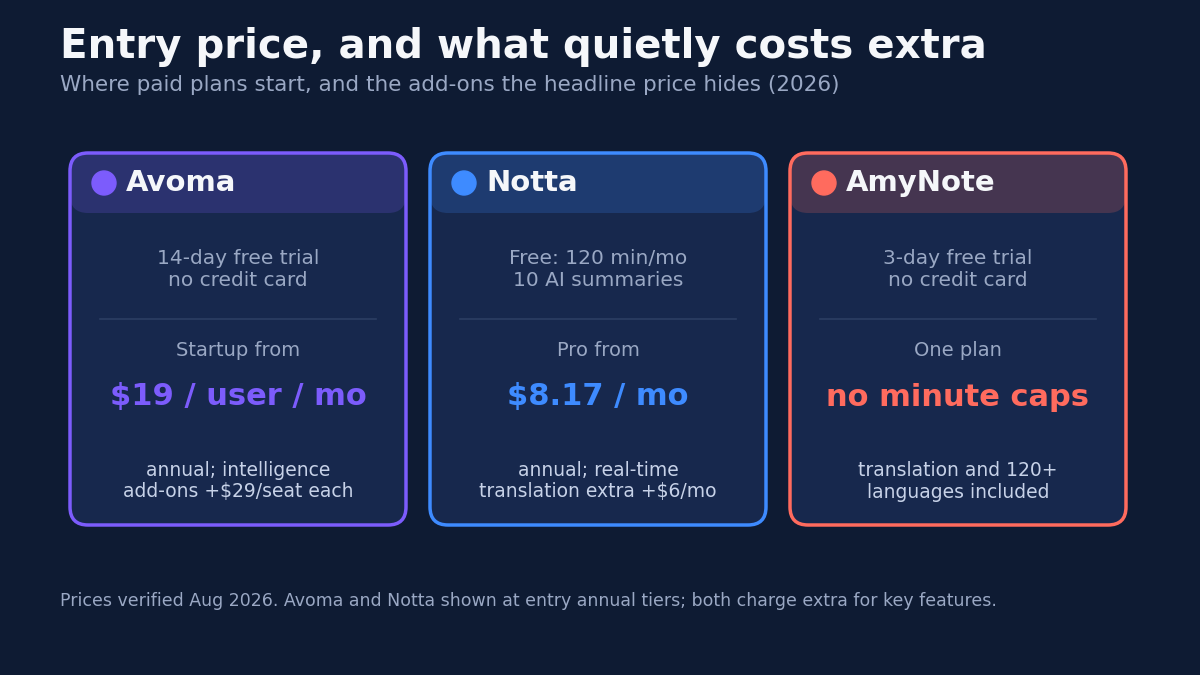
Weaknesses. The headline price hides the good part. Plans start at $19 per user per month on annual billing (Startup), rising to $29 (Organization) and $39 (Enterprise). But the Conversation Intelligence and Revenue Intelligence modules that actually differentiate Avoma are paid add-ons at $29 per seat each, so a fully loaded seat runs about $77 per month. Read the entry price as an opening bid, not the real cost. It is also a bot-based cloud tool: the recorder is visible to everyone on the call, and it is aimed at scheduled video meetings, not the conversation across a table.
Notta: Strengths and Weaknesses
Notta is a transcription-first app that also sells hardware. You can record from the iOS or Android app, upload files, live-transcribe a meeting, or pair the Notta Memo recorder that syncs over Bluetooth. It is the most affordable of the three at the entry tier and a solid pick if transcription is the whole job and you do not need coaching analytics stacked on top.
Strengths. Clean transcripts with speaker diarization, structured AI summaries, and mind-map templates. The Pro plan is $13.99 per month, or $8.17 billed annually, for 1,800 minutes a month and recordings up to five hours. There is a real free tier, and the optional Memo device makes in-person capture more discreet than holding up a phone.
Weaknesses. The free plan is tight: 120 minutes a month, three minutes per conversation, and ten AI summaries — barely a demo. Language coverage is 58 languages, narrower than it sounds against competitors, and the features many buyers actually want — real-time translation and bilingual transcription — are separate add-ons starting at $6 a month. It is a capable transcriber, but the AI analysis is lighter than Avoma's and the privacy posture is standard cloud SaaS: your recordings live in Notta's cloud under its default data policy.
AmyNote: Strengths and Weaknesses
AmyNote takes the opposite path from Avoma. No bot, no hardware to buy, no video call required. You open the app and it captures the room from your phone, which is exactly the situation the other two handle least well: the candid, in-person conversation with nothing to invite and no meeting link.
Strengths. Transcription runs on OpenAI's latest Speech API and the analysis is powered by Anthropic's Claude Opus, so you get structured summaries and semantic search, not just a wall of text. 120-plus languages and real-time translation are included, not sold as an add-on. Cross-session Speaker ID remembers voices from one meeting to the next. And the privacy architecture is the real differentiator: both OpenAI and Anthropic contractually guarantee zero training on user data, audio is encrypted in transit and not retained after processing, and transcripts stay stored locally on your device with end-to-end encryption. The trial is three days, no credit card.
Weaknesses, honestly. AmyNote is mobile-first, so there is no desktop app. It has no CRM integrations, which is where Avoma clearly wins for sales teams. There is no video recording and no team or enterprise tier yet, and it is a smaller brand than the other two. If your workflow is built around scheduled video calls piped into a CRM, Avoma fits better. If you only need a cheap transcriber for solo work, Notta is hard to beat on price. AmyNote does one job — mobile, in-room, multilingual capture — and does not pretend to do the rest.
Side-by-Side
| Avoma | Notta | AmyNote | |
|---|---|---|---|
| Capture model | Bot joins video calls | Phone app or Memo hardware | Bot-free phone capture in the room |
| Best for | Sales & revenue teams | Individual transcription | In-person, multilingual, privacy-sensitive talks |
| Entry price | $19/user/mo (annual) | $8.17/mo (annual Pro) | One plan, no per-minute caps |
| The catch | Intelligence is +$29/seat add-ons (~$77 loaded) | Real-time translation is a +$6 add-on | No desktop, no CRM, no video |
| Languages | 40 to 75-plus | 58 | 120-plus, translation included |
| Data policy | Standard cloud SaaS | Standard cloud SaaS | Zero-training guarantee, local encrypted storage |
Read down the columns and the trade is obvious: Avoma buys you coaching and CRM depth in exchange for cost and a visible bot; Notta buys you cheap, broad transcription in exchange for lighter analysis and a standard cloud data posture; AmyNote buys you in-room reach and privacy in exchange for the desktop, CRM, and video features it simply does not have.
The Bottom Line
These three tools answer three different questions. If the question is "how do I coach my sales team off their calls," Avoma is the answer, as long as you budget for the add-ons that make it worth having. If the question is "what is the cheapest reliable way to transcribe," Notta wins, provided you do not need heavy analysis or included translation.
But if the question is "how do I capture the real conversation — the one in a room, in whatever language it happens in, without a bot in the way and without a vendor training on it," that is the exact shape AmyNote at amynote.app was built for. No hardware to carry, no bot to invite, nothing left behind in someone else's cloud — and the 3-day trial with no credit card makes the test cheap.
Originally published as an X Article by @AmyNoteApp.