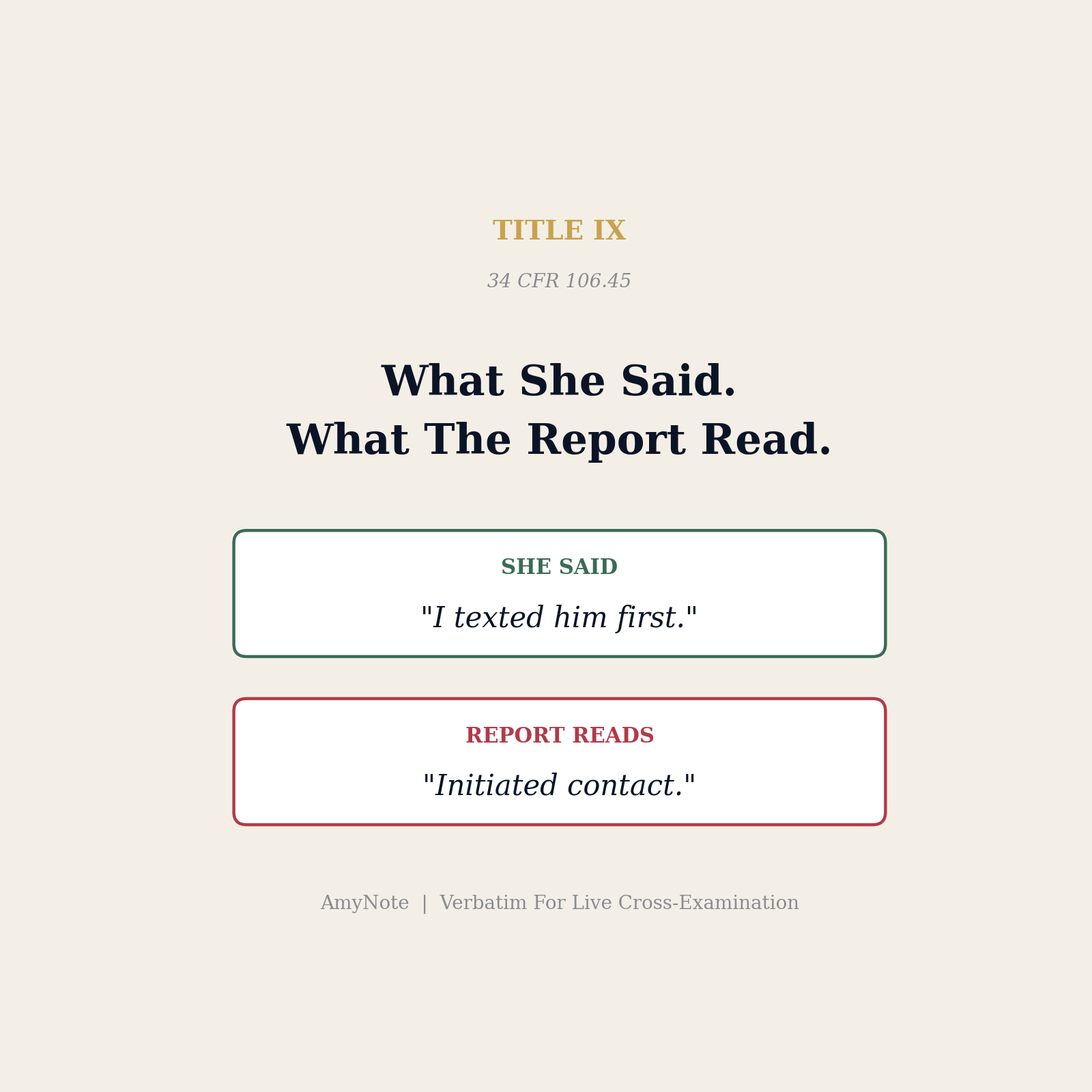
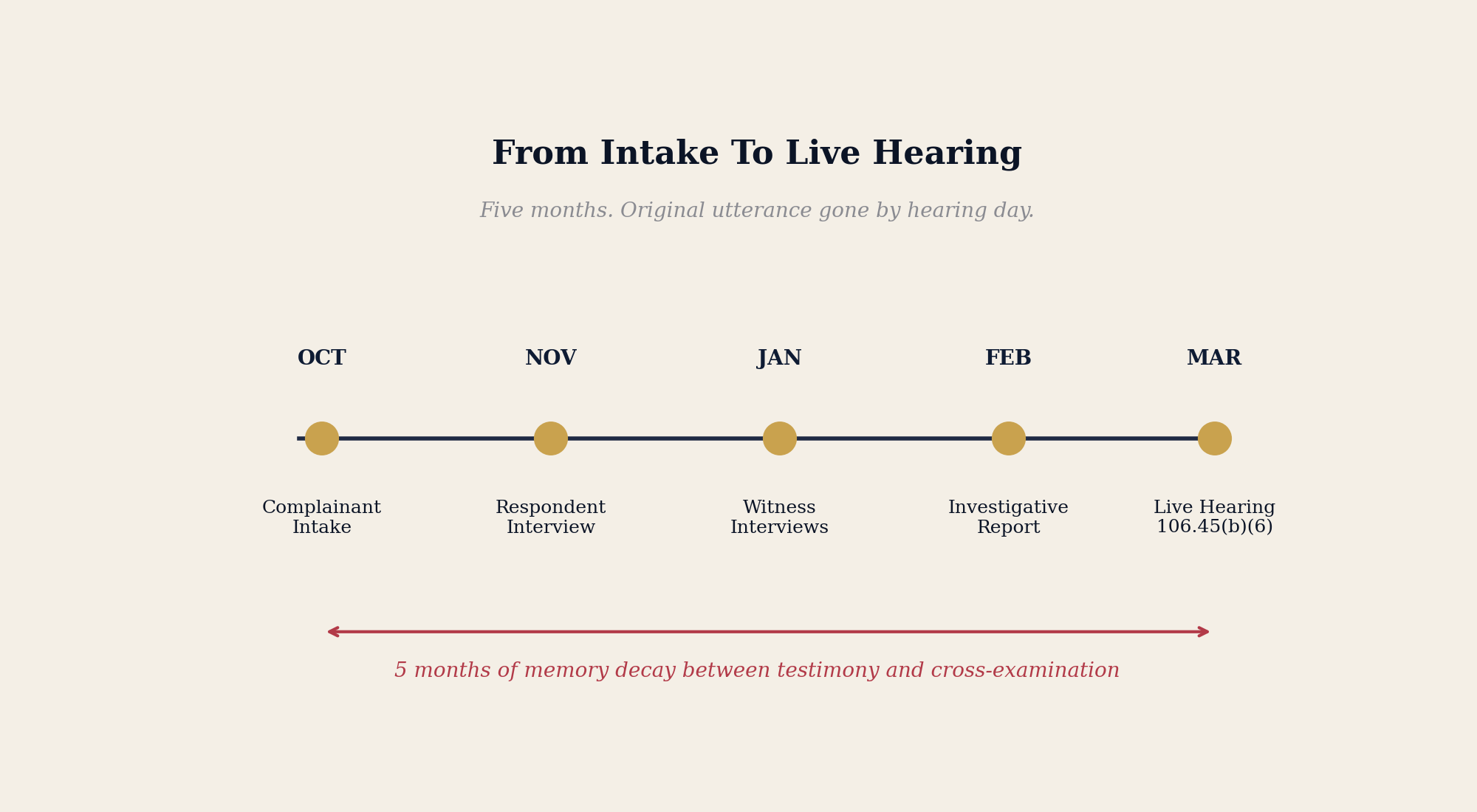
A Title IX investigator interviews the complainant in October. She types out summary notes that night. The investigative report goes out in February. At the live hearing in March, the respondent's advisor tries to cross-examine on the words "I texted him first." The investigator does not have them. She has a paraphrase. The decision-maker rules preponderance against the respondent. OCR reverses on appeal because the report failed the accurate summary standard under 34 CFR 106.45(b)(5)(vii). The institution reopens the process, the parties relive five months of interviews, and the investigator's career gets one more footnote that lives in every retainer conversation going forward.
The Problem
Title IX coordinators and investigators conduct party and witness interviews under 34 CFR 106.45(b)(5). Those interviews feed the investigative report required by 106.45(b)(5)(vii), which must "fairly summarize relevant evidence." That report becomes the spine of the live hearing under 106.45(b)(6), where each party's advisor conducts real-time cross-examination. The decision-maker reads the report before the hearing. The advisors read it. Both parties read it. By the time anyone walks into the hearing room, the report has already framed the case.
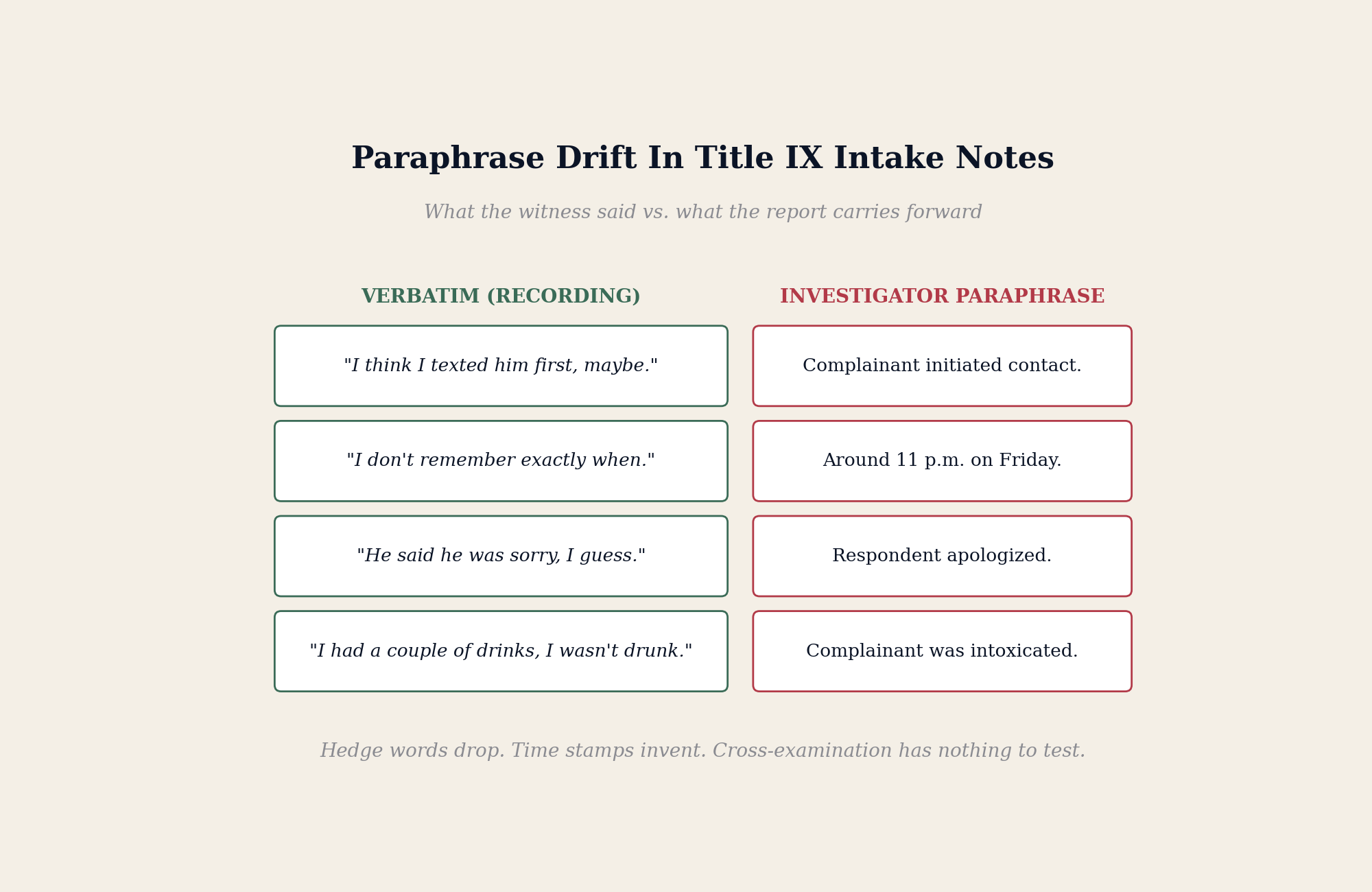
Most investigators take notes by hand or type into a Word doc while listening. They paraphrase. They reorder. They drop hedge words like "I think," "maybe," "I don't remember exactly." Two months later when the hearing convenes, the original utterance is gone. The advisor asks "did you say you texted him first" and the investigator answers from a summary that already smoothed the language. Cross-examination collapses because there is nothing to cross-examine against — only a tidied second draft of what the complainant actually said.
Under the 2024 final rule revisions and the 2020 baseline still operative at most institutions, the burden of producing evidence sits squarely on the recipient. Paraphrased intake notes do not satisfy it. The 2024 rule reinforces the requirement that parties have equal access to evidence directly related to the allegations and a meaningful opportunity to inspect it. A summary that omits the verbatim phrasing of a key statement deprives the respondent of that opportunity — not because the investigator acted in bad faith, but because the artifact is structurally incomplete.
Why Current Solutions Fail
Audio recording is allowed by most institutional procedures but is rarely processed into anything usable. The investigator records on a phone, files the MP3 to a shared drive, and types a summary anyway. Nobody transcribes. At the hearing the recording exists in theory but is not paginated, not timestamped, and not searchable. The advisor cannot point to a line and ask the witness to confirm. The decision-maker cannot scroll to the moment in question. The recording sits in the case file as a placeholder, the way an unwatched body-camera video sits in a police evidence locker — present, but not in the room when the decision is made.
Outsourced transcription is too slow and too expensive for the volume. A mid-size university runs 30 to 80 formal investigations per year. Per-hour transcription at $1.50 to $3.00 per minute does not scale. A two-hour intake interview costs $180 to $360, and a typical matter involves four to seven interviews. Multiply that by the docket and the institution is looking at $30,000 to $120,000 a year in transcription line items that have no budget line. The Title IX office requests it, the General Counsel approves it occasionally for the highest-stakes matters, and everything else moves forward on paraphrase.
Hand notes are fast enough for procedural questions but fail on the verbatim quote. The note "complainant said she contacted the respondent first" is useful for sequencing. The note that captures the complainant's actual phrasing — "I texted him first, I think on the Wednesday, but it was just to ask about the reading" — is the one that survives cross-examination, because it carries the hedge ("I think"), the temporal qualifier ("on the Wednesday"), and the contextual framing ("just to ask about the reading") that the paraphrase erases. The first note paraphrases. The second note quotes. Only the second one holds when the advisor tests it.
What Actually Works
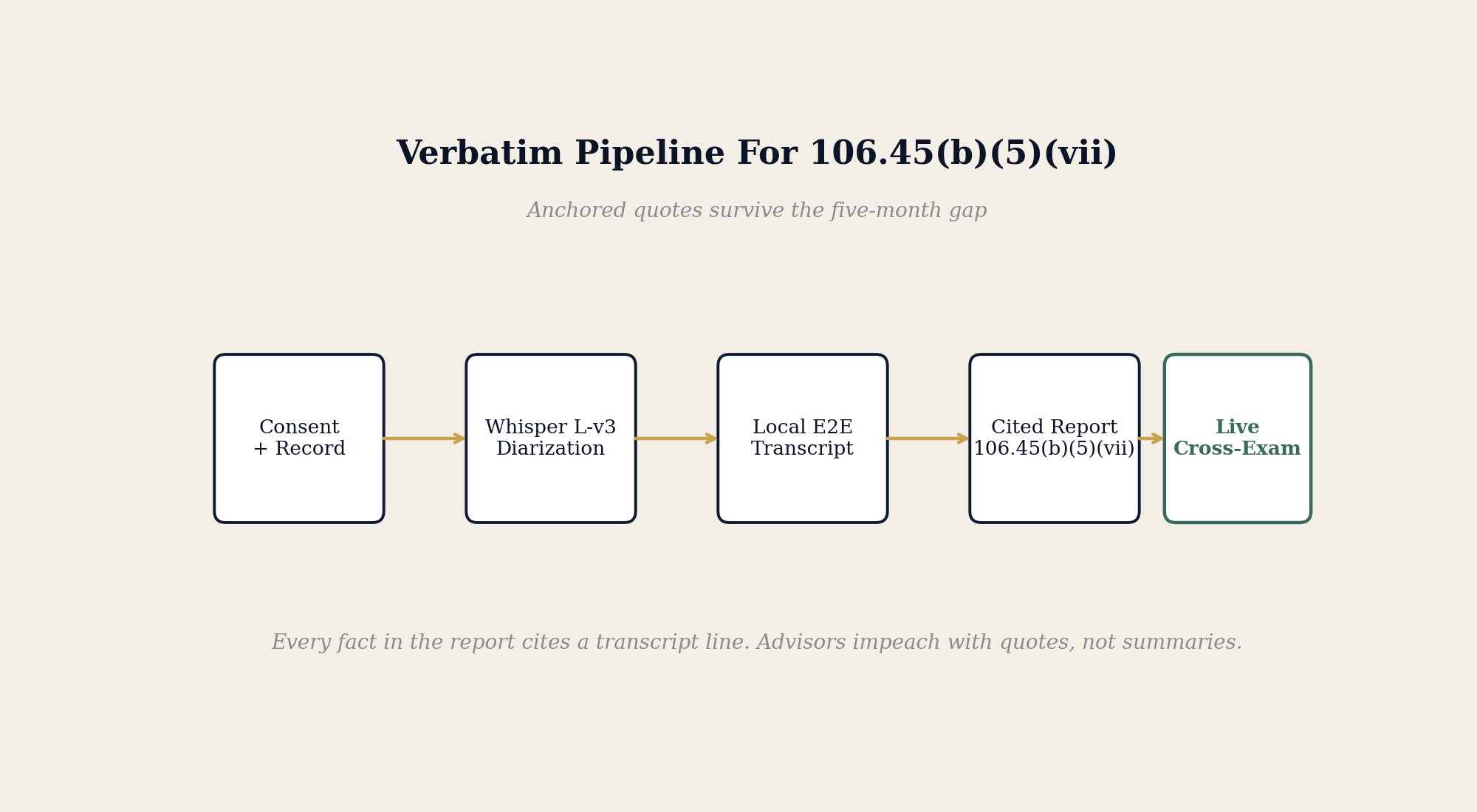
The investigator records the interview in the room with party consent, and an on-device speech model transcribes verbatim in real time. Every "um," every "I think," every "first" or "after" is preserved with a timestamp. Speaker labels separate complainant, investigator, and advisor. When the investigator drafts the report under 106.45(b)(5)(vii), the fairly summarize language is anchored to specific quoted lines. At hearing, the decision-maker and advisors work from the same verbatim record. The cross-examination question "did you say you texted him first" stops being a memory test and becomes a citation check — the transcript line is on the page, the timestamp is on the record, and the witness either confirms, qualifies, or recants in front of everyone.
AmyNote runs the audio pipeline through Whisper Large v3 with diarization, and the language model summary through GPT-4.1 or Claude Sonnet 4.6. Both OpenAI and Anthropic contractually guarantee zero training on user data. Audio is encrypted in transit; processing copies may be retained to deliver and recover requested features. Transcripts stored locally on device with encrypted transport. That last sentence is what gets AmyNote past the data-handling clauses in most institutional Title IX procedures, which forbid retention of party statements by third-party processors and require that recordings and transcripts live inside the recipient's custody.
The summary the investigator submits to the Title IX coordinator cites every factual assertion back to a transcript line. When the respondent's advisor cross-examines at the 106.45(b)(6) hearing, the inconsistent statement is on the page. The decision-maker can make the credibility call on the record, not on the investigator's memory of what was said five months ago.
What Survives Until the Hearing
The five months between the October intake and the March hearing look different when the verbatim survives. The investigator closes the laptop at the end of intake, and the transcript is already attached to the case file with the speaker labels in place. The Sunday-night session that used to consume three hours of memory archaeology — re-listening to the phone recording, reconstructing the sequence, drafting the summary from scratch — becomes a forty-five-minute review pass with the verbatim already on the screen. The investigator moves the case forward instead of reconstructing it.
When the report goes to the parties for the ten-day inspection window under 106.45(b)(5)(vi), each quoted statement carries a line citation back to the transcript. The respondent's advisor can verify the quote in context before the hearing. The complainant's advisor can flag any selective quotation. The pre-hearing disputes that used to arrive on day nine — "the report says my client initiated contact but the audio shows she said she texted him about the reading" — get raised on day three, resolved in writing, and never become hearing-room arguments. The hearing itself is shorter because the cross-examination is targeted.
The Credibility Determination Becomes Defensible
The most underrated artifact in a Title IX matter is the credibility determination. Under 106.45(b)(7)(ii)(B), the decision-maker's written determination must include a description of the rationale for the result as to each allegation. When two parties tell different versions of the same evening, the decision-maker has to explain why one version was credited over the other. "Inconsistency between the party's hearing testimony and her earlier statement to the investigator" is a defensible reason — but only if the earlier statement exists in the record as words rather than as the investigator's paraphrase. With verbatim transcripts, the inconsistency is line A versus line B. Without them, it is the investigator's recollection of line A versus the witness's testimony of line B, and the appeal will not survive the OCR review.
Searchable verbatim across all the interviews in the case turns this from an art into a procedure. The investigator who used to be selective about which interviews she requested transcripts for now treats the on-device transcript as the baseline product of every party and witness conversation, with the structured report as a downstream artifact rather than the primary record.
Getting Started
Open AmyNote at the start of the intake interview. Confirm party consent on the audio. Let it run. Draft the 106.45(b)(5)(vii) report directly from the verbatim transcript, with each factual assertion cited to a line. Hand the decision-maker something cross-examination can actually test, and hand the appeals office something OCR will not reverse on.
One investigation at a time, the practice changes from reconstruction to retrieval. The verbatim survives the five-month gap. The credibility determination is defensible. The respondent's advisor cross-examines from the same record the investigator drafted from. Try AmyNote free at amynote.app — 3-day trial, no credit card, processing copies may be retained to deliver and recover requested features.
Originally published as an X Article: She Said "I Texted Him First." The Title IX Report Reads "Initiated Contact." on X.