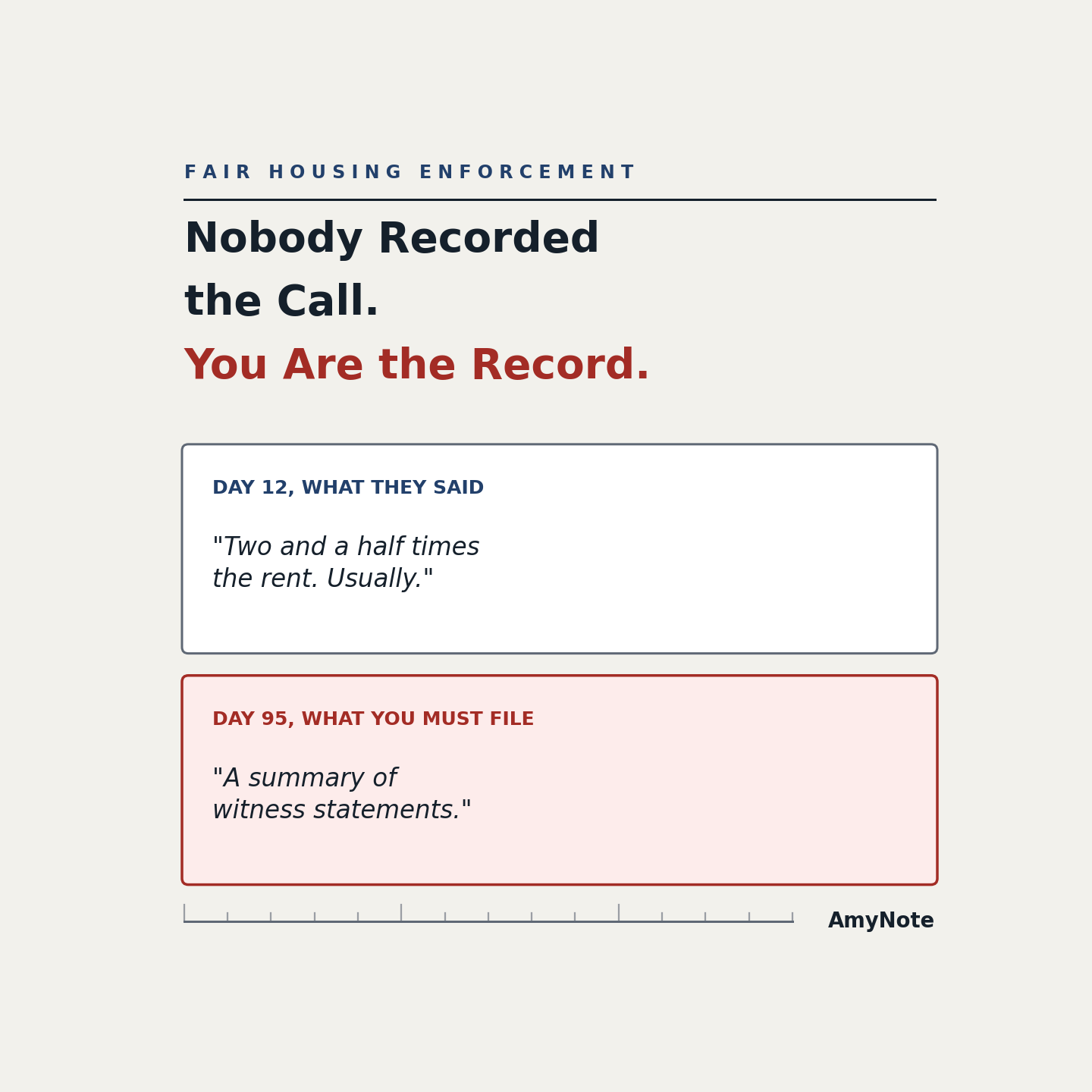
A fair housing complaint comes in, and you reach the leasing agent by phone during the second week. Nobody has told them to be careful yet. For twenty minutes they talk freely about how they screen applicants — the income multiple they use, the exceptions they make, who signs off on those exceptions, and when the policy last changed.
It is the most useful conversation in the file. It is also, at that moment, the least protected one.
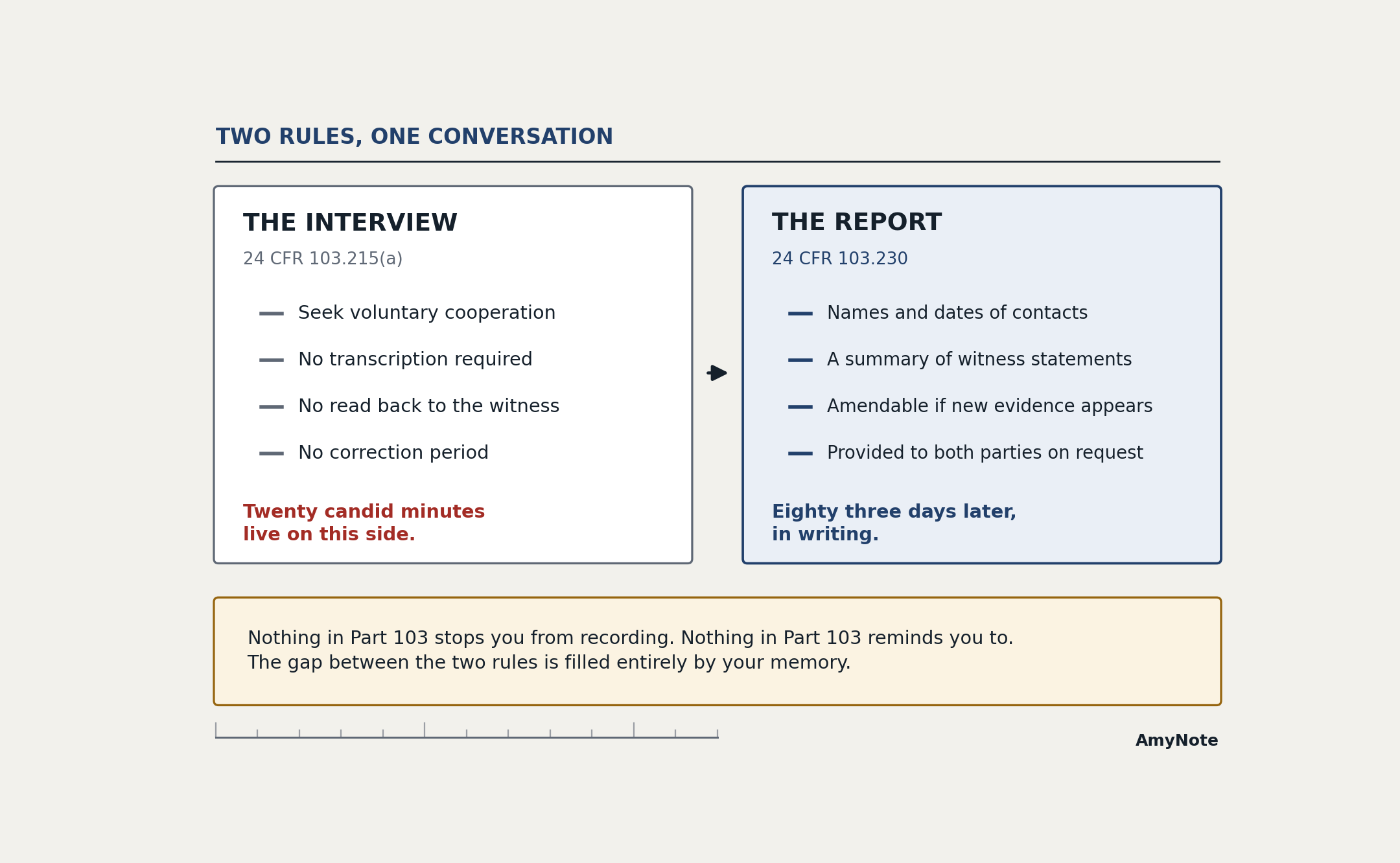
Eighty three days later you sit down to write the final investigative report. Under 24 CFR 103.230(a)(4) it must contain “a summary of witness statements,” and under 103.230(c) the respondent gets to read it. The twenty minutes you spent on day 12 have to survive that trip, and the only vehicle they have is your memory of them.
Two Rules Govern the Same Conversation, and They Do Not Match
The rule that governs the interview asks for almost nothing. Section 103.215(a) says you will seek voluntary cooperation to “take and record testimony or statements of persons reasonably necessary for the furtherance of the investigation.” That is the entire instruction. No transcription requirement. No read back. No correction period for the witness. Nothing that produces an artifact anyone can check later.
The rule that governs the output asks for considerably more. The final investigative report must contain the names and dates of contacts with witnesses under 103.230(a)(1), and a summary of witness statements under (a)(4). That summary is not a working note. It is the official version of what the witness said, and it goes into a document both parties can read.
So the statement becomes whatever you wrote down. There is no underlying recording sitting behind it, no transcript to check the paraphrase against, and no moment where the witness confirmed that your rendering matched their meaning. The gap between what Part 103 requires of the interview and what it requires of the report is filled entirely by one person’s recall.
Eighty Three Days Is a Long Time to Hold a Sentence
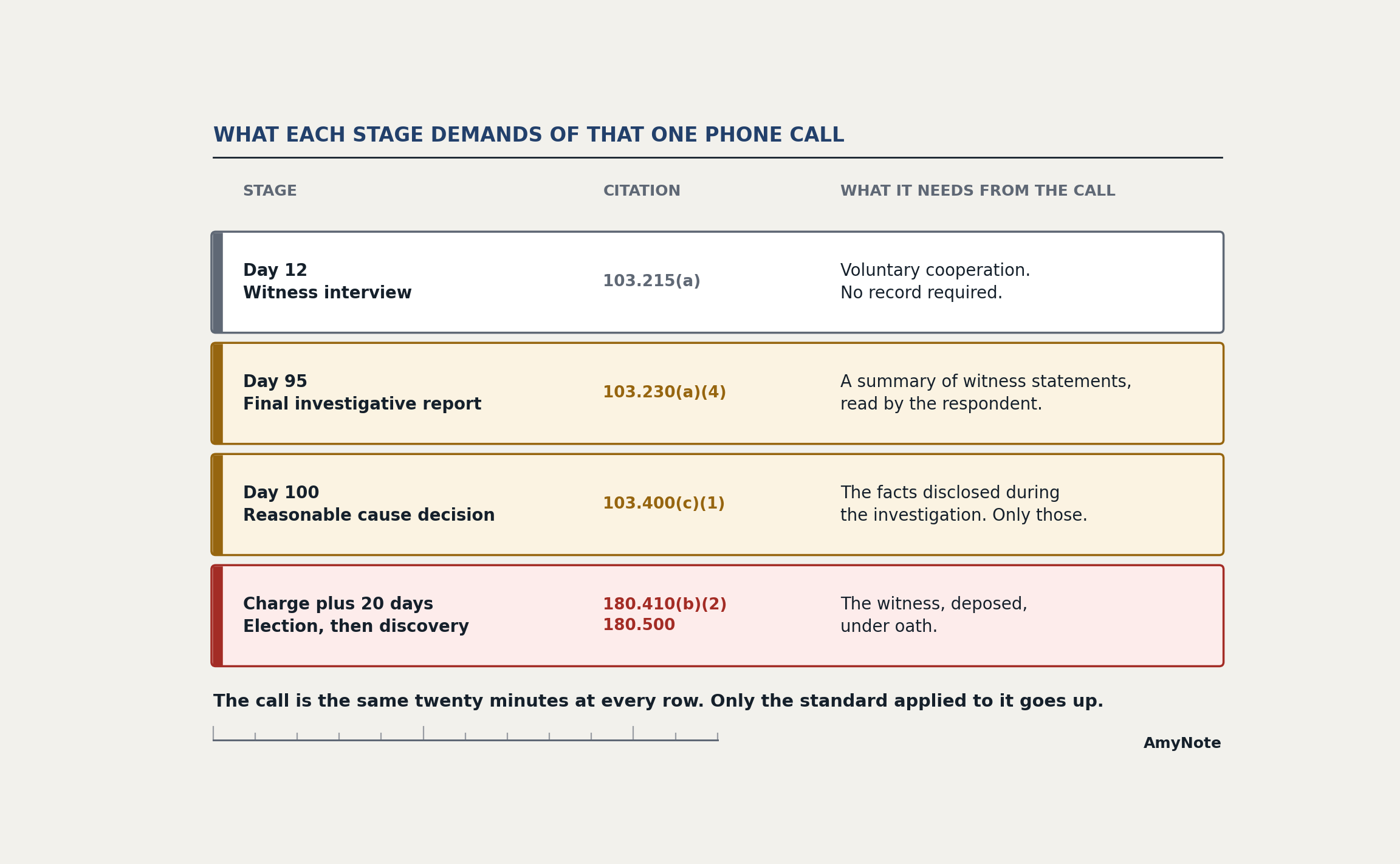
The clock is not generous. Section 103.225 gives you 100 days to complete the investigation, and 103.400(c)(1) sets the same 100 days for the reasonable cause determination. Miss either deadline and you owe both parties a mailed explanation of the delay. Between the day 12 phone call and the day 95 report sit eighty three days of other complaints, other interviews, and other files with their own 100 day clocks running.
What has to survive that stretch is not the gist of the conversation. It is a distinction fine enough to decide the case.
Consider two versions of the same answer. “We require two and a half times the rent” describes a uniform standard applied to everyone. “We require that from applicants we are not sure about” describes a discretionary standard applied selectively — which is a very different fact, and possibly the entire complaint. Both sentences take about two seconds to say. Eighty three days later, the difference between them is a coin flip against your own recollection.
Nothing about that risk reflects poorly on the investigator. It is what human memory does with a twenty minute conversation held under time pressure among dozens of others. The problem is structural, and it has a structural fix.
Your File Logs Every Contact Except the Content
You already capture everything the rule names. The date of the call. The name of the witness. Documents requested and documents received. Answers to interrogatories. Dates of correspondence with both sides. A well kept FHEO or FHAP file is a meticulous record of process.
Each of those entries records that a conversation happened. None of them records what was in it.
That asymmetry would matter less if the summary stayed with you. It does not. Two things happen to it that the investigator does not control:
- Under 103.300(c), someone else may negotiate from your paraphrase. The staff who investigate a complaint generally do not conciliate it. A different person opens your file and works from your sentence about the leasing agent, without ever having heard the leasing agent.
- Under 103.230(c), the report goes to both sides. The aggrieved person and the respondent both receive it. Your one sentence about screening criteria is read closely by the respondent’s attorney, who will compare it against what their own client remembers saying.
A paraphrase written for your own use is being asked to do work it was never built for: to brief a colleague who was not there, and to withstand adversarial reading by counsel.
The Conciliation Line You Cannot Prove You Crossed
There is a quieter trap in 103.330(a). Nothing said or done in the course of conciliation may be used as evidence without written consent. And 103.300(c) expressly contemplates an investigator suspending fact finding to explore resolution — which is often the right instinct when a call is going well and the respondent sounds open to fixing the problem.
The line between the two modes is real, but it is invisible in the moment. A single phone call can start as fact finding, drift into a discussion of what a resolution might look like, and drift back. If nothing marks where that happened, you cannot demonstrate afterward which half of the conversation is evidence and which half is protected. That is not a memory problem you can solve by writing faster afterward. It is a timestamp problem, and only a contemporaneous record solves it.
Capture It on the Terms the Hearing Will Demand
Nothing in Part 103 stops you from recording an interview. Say that you are recording, note the consent in the file, and follow your jurisdiction’s consent law and your agency’s own policy. Done that way, recording is not an aggressive step. It is doing early what the litigation stage takes entirely for granted.
And the litigation stage is genuinely coming. If a charge issues, any party has 20 days under 24 CFR 180.410(b)(2) to elect federal court instead of an administrative hearing. Either path brings discovery, and 180.500 puts depositions on the table. The leasing agent you called on day 12 will be asked, under oath and with counsel present, what they told you. At that point the question stops being whether your summary was reasonable and becomes whether it was accurate.
AmyNote runs on the phone already in the investigator’s hand. No meeting bot joins the call, so nothing external is invited into a civil rights complaint file, and it behaves the same on a site visit or a walk through a leasing office as it does on a conference line. It captures the audio, transcribes with OpenAI’s Speech API, and runs the analysis through Anthropic’s Claude models to surface the answers that map to your elements: the stated policy, the exception, who authorized it, and when it changed.
Because this is a civil rights file, the architecture deserves a direct look before the first interview rather than after. Both OpenAI and Anthropic contractually guarantee zero training on user data. Audio is encrypted in transit and not retained after processing. Transcripts are stored locally on the device with end to end encryption. Run that through your agency’s vendor review on your own schedule, not in the middle of a case.
A Real Record Also Protects the Witness
Anonymity requests are common, and they are usually made by the person with the most to lose — a current employee, a neighbor, a former tenant still in the market. Section 103.230(a)(1) is candid about the limits of what you can promise them: HUD may have to disclose that name at a part 180 hearing anyway.
If the name may eventually surface, the statement attached to it should be as solid as the name. A witness whose words are preserved accurately is far better positioned than one whose contribution reaches the respondent as a paraphrase they never saw and cannot correct.
Getting Started
Do not begin with the case that has a systemic pattern behind it and a respondent who has already retained counsel. Begin with the next routine intake call, where nobody is guarded and nothing turns on the outcome.
Build the habit while the stakes are low, so it is automatic when they are not. Give notice, follow your policy, and file the record with the investigation the same way you file the interrogatory responses. Setup takes about a minute.
The report you file on day 95 is only as good as the twenty minutes you spent on day 12. Those twenty minutes deserve a real record. Details are at amynote.app.
Originally published as an X Article by @AmyNoteApp.